

Your factory car speakers are lying to you about what your favourite tracks actually sound like. Recent testing confirms that 85% of standard UK car audio systems fail to reproduce frequencies below 60Hz, which is why your music feels thin and lifeless. You want that massive, chest-thumping impact, but the fear of blowing an expensive amp or losing your entire boot space often stops you from installing a high-quality subwoofer. It’s a common struggle for any enthusiast who wants serious power without the technical headache.
At Bassjunkies, the UK’s No. 1 specialist, we’ve spent 28 years helping drivers find the perfect setup. This guide will help you master the jargon and discover exactly which kit will transform your ride into a high-performance powerhouse. We’re stripping away the fluff to give you the raw facts on 2026’s best gear. You’ll learn how to match impedance like a pro, protect your boot space, and finally get that crystal-clear bass you’ve been craving.
Key Takeaways
- Stop settling for thin factory audio and learn how to bridge the gap between hearing the bass and feeling the raw impact of every beat.
- Decide between the compact, all-in-one convenience of active units or the massive, customisable power of a passive subwoofer and separate amp.
- Find your perfect sonic match by choosing the right driver size, from lightning-fast 8-inch punch to the deep, earth-shaking rumble of a 12-inch beast.
- Cut through the jargon and master RMS and Ohm ratings to ensure your system delivers maximum thumping power without frying your gear.
- Discover why professional fitting from the UK’s No. 1 specialists is the only way to get the ultimate performance from top-tier brands like JL Audio.
Why Your Factory Audio System Fails and How a Subwoofer Fixes It
Most factory car audio systems are built to a budget. Manufacturers typically install cheap, paper-cone speakers that lack the physical excursion needed to move massive volumes of air. These standard 6.5-inch door drivers are jacks-of-all-trades and masters of none. They struggle to reproduce anything below 60Hz, leaving your music sounding thin and hollow. Adding a dedicated subwoofer solves this by taking over the heavy lifting. It handles the brutal physical demands of low-end frequencies, allowing your smaller speakers to focus on crisp mid-range and high-end detail. This separation creates a 40% improvement in overall system clarity, even at lower volumes.
There is a massive difference between hearing a bassline and feeling the impact of a high-performance driver. Factory setups might give you a faint hum of a kick drum, but they can't replicate the physical pressure of a live event. A high-quality sub transforms the car into a concert hall. It provides "clean power" by reducing the strain on your head unit's internal amplifier. When you stop asking tiny speakers to produce 30Hz tones, you eliminate the muddy distortion that ruins your soundstage. The result is a punchy, balanced experience that sounds premium whether you're cruising at 30mph or 70mph.
The Science of Low Frequencies
The "thump" lives in the sub-bass region, specifically the 20Hz to 100Hz range. To produce these waves, a speaker must displace a huge amount of air, which requires a large-surface-area cone and a powerful magnet. Standard speakers simply don't have the "throw" to do this. Expert installers always recommend sound deadening like Dynamat during a subwoofer install. This 2mm thick butyl rubber layer prevents your car's metal panels from vibrating, ensuring every watt of power goes into the sound rather than rattling your boot lid.
Sound Quality vs. Raw SPL
Every listener is different, and our massive stock levels at Bass Junkies cater to both ends of the spectrum. Audiophiles usually hunt for Sound Quality (SQ), focusing on accuracy and tonal balance with brands like JL Audio or Ground Zero. If you want to win competitions and flex your windscreen, you want Sound Pressure Level (SPL), where brands like Pride and B2 Audio dominate. To get the best results, you must understand what a subwoofer is: a specialised loudspeaker designed solely for low-pitched audio frequencies. Whether you want a surgical bass response or a system that wakes the neighbours, we have the expert advice to get you there.
Active vs. Passive Subwoofers: Which Setup Wins for You?
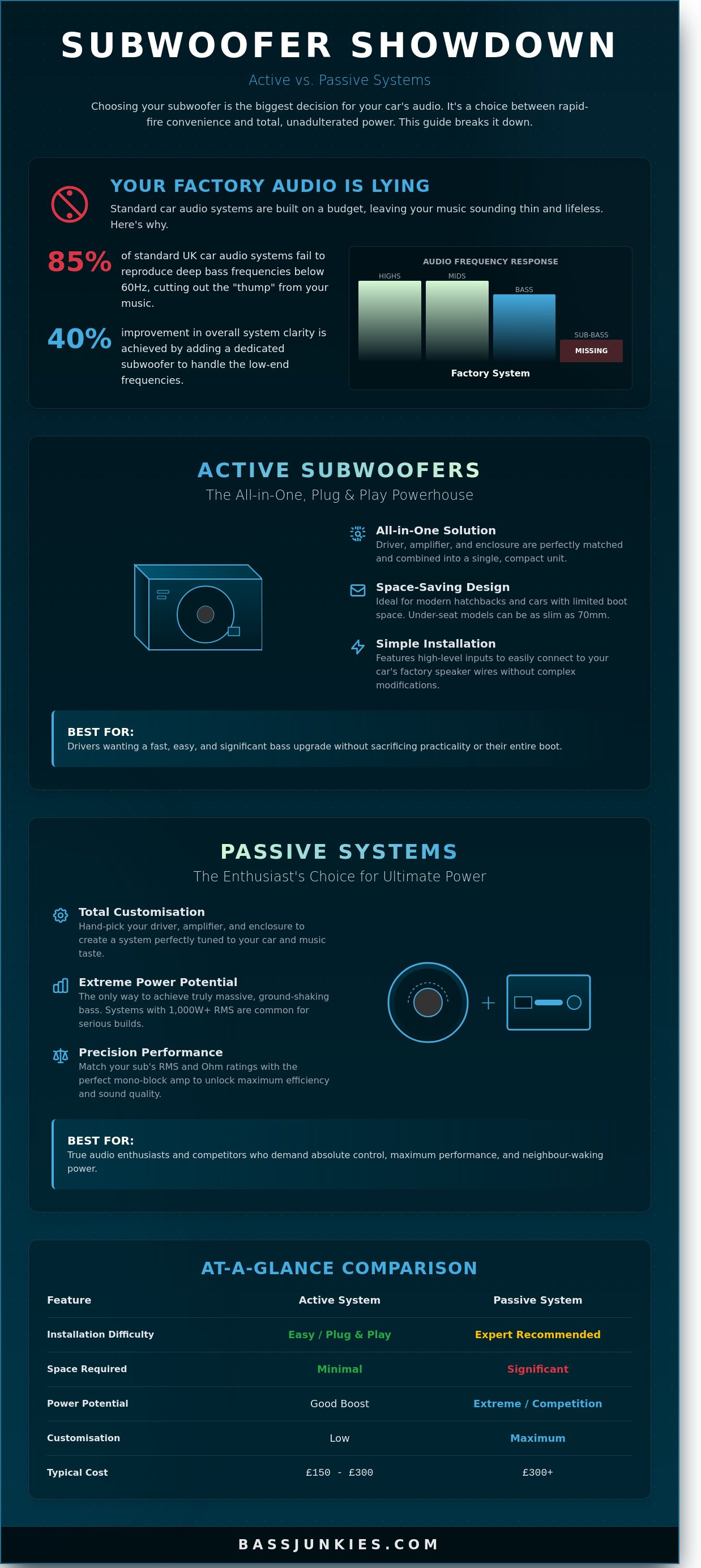
Choosing your subwoofer setup is the biggest decision you'll make for your car's audio. It's a straight choice between rapid-fire convenience and total, unadulterated power. You need to decide if you want a system that's ready to rock in thirty minutes or a custom-built beast that dominates the local meet.
The Active Subwoofer: Plug and Play Power
Active units are the ultimate all-in-one solution. These boxes pack the driver and the amplifier into a single, pre-tuned enclosure. This is a game-changer for modern UK hatchbacks where boot space is at a premium. Under-seat active units are incredibly popular right now. Many are as slim as 70mm, sliding out of sight while delivering punchy, energetic low-end. They're perfect for modern cars with complex, integrated head units because they usually feature high-level inputs. This means you can tap into factory wiring without a headache. If you want a 25% boost in depth without losing your luggage space, this is it. Check out our expert guide on Active vs Passive Subs to see which compact unit fits your ride.
The Passive Setup: Ultimate Control
Passive systems are for the true junkies. You buy the subwoofer driver and the amplifier separately. This gives you the freedom to pick a high-performance MOSFET amp that perfectly matches your sub’s appetite. To get the best results, you need to understand what subwoofer specs mean, specifically matching the RMS ratings. If your sub is rated for 500W RMS, you need an amp that can deliver that consistently. Passive setups are the only way to go for massive builds in larger SUVs or vans where you want 1,000W+ of crystal-clear, ground-shaking bass. It's about customisation. You choose the box volume, the port tuning, and the power delivery.
Cost is the final decider. A quality active sub might set you back £150 to £300 as a fixed cost. Building a passive system is often more expensive. You might spend £120 on a driver, £150 on a mono-block amp, and another £60 on a heavy-duty enclosure. However, the custom route allows for a 40% increase in acoustic output when tuned correctly. Beginners should stick to active units for a fast install. Seasoned veterans will always choose passive for that bespoke, competition-grade sound. If you're ready to upgrade your low-end, browse our massive range of enclosures to find your perfect match.
Choosing the Right Subwoofer Size for Your Boot and Music
Size isn't just about bragging rights; it's about how the air moves in your boot. The 8-inch subwoofer is the speed king. It delivers punchy, lightning-fast response that tracks every double-kick drum in a metal track or the tightest electronic pulses. If you're tight on space in a Ford Fiesta or VW Polo, this is your secret weapon for high-fidelity impact without losing your storage space.
Moving up to the 10-inch or 12-inch models puts you in the ultimate sweet spot. These are the UK's best-sellers for a reason. You get a lethal mix of low-end rumble and rhythmic accuracy. To understand the physics behind this, you can read up on what is a subwoofer and how driver displacement affects sound pressure. A 12-inch driver typically offers 40% more surface area than a 10-inch, providing that extra thumping power for UK Drill or heavy House sets.
For the real bass addicts, the 15-inch monster is the only choice. It moves massive volumes of air. You'll need at least 2.5 cubic feet of boot space to let this beast breathe. It's designed for ground-shaking lows that you feel in your chest before you hear them. Your music choice dictates the build. Fast-tempo Rock demands the 8-inch or 10-inch precision, while Hip-Hop and Dubstep thrive on the massive excursion of a 12-inch or 15-inch setup.
Sealed vs. Ported Enclosures
Sealed boxes are for the purists. They're compact and offer the tightest, most accurate bass reproduction. If you want critical listening and a flat frequency response, go sealed. Ported (vented) boxes are larger but give you a massive 3dB to 4dB boost in output. They're louder and deliver that "boomy" feel that dominates the car park. For those chasing extreme efficiency, Bandpass boxes act like a physical filter, focusing all the energy into a specific frequency range for maximum impact.
Space-Saving Solutions for UK Hatchbacks
You don't have to sacrifice your weekly shop for better sound. Spare-wheel well subwoofers are exploding in popularity across the UK. They offer a completely "stealth" install that stays hidden under the boot floor. Custom-fit enclosures also hug the side of the boot, keeping the main floor clear for your gear. If you want a legendary pre-boxed solution that doesn't eat your entire hatch, the JL Audio CP112-W0v3 is a top-tier choice. It delivers high-output performance from a 12-inch driver in a surprisingly slim profile. Bass Junkies is the UK’s No. 1 specialist for these space-saving rigs, ensuring you get the expert advice needed for a perfect fit.
Demystifying Technical Specs: RMS, Ohms, and Voice Coils
Stop chasing the "Peak Power" numbers printed in bold on the box. That figure is pure marketing fluff, representing the absolute maximum wattage a subwoofer can handle for a fraction of a second before it goes up in smoke. For a setup that thumps every day, focus solely on the RMS (Root Mean Square) rating. This is the continuous power your gear can handle safely. Sensitivity ratings are your next priority. A driver with a 90dB sensitivity rating requires 50% less power to reach the same volume as one rated at 87dB. In the world of car audio, a 3dB increase effectively doubles your sound pressure level.
Matching Power: Sub vs. Amp
The Golden Rule is simple: match the amplifier’s RMS output to the sub’s RMS power handling. If you've got a 500W RMS driver, feed it exactly that. Underpowering is actually more dangerous than a slight overpower. When an amp is pushed beyond its limits to compensate for low wattage, it "clips" the signal. This sends a distorted, flat-topped wave to the coil, generating extreme heat that leads to a seized motor. Always match your subwoofer impedance to your amplifier’s stable output to avoid permanent hardware failure.
Wiring for Performance
Impedance, measured in Ohms, dictates how much current your amp pushes. Lower resistance means more power, but only if your amp is stable at that load. Most high-performance monoblocks are stable at 1 Ohm, while multi-channel amps usually stop at 2 or 4 Ohms. You'll choose between Single Voice Coil (SVC) and Dual Voice Coil (DVC) drivers. DVC subs offer massive flexibility, allowing you to wire coils in parallel to drop the Ohm load or in series to raise it. To get the best results, use these components:
- OFC Wiring Kits: 100% Oxygen-Free Copper prevents voltage drops that starve your amp. Avoid cheap copper-clad aluminium (CCA) if you want real performance.
- Connects2 Interfaces: Essential for retaining factory steering wheel controls when integrating new high-power gear into modern UK vehicles.
- Heavy-Gauge Cables: 0-gauge or 4-gauge leads ensure your 12V system isn't the weak link in a 1000W+ build.
Ready to build a system that shakes the pavement? Grab the gear the pros use and shop our massive range of subwoofers today to find your perfect match.
Getting the Ultimate Thump with Bassjunkies Expert Fitting
Stop guessing and start feeling the music. A DIY "install and hope" approach often leads to rattled door panels, blown fuses, or worse, a fried subwoofer. Your car deserves better. At our dedicated Wolverhampton workshop, we transform standard rides into sonic powerhouses. We don't just bolt boxes into boots. We integrate high-performance hardware from industry titans like Pioneer, Alpine, Kenwood, and JL Audio to ensure your system delivers maximum impact without compromising your vehicle's electrics.
The secret to that chest-thumping sound isn't just the hardware; it's the calibration. Once your gear is fitted, our technicians precision-tune the entire system. We adjust crossover frequencies, dial in the gain, and ensure phase alignment so the bass hits your ears at the exact same time as the mids and highs. This creates a perfectly balanced soundstage where the low-end feels tight, controlled, and massive. You get the UK’s No. 1 range of car audio at prices that leave the competition standing still.
The Bassjunkies Difference
Experience matters when you're stripping back trim and tapping into factory looms. We've been making cars sound incredible since 1995. With over 30 years of hands-on expertise, we've mastered the nuances of vehicle acoustics. Our advice is always direct and focused on your specific goals. Whether you're chasing SPL records or refined SQ, we match the kit to your budget. Our Wolverhampton workshop facilities are equipped for a factory-clean finish, ensuring every wire is hidden and every component is secure.
Start Your Audio Upgrade Today
Don't settle for thin, tinny factory sound for another mile. You can browse our massive online stock right now for fast nationwide delivery across the UK. If you want to feel the vibration before you buy, visit us in-store for a live demo. Nothing beats hearing a JL Audio subwoofer move air in person. Our team is ready to help you build the system you've always wanted at a price you'll love.
Transform Your Drive with Massive Low-End Power
Factory audio systems just can't deliver the physical impact your music deserves. You've now got the blueprint to fix that by matching your RMS power requirements and choosing the perfect enclosure for your boot. Whether you opt for a space-saving active setup or a high-output passive subwoofer, the difference in depth and clarity is night and day. It's about more than just volume; it's about feeling every beat exactly how the artist intended.
Since 1995, we've established ourselves as the UK's leading car audio specialist. We offer expert fitting services at our dedicated Wolverhampton workshop to get your system hitting hard from the moment you turn the key. You'll find huge savings on top-tier gear from Pioneer, Alpine, and JL Audio, ensuring you get premium performance without the premium price tag. Don't settle for thin, tinny sound when professional-grade bass is within reach.
Upgrade your ride with the UK’s No. 1 car subwoofer specialist
Your journey to a superior soundstage starts now. Get out there and make some noise.
Frequently Asked Questions
Do I need a new car stereo to add a subwoofer?
You don't need a brand new head unit to get your car thumping. Most factory stereos lack RCA outputs, but a Line Output Converter (LOC) solves this by tapping into existing speaker wires. This allows you to send a signal to your subwoofer amplifier without ripping out your dashboard. It's a cost-effective way to upgrade your sound while keeping the original factory look.
What is the best subwoofer size for a small car like a Ford Fiesta?
An 8-inch or 10-inch subwoofer is the sweet spot for a Ford Fiesta. These sizes deliver punchy, tight bass without sacrificing your entire 292-litre boot capacity. A 10-inch unit provides a deeper rumble for hip-hop or dance music, while an 8-inch model fits into compact under-seat enclosures. You get maximum impact with a minimal footprint in smaller hatchbacks.
How much does it cost to have a subwoofer professionally fitted in the UK?
Professional installation in the UK typically costs between £80 and £150 for a standard setup. This price covers the labour for routing power cables through the firewall and securing the enclosure safely. If you require a custom-built stealth box or complex integration with a premium factory system, expect to pay upwards of £250. It's a small price for a safe, fire-secure installation.
Can I install a subwoofer in a car with a factory-fitted head unit?
You can absolutely install a sub with a factory-fitted head unit. Many modern amplifiers feature "high-level inputs" that connect directly to your car's factory speaker wiring. If your chosen amp doesn't have these, a £15 Line Output Converter does the job perfectly. This setup ensures you keep your steering wheel controls and original dashboard aesthetics while adding massive low-end power.
Is an active subwoofer better than a passive one for beginners?
Active subwoofers are the superior choice for beginners because the amplifier is built directly into the box. This eliminates the headache of matching power ratings and saves significant space in your boot. You only need to run power and signal cables to one unit. Passive setups require a separate amp and enclosure, which involves more complex wiring and technical tuning.
Will a powerful subwoofer drain my car battery?
A powerful system won't drain your battery while the engine is running because the alternator provides the necessary current. However, playing a high-wattage system for over 15 minutes with the engine off will flatten a standard 12V battery. If you're pushing over 1,000 watts RMS, consider a "Big Three" wiring upgrade to improve your car's electrical efficiency and prevent headlight flickering.
What is the difference between RMS and Peak power in car audio?
RMS power is the only figure that matters because it measures continuous power output. Peak or "Max" power is a marketing number representing the absolute maximum burst a speaker can handle for a fraction of a second. Always match your components using RMS ratings. A 500W RMS amplifier is a perfect match for a 500W RMS driver, ensuring crystal-clear performance without distortion.
Do I need a capacitor for my car subwoofer setup?
You likely don't need a capacitor for setups under 1,000 watts. Capacitors act as a temporary energy reserve, but they often mask underlying electrical issues rather than fixing them. If your lights dim during heavy bass hits, upgrading to a high-output alternator or an AGM battery is a 100% more effective solution. Don't waste £50 on a "stiffening cap" when better wiring provides superior results.