

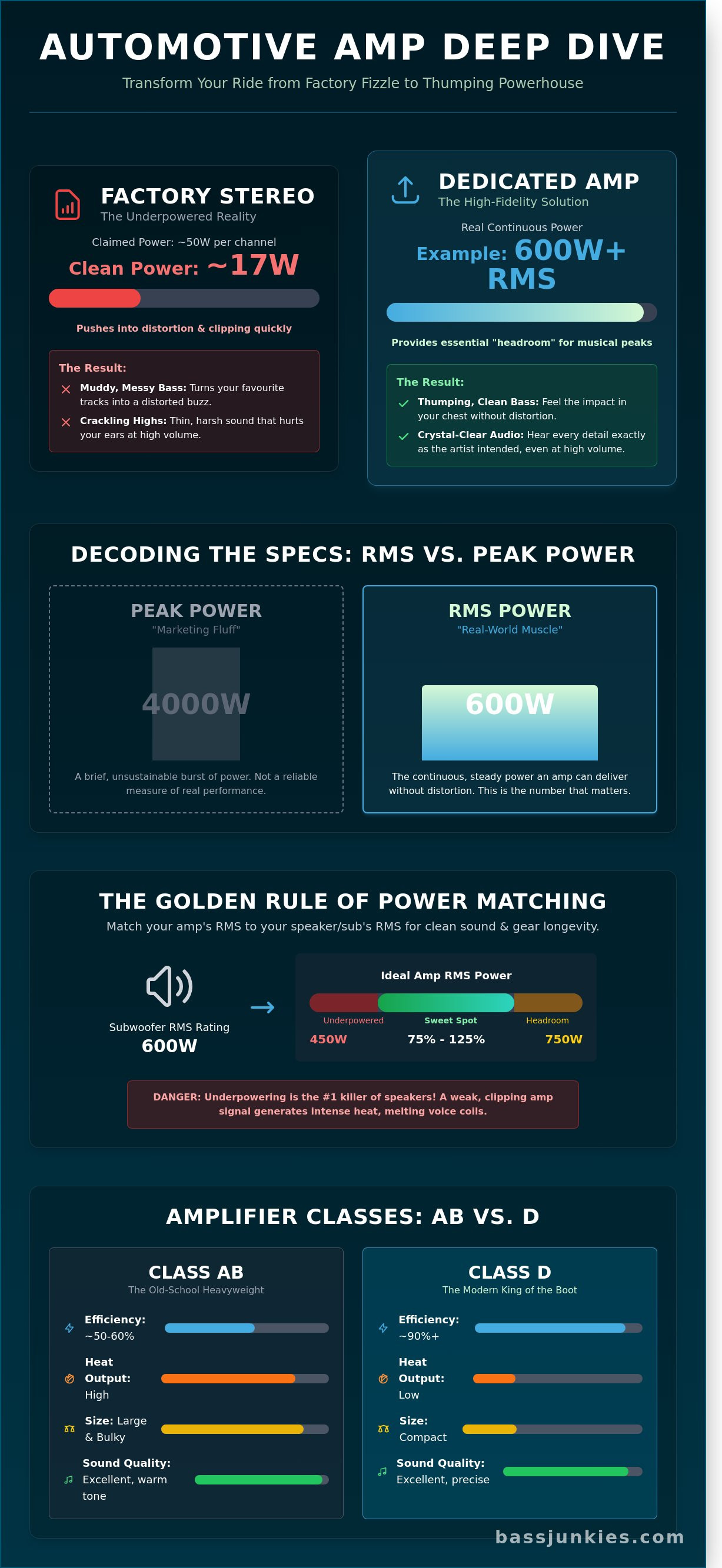
Most factory car stereos claim 50 watts per channel, but they often struggle to push even 17 watts of clean power before the signal clips and destroys your soundstage. You know the feeling of cranking your favourite anthem only to hear the bass turn into a muddy mess while the high notes start to crackle. It is a total buzzkill when your hardware cannot keep up with your volume demands. We are going to fix that right now.
This guide helps you master the art of car audio by showing you how to choose, match, and install the perfect automotive amp for a setup that hits hard and stays crystal-clear. You deserve a system that delivers thumping performance without the distortion. We have spent over 25 years as the UK's specialist in high-performance sound, and we are sharing that expertise today. We will break down everything from impedance matching to professional wiring techniques. You will learn how to turn a basic boot install into a professional-grade powerhouse that commands attention on the road.
Key Takeaways
- Stop settling for thin factory audio and learn how a high-performance automotive amp transforms your car into a thumping, high-fidelity powerhouse.
- Cut through the marketing fluff by mastering the difference between RMS and Peak power so you only pay for real, usable performance.
- Discover the "Golden Rule" for matching power output and impedance to protect your gear and deliver crystal-clear sound.
- Master the essentials of a safe, pro-level installation, from selecting the right fuse to routing cables for zero signal interference.
- Unlock expert advice and massive savings on legendary brands like Alpine and Pioneer from the UK’s No. 1 car audio specialists.
What is an Automotive Amp and Why Does Your Car Need One?
You have the sub. You have the enclosure. Now you need the muscle to move them. An automotive amp acts as the powerhouse of any high-performance car audio system. It takes the weak, low-voltage signal from your head unit and transforms it into a massive, high-voltage current capable of driving heavy-duty voice coils. Without this dedicated power source, your subwoofer is just a heavy paperweight taking up space in your boot.
Factory head units are engineered for budget, not for bass junkies. Most standard UK vehicles ship with internal chips that struggle to deliver more than 15 or 20 watts of clean power per channel. When you try to push these systems, they run out of steam instantly. Adding a dedicated automotive amp provides essential "headroom." This is the power reserve that allows your system to handle sudden musical peaks, such as a heavy kick drum or a synth drop, without straining. It turns a flat, lifeless commute into a front-row concert experience with the thumping impact you can feel in your chest.
The Difference Between Volume and Quality
Many owners believe that too much power destroys speakers, but underpowering is actually the primary killer. When an amp reaches its limit, it begins "clipping" the audio signal. This flattens the tops of the sound waves, creating a square wave that generates intense heat and melts voice coils. Total Harmonic Distortion (THD) is the enemy of crystal-clear audio. High-end amplifiers keep this distortion figure below 0.1% at rated power, ensuring that your music remains sharp and accurate even when the volume is cranked to 11.
When Should You Upgrade Your Amp?
If your music sounds thin or starts to crackle when you turn the dial past the halfway mark, your factory system is gasping for air. This is especially true if you have installed aftermarket speakers; these high-spec components often feature heavier magnets and stiffer surrounds that require more current to move effectively. You must upgrade to a dedicated amp if you are adding a subwoofer. A standard head unit cannot provide the raw current needed to shift the massive surface area of a 10-inch or 12-inch driver. It is about total control, precision, and the pure adrenaline of a perfect bassline.
Understanding the Specs: RMS, Channels, and Amplifier Classes
Don't get blinded by the massive numbers printed on the box. Those 4000W "Max Power" claims are usually pure fantasy. If you want a setup that actually bangs, you need to look at the RMS rating. This is the continuous power your automotive amp can push without melting its internals. Understanding amperage and how current flows at a steady 14.4V is vital for any serious UK build. Peak Power is a burst measurement, not a performance standard.
The RMS Power Rule
RMS (Root Mean Square) measures real-world muscle. If your sub is rated for 600W RMS, you need an amp that matches it at the correct impedance. We recommend choosing an amp capable of delivering 75% to 125% of the sub's RMS rating to ensure clean headroom. This prevents clipping; the number one killer of voice coils. Always check the birth sheet included with high-end units. These often show the automotive amp outperforming its rated specs by 10% or more.
Class AB vs Class D: The Great Debate
The tech inside the heat sink determines how your music feels. Class AB amps are the old-school heavyweights. They offer incredible warmth and 0.01% THD (Total Harmonic Distortion), but they're bulky and run hot. Class D is the modern king of the boot. These digital powerhouses are up to 90% efficient. They convert almost all draw into raw sound rather than heat. Because they're compact, they fit under seats or in tight corners where space is at a premium.
- Mono-blocks: Built for one job. Driving subs with massive current.
- 5-Channel Beasts: One unit to rule them all. Powers four speakers plus a dedicated sub channel.
- MOSFET Power Supplies: These high-speed switching transistors ensure your voltage stays rock solid even when the bass drops hard.
If you're ready to upgrade your thumping low-end, check out our range of high-performance amplifiers today. Stop settling for factory weak sauce and get the power your car deserves. The right choice depends on your battery capacity and how much room you've got left in the boot. Stick to these specs and you'll avoid the common mistakes that ruin a good system.
How to Match an Automotive Amp to Your Speakers and Sub
The Golden Rule of car audio is simple: match your RMS, not the "Max Power" stickers. If your subwoofer is rated for 500W RMS, your automotive amp should ideally deliver between 75% and 100% of that figure. Underpowering a sub is a fast track to clipping, which destroys voice coils faster than a 1000W surge ever could. Overpowering is equally risky. Pushing 800W into a 400W driver will cause mechanical failure within minutes of heavy play.
Wiring configuration is your primary tool for manipulating power. Parallel wiring, where you connect all positive terminals together, drops the impedance and forces the amp to work harder. In contrast, series wiring adds the resistance together. If you have two 4-ohm subwoofers, wiring them in parallel creates a 2-ohm load. This allows the amp to dump more current into the coils. This delicate balance between resistance and output mirrors the principles of motor load and efficiency found in industrial electrical systems. When the load is matched correctly, the system runs cool and hits hard.
Bridging is the ultimate "cheat code" for 4-channel amps. By combining the positive lead of one channel with the negative of another, you can turn two 60W channels into a single 180W powerhouse. It's the perfect way to power a pair of high-end components or a small 10-inch sub without buying a dedicated mono-block.
The Impedance Puzzle
Impedance is measured in Ohms. It's the resistance your speakers offer to the current. A 2-ohm load is "wider" than a 4-ohm load, letting more power flow through. However, you must check your amp's stability. Most 4-channel amps are only stable down to 2-ohms per channel. Dropping to 1-ohm on an unsupported automotive amp will cause a 45% spike in heat, likely triggering protect mode or blowing a fuse. Always verify the "Stable at" rating on the box before you twist any wires.
Choosing the Right Channel Count
- Mono-block Amps: These are the specialists. They're Class D designs built specifically for bass, offering massive efficiency for subwoofers.
- 2-Channel and 4-Channel Amps: These units are the backbone of your mids and highs. Use a 4-channel to power your front components and rear coaxials for a full 360-degree soundstage.
- 5-Channel Amps: The ultimate space-saver. These provide four channels for your speakers and a high-current fifth channel for the sub. It's a "one and done" solution that saves about 35% of boot space compared to a twin-amp setup.
How-To: Planning and Executing Your Amp Installation
Installing an automotive amp isn't just about plugging in wires; it's about engineering a high-performance environment. Safety starts at the source. Disconnect your negative battery terminal before you touch a single cable. One accidental short can fry your car's ECU, leading to a repair bill north of £600. Always place your main fuse within 30cm of the battery. This protects the entire length of the cable from fire risks. If your amp's maximum current draw is 60 amps, use a 60-amp fuse to ensure the circuit is matched to the load.
Cable routing determines your sound floor. Run your heavy-gauge power cables down the left side of the vehicle and your RCA signal cables down the right. This physical separation prevents electromagnetic interference from the power line bleeding into your audio signal, which causes that dreaded engine whine. For the ground point, don't settle for a loose bolt. Find a solid chassis point, sand it down to bare shiny metal, and secure it tightly. A poor ground accounts for 85% of all amp protection mode issues.
Heat is the enemy of electronics. Mount your amp in a location with at least 5cm of clear airspace around the cooling fins. Avoid mounting directly to a sub box as the vibrations can rattle internal components loose over time. Vertical mounting is often best for heat dissipation, allowing hot air to rise away from the heat sink naturally.
The Essential Wiring Kit
Gauge is everything. A 1500W system pulling massive current through thin 8-gauge wire will starve your sub. Always choose OFC (Oxygen Free Copper) over CCA (Copper Clad Aluminium). CCA is cheaper, but it has 40% higher resistance, meaning less power reaches your speakers. If you're keeping the factory head unit, use a Connects2 interface. This keeps your steering wheel volume and track controls functional while sending a clean signal to your new gear.
Tuning Your System for Peak Performance
The gain control is a level match, not a volume knob. Set it too high and you'll send a clipped signal that melts voice coils in minutes. Set your LPF (Low-Pass Filter) to approximately 80Hz to ensure your sub only handles the deep stuff. To truly feel the impact, apply Dynamat Xtreme to your boot floor and lid. It reduces panel resonance by up to 10dB, ensuring you hear the bass, not the rattle of your number plate.
Ready to build a system that shakes the pavement? Grab the gear the pros use.
Shop the UK's biggest range of automotive amp kits and accessories at Bass Junkies.Get the Ultimate Sound with Bassjunkies Expert Gear
You've done the research and crunched the numbers. Now it's time to kit out your ride with hardware that actually delivers. Bassjunkies stands as the UK’s No. 1 choice for high-performance car audio because we don't just sell gear; we live for the decibels. We've spent over 30 years obsessing over every watt and ohm to ensure our customers get the most aggressive performance possible. Our warehouse holds a massive stock of over 5,000 products, meaning you won't be waiting weeks for your automotive amp to arrive. We offer huge savings on heavy hitters like Pioneer, Alpine, and Kenwood, making elite sound quality accessible for every budget. When you talk to us, you're talking to "junkies" for the craft who understand the raw excitement of a perfect bassline.
Shop the Best Brands in the UK
Getting the right automotive amp requires picking a brand that matches your sonic goals. If you want thumping bass that hits you in the chest, the raw power of JL Audio is unbeatable. For those chasing precision and crystal-clear highs, Focal offers the kind of engineering excellence that wins competitions. Buying from an authorised specialist like Bassjunkies ensures you receive genuine UK warranties. This protects your investment against faults and gives you direct access to official support. Don't settle for grey imports that leave you stranded if something pops. Ready to upgrade? Browse our massive range of car amplifiers here and find the unit that turns your car into a mobile concert hall.
Professional Installation vs DIY
Wiring a system yourself is a rite of passage, but modern vehicles are increasingly hostile to DIY tweaks. Since 2021, we've seen a 40% increase in complex digital integrations that require specialist knowledge to bypass factory restrictions. Our professional workshop handles everything from intricate dash modifications to seamless CAN-bus integration. We ensure your 0-gauge power cables are fused correctly and your gains are set with precision tools to prevent clipping. This level of detail guarantees your gear lasts for years rather than months. If you want a show-quality finish without the headache, we've got you covered. Contact our team today for a custom quote on your dream system. We provide nationwide delivery for the builders and expert fitting for the perfectionists.
Ignite Your Sound System Today
You now have the blueprint for a high-performance setup. Matching the right RMS output to your speakers and selecting the perfect class of automotive amp is vital for achieving that thumping, distortion-free sound. Proper planning and a clean installation will keep your hardware running cool while delivering maximum impact. Every component matters when you are chasing that crystal-clear high and heavy low end.
Stop putting up with weak, tinny audio that gets drowned out by road noise. Bass Junkies has been the UK’s No. 1 Car Audio Specialist since 1995, providing expert advice to enthusiasts for over 29 years. Our warehouse is packed with a massive stock of high-end gear from Pioneer, Alpine, and Kenwood, ready for immediate dispatch. We don't just sell boxes; we live for the raw energy of a perfect bassline and the technical precision of a well-tuned system.
Upgrade your sound today with the UK’s best automotive amps!
Your car is waiting for a massive power injection. Get your gear sorted and let the music hit harder than ever before.
Frequently Asked Questions
Can I add an automotive amp to my factory car stereo?
You can definitely add an automotive amp to your factory car stereo by using a Line Output Converter or an amplifier with high-level inputs. Most modern factory head units lack RCA outputs, so these tools tap into your existing speaker wires to grab the signal. It's a game-changer for 95% of stock systems that lack the punch needed for a real subwoofer setup. You get to keep your dashboard's original look while delivering massive, thumping bass.
What size wiring kit do I need for a 1000W amp?
You need at least a 4-gauge OFC wiring kit for a 1000W amp to ensure maximum current flow without voltage drops. If you're pushing a true 1000W RMS over a distance of more than 5 metres, step up to a 0-gauge kit for total safety. Cheap CCA cables often fail to deliver the 80 to 100 amps of current required for high-performance builds. Don't starve your gear of power; use quality copper to keep the beat strong.
Will an amplifier drain my car battery when the engine is off?
An amplifier won't drain your battery if the remote turn-on wire is connected correctly to a switched 12V source. This wire tells the amp to shut down the moment you turn the key off. However, a class A/B amp left idling can pull 1 to 2 amps of current, which will flatten a standard 60Ah battery in less than 24 hours. Always double-check your wiring to ensure your system stays dormant when the engine isn't running.
Where is the best place to mount an amp in a car?
The best place to mount your automotive amp is the boot floor or the back of the rear seats where airflow is 100% unobstructed. Some enthusiasts prefer under-seat mounting for a stealthy look, but you must ensure at least 5cm of clearance above the cooling fins. Avoid mounting directly onto a subwoofer box, as vibrations from a 120dB bassline can shake internal components loose over time. Keep it cool and keep it secure for the best results.
What is the difference between a 2-channel and a 4-channel amp?
A 2-channel amp powers a single pair of speakers, while a 4-channel amp handles four individual speakers or a front stage plus a bridged subwoofer. Choose a 4-channel unit if you want a complete system overhaul covering the front doors and rear deck. For a dedicated sub setup, a 2-channel amp bridged into a 4-ohm load often delivers more raw grunt for your money. It's all about how many components you need to drive.
Why is my car amp getting hot and turning off?
Your amp is entering thermal protection mode because it's either overworked by a low-impedance load or lacks proper ventilation. If you're running a 2-ohm stable amp at 1-ohm, it will generate 30% more heat than it can dissipate. Check your ground connection too, as a loose ground causes resistance and massive heat buildup. Ensure your cooling fins aren't covered by carpet or luggage so the heat can escape during those long, loud sessions.
Do I need a capacitor for my high-power audio system?
You likely don't need a capacitor unless you've already performed the "Big Three" wiring upgrade and installed a high-output alternator. Capacitors provide a quick burst of energy for 0.5 seconds, but they can actually strain a weak charging system by becoming an extra load. If your headlights flicker during heavy bass hits, a second AGM battery is a 100% more effective solution than a 1-farad cap. Focus on the foundation of your power first.
How much does it cost to have a car amp professionally installed in the UK?
Professional installation for a single amplifier in the UK typically costs between £80 and £150 depending on your vehicle's complexity. If you require a custom stealth floor or intricate tuning using a DSP, expect prices to rise above £250. Most UK specialists charge an hourly rate of approximately £60 to £90. Investing in professional fitting ensures your 12V connections are fused correctly and your interior trim remains intact during the process.