

To get more bass in your car, you must optimize your head unit EQ settings, apply sound-deadening insulation to stop panel rattle, and install a dedicated subwoofer powered by a high-efficiency Class-D amplifier. With the global car audio market reaching a value of $13.46 billion in 2026, achieving massive low-end now relies on a tiered approach of digital optimization and hardware integration. Learning how to get more bass in your car is the only way to eliminate distortion and achieve the crystal-clear punch your factory speakers lack. This professional method ensures your system hits hard while staying within the 2025 "plainly audible" legal limits found in many regions.
You've likely felt the frustration of a kick drum that lacks power and door panels that vibrate more than the air. It's a common struggle for enthusiasts who want a high-performance soundstage but end up with a muddy, rattling mess. This guide promises to give you a clear, technical roadmap to a thumping system that looks and sounds professional. We'll explore everything from free software adjustments to the latest 6% annual growth trends in compact, shallow-mount subwoofer technology and AI-driven sound personalization.
Key Takeaways
- Switch to high-bitrate FLAC files and disable the "Loudness" setting to eliminate signal distortion at the source.
- Apply mass loading deadening material to door panels to transform thin metal into a solid speaker enclosure that prevents energy leaks.
- Learn how to get more bass in your car by bypassing weak 15W RMS factory head units with high-efficiency Class-D amplifiers.
- Select the right enclosure type for your music style, choosing sealed boxes for tight accuracy or ported enclosures for maximum SPL.
- Protect your hardware and maximize impact by correctly setting amplifier gain and using the proper wiring gauge to prevent current starvation.
Maximising Bass with Your Current Setup: EQ and Source Tuning
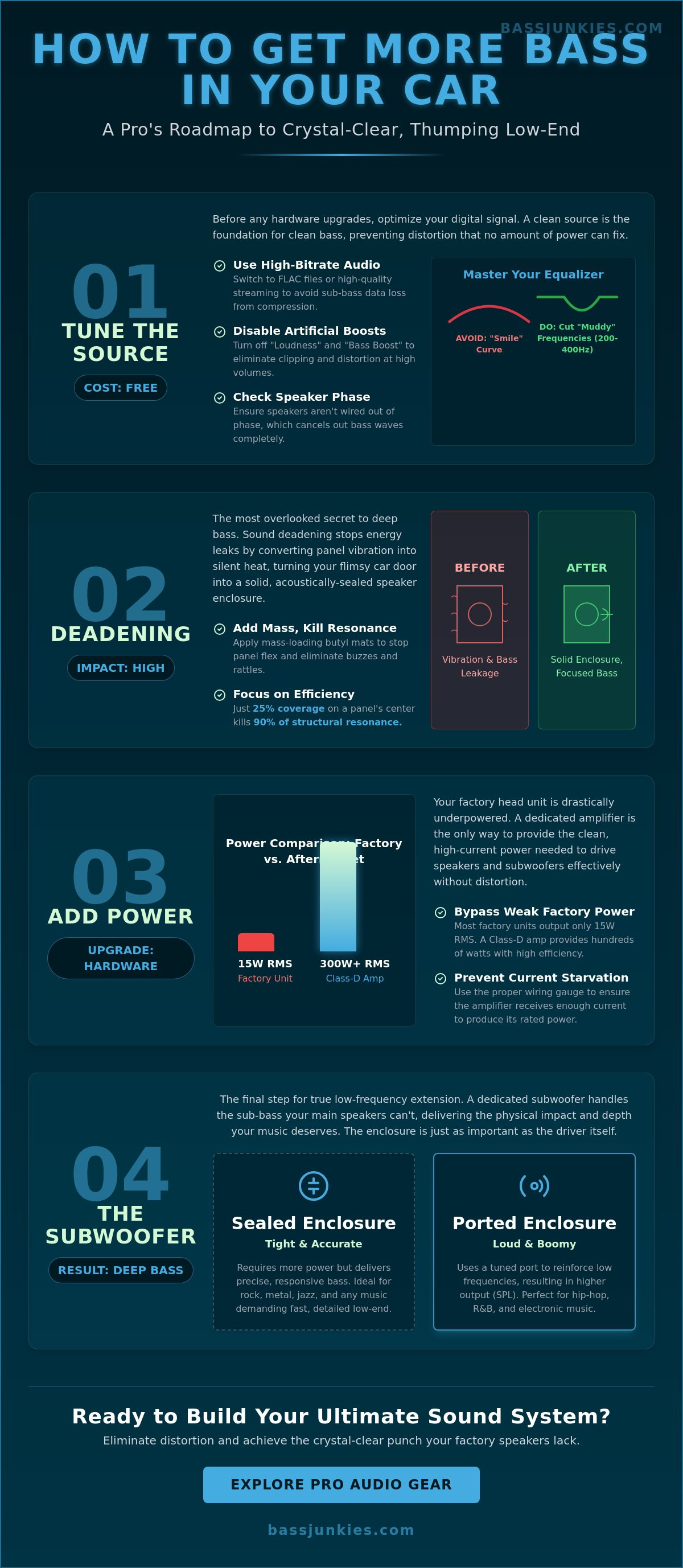
You can get more bass in your car by fixing the signal at the source before spending a penny on hardware. Start by switching from standard Bluetooth to high-bitrate streaming or FLAC files to recover lost low-frequency data. Standard Bluetooth compression often strips away the sub-bass frequencies that give your music its weight. For a comprehensive overview of vehicle audio systems, it is clear that the head unit acts as the brain of your setup. If the signal is weak or distorted here, no amount of amplification will fix it.
Disable the "Loudness" and "Bass Boost" settings on your head unit immediately. While they seem to add punch, they actually introduce clipping and distortion that can overheat your speaker coils. These settings are designed for low-volume listening and shouldn't be used when you're cranking the system. Learning how to get more bass in your car requires understanding phase correction. If your speakers are wired out of phase, one pushes while the other pulls, cancelling out the bass waves entirely and leaving your audio sounding thin.
Mastering Your Head Unit's Equaliser
Avoid the classic "Smile" curve where you max out the low and high ends. This creates a hollow sound and puts unnecessary strain on your equipment. Focus on cutting the "muddy" frequencies between 200Hz and 400Hz instead. Removing this frequency clutter allows the true sub-bass to shine through without being masked by lower-midrange resonance. Set your High-Pass Filter (HPF) to 80Hz for your factory door speakers. This stops them from trying to play ultra-low notes they can't handle, leaving them free to produce clean mid-bass punch.
Optimising Digital Sound Processing
If you have a modern head unit with Digital Signal Processing (DSP), use time alignment features. This feature delays the sound from the closest speakers by milliseconds so the waves from all speakers hit your ears at the exact same time. This makes the bass feel like it's hitting you in the chest rather than coming from the floor or the boot. Adjust your fader slightly toward the front to use the cabin's natural acoustics to reinforce the soundstage. If your current unit lacks these features, view high-performance car stereos to find models with built-in DSP and 13-band equalisers.
The Foundation: Why Sound Deadening is the Secret to Deep Bass
Sound deadening is the most effective way to improve low-end response without upgrading your hardware. It works by stopping thin metal door panels from vibrating, which prevents "bass leakage" and structural phase cancellation. By adding mass to the vehicle's panels, you turn a hollow, resonant door into a rigid speaker enclosure. This ensures that 100% of the acoustic energy produced by your woofer moves into the cabin rather than being wasted on rattling metal. If you want to know how to get more bass in your car, the answer starts with creating an acoustic seal using butyl-based mats and closed-cell foam to stop panel flex.
Vibration is the primary enemy of low-frequency impact. When a speaker cone moves forward to create a bass note, it generates massive pressure. If the door panel it's mounted to moves backward at the same time, that pressure is cancelled out instantly. This is why factory systems often sound "thin" or "tinny" even when the volume is high. Mass loading involves applying heavy, adhesive-backed sheets to the metal skins to lower their resonant frequency. This process kills the annoying buzzes and hums that distract from the perception of deep, thumping power.
Applying Sound Deadening Kits Correctly
Focus your application on the "outer skin" of the door for the most significant impact. This is the large, flat sheet of metal furthest from the cabin that acts like a drum head when the music hits. You don't need to cover every square inch to see a massive improvement. Applying coverage to just 25% of the panel's center is often enough to kill 90% of structural resonance. For a deeper look at this process, check out our guide on Sound Deadening: The Essential Foundation for high-performance audio.
Sealing the Baffles and Speaker Mounts
Air leaks at the mounting point will destroy your mid-bass response. If air can escape between the speaker frame and the door baffle, the pressure wave is lost. Use foam gaskets or "fast rings" to bridge the gap between the speaker and the interior door card. This forces the sound through the factory grille and directly into the cabin. Upgrading to new car speakers is only effective if you create a perfect acoustic seal at the mount. Always use butyl mats for mass and closed-cell foam to decouple the door card from the metal frame. To get your installation started, you can browse our professional sound deadening accessories to find the right materials for your vehicle.
Upgrading Speakers and Adding Power with Car Amplifiers
To get more bass in your car, you must replace factory speakers with high-sensitivity aftermarket units and power them with a dedicated amplifier. Most factory head units only output approximately 15W RMS per channel. This low wattage lacks the current to drive a woofer cone through its full range of motion, which results in flat, distorted sound when the volume increases. Adding a multi-channel amplifier provides the headroom necessary for crystal-clear dynamic peaks and thumping mid-bass punch.
Modern Class D amplifiers are the ultimate solution for enthusiasts who need power without sacrificing space. These units operate at up to 90% efficiency, meaning they generate very little heat and can often be hidden under seats or behind dashboards. Unlike older, bulky Class A/B designs, a compact Class D amp delivers massive power while reducing the electrical load on your vehicle. This efficiency is critical for maintaining stable voltage during heavy bass passages in modern vehicles.
Understanding how to get more bass in your car involves moving beyond "peak power" marketing and focusing on RMS ratings. A dedicated 4-channel amplifier allows you to bridge channels to send more power to specific woofers or even a small subwoofer. This flexibility ensures your system can grow as you add more hardware. High-quality amplification also improves the "attack" of kick drums, making the music feel more immediate and physical.
Choosing the Right 2-Channel or 4-Channel Amp
Always match the amplifier's RMS output to the continuous power handling capabilities of your speakers. If your speakers are rated for 60W RMS, select an amp that delivers at least that much per channel to prevent clipping. If you're keeping your factory stereo, look for an amp with high-level inputs to simplify the installation process. You can browse high-performance car amplifiers to find the perfect match for your system's power requirements.
Upgrading Your Front Stage Speakers
In most UK vehicles, 6.5-inch woofers are the standard "sweet spot" for door-mounted audio upgrades. Component speaker sets are superior to coaxial designs because they separate the woofer from the tweeter, allowing for a more focused mid-bass response. Materials like polypropylene offer great durability in damp door environments, while treated paper cones provide a lighter, more responsive bass character. To find the right fit for your vehicle, view specialist car speakers designed for high-excursion performance.
The Subwoofer Solution: Choosing the Right Enclosure for Your Boot
Adding a dedicated subwoofer is the most effective way to learn how to get more bass in your car. You must choose between a sealed enclosure for tight, accurate musicality or a ported (vented) box for maximum volume and physical impact. While a sealed box provides a flat frequency response ideal for rock and jazz, a ported enclosure uses a tuned vent to boost output by up to 3dB at specific frequencies. This makes ported designs the ultimate choice for hip-hop and EDM fans who want high-volume thumping without distortion.
Space constraints in 2026 vehicles no longer prevent you from achieving massive low-end. Under-seat subwoofers and spare-wheel well enclosures allow you to add a driver without losing your entire boot. These compact solutions often use shallow-mount technology to deliver performance that rivals traditional large boxes. The demand for these space-saving designs is growing at over 6% annually as enthusiasts seek a balance between vehicle utility and high-performance audio.
Active Subwoofers for Quick Upgrades
Active subwoofers are "all-in-one" units that include a matched amplifier built directly into the enclosure. This setup simplifies wiring and ensures the driver always receives the correct amount of power without the risk of clipping. They are perfect for modern cars where space is at a premium and you want a professional look with minimal installation fuss. Read our Ultimate Subwoofer Buying Guide to see which active model fits your ride.
Custom Passive Setups for Maximum Thump
Passive setups involve pairing a standalone subwoofer with a dedicated mono-block amplifier for raw, unadulterated power. This allows you to fine-tune the impedance, measured in Ohms, to squeeze every drop of current from your amp. Wiring two 4-Ohm subs in parallel to reach a 2-Ohm load can significantly increase the wattage delivered by your mono-block. If you are ready for a custom build, shop car subwoofers and enclosures to find the heaviest hitters in the UK. You can view our full range of subwoofers to find the perfect enclosure for your boot today.
Professional Installation and System Tuning for Maximum Impact
Professional installation and precise digital tuning are the final steps in how to get more bass in your car. You must set the amplifier gain using a digital multimeter to match your head unit's output voltage, which prevents signal clipping and blown speakers. Using a high-quality 4-gauge or 0-gauge oxygen-free copper (OFC) wiring kit is essential to prevent current starvation during heavy bass hits. A solid, metal-to-metal chassis ground ensures your amplifier operates at maximum efficiency without introducing engine whine. For systems exceeding 1000W RMS, the "Big 3" upgrade is required to strengthen your vehicle's charging system and prevent voltage drops.
The "Big 3" upgrade involves replacing the factory wires between the alternator and battery, the battery and chassis, and the engine block and chassis. Standard factory wiring is often only 8-gauge, which cannot handle the massive current draw of high-performance Class D amplifiers. Strengthening these connections ensures your alternator can deliver full power to your subwoofers without causing dimming headlights. This keeps your bass thumping consistently even during long listening sessions at high volume. Proper grounding is the most critical safety step, as a loose ground is the #1 cause of amplifier failure and poor low-end performance.
The 5-Step Tuning Process
- Step 1: Set all head unit EQ settings, bass boost, and DSP processing to flat to start with a clean, uncoloured signal.
- Step 3: Adjust the amplifier gain using a digital multimeter or oscilloscope to ensure the amp isn't pushed into square-wave distortion.
- Step 3: Dial in the Low Pass Filter (LPF), typically around 80Hz, to ensure the subwoofer only plays the deep frequencies it was designed for.
- Step 4: Check the subwoofer phase; reversing the polarity can sometimes increase cabin reinforcement depending on your enclosure placement.
- Step 5: Apply final EQ tweaks to account for your car's specific cabin acoustics and your personal listening preference.
Why Professional Fitting Wins Every Time
Modern vehicles use complex CAN-bus electrical systems that are easily damaged by improper wiring taps. A professional installer understands how to integrate high-power audio without triggering dashboard error lights or draining the battery. They can also provide custom fabrication for "stealth" installs that keep your boot fully usable while hiding massive hardware. If you want the ultimate finish, read our guide on Professional Car Audio Installation Services to see how the experts do it. You can also view high-quality wiring kits and accessories to ensure your DIY project has the right foundation.
Ready to Transform Your Driving Experience?
Achieving a massive low-end response requires a tiered approach that combines digital optimization with professional-grade hardware. You've learned that the secret to knowing how to get more bass in your car starts with high-bitrate FLAC files and a rigid, sound-deadened environment. By integrating a high-efficiency Class D amplifier and a correctly tuned subwoofer enclosure, you eliminate the distortion that plagues factory setups. Proper gain setting and wiring remain the final hurdles to ensuring your system hits hard without risking equipment failure.
Bass Junkies has been the UK's No. 1 specialist since 1995, offering the technical authority you need for a crystal-clear build. We carry a massive stock of components from industry leaders like Pioneer, Alpine, and Kenwood, ensuring you get the ultimate performance for your budget. If you prefer a professional touch, our specialist workshop is ready for custom installations that maximize your cabin's acoustics. Upgrade your low-end with the UK's No. 1 car audio specialists and feel the difference that 30 years of expertise makes. It's time to stop settling for flat audio and start feeling every beat.
Frequently Asked Questions
Can I get more bass without adding a subwoofer?
Yes, you can significantly improve low-end response by applying sound-deadening mats to your door panels and upgrading to high-sensitivity 6.5-inch woofers. Sound deadening stops panel vibration which otherwise cancels out bass waves before they reach your ears. Adding a compact 2-channel amplifier to these speakers provides the current needed for a deeper mid-bass punch. This is the most effective way to learn how to get more bass in your car without sacrificing boot space for a large enclosure.
Will adding a subwoofer drain my car battery?
A subwoofer only drains the battery if you play the system for extended periods while the engine is off. Modern Class-D amplifiers are up to 90% efficient, which significantly reduces the electrical load on your alternator compared to older technology. If you install a massive system exceeding 1000W RMS, you should perform the "Big 3" wiring upgrade to ensure your battery stays charged. Always use a proper gauge power cable to prevent voltage drops and dangerous heat buildup.
What is the best EQ setting for bass?
The best EQ setting involves a surgical boost at 60Hz or 80Hz while cutting frequencies in the 200Hz to 400Hz range to remove "muddiness." Avoid the common mistake of maxing out the "Bass" slider, as this causes amplifier clipping and permanent speaker damage. Use a High-Pass Filter (HPF) set to 80Hz on your door speakers to protect them from ultra-low notes. This allows your dedicated subwoofer to handle the heavy lifting exclusively for a much cleaner sound profile.
Why does my bass sound distorted at high volumes?
Distortion usually occurs because your head unit's built-in 15W RMS amplifier is "clipping" the signal when pushed beyond its limits. It can also happen if your amplifier gain is set too high, which forces a distorted square-wave signal into your speakers. This heat buildup can permanently char your voice coils. To fix this, reduce the gain settings and ensure you are using high-bitrate FLAC or 320kbps audio files to avoid source-level digital distortion at high volumes.
Do I need a new head unit to get better bass?
You don't strictly need a new head unit if your current one has RCA pre-outs or if you use an amplifier with high-level inputs. However, a modern 2-DIN head unit provides 4V or 5V pre-out signals and built-in Digital Signal Processing (DSP) for superior tuning. These features make it much easier to understand how to get more bass in your car. If your factory unit lacks these tools, an external DSP can bridge the technical gap.
What is the difference between a sealed and a ported subwoofer box?
A sealed enclosure provides tight, accurate bass that is ideal for musical genres like rock or jazz where precision matters. In contrast, a ported box uses a tuned vent to increase output by up to 3dB at specific frequencies. This extra efficiency makes ported boxes the top choice for hip-hop and EDM fans who want maximum physical impact. Ported boxes are generally larger, so ensure you have enough boot space before choosing this high-volume design.
How much does it cost to get more bass in a car?
A basic upgrade including a quality head unit and speakers typically costs between $325 and $900 based on verified 2026 market data. If you want a professional subwoofer installation, the average cost is around $1,000 including labor. A complete high-performance system with an amplifier, subwoofer, and sound deadening can range from $300 to over $1,500. Professional installation for a head unit usually adds another $100 to $150 to your total project cost.