

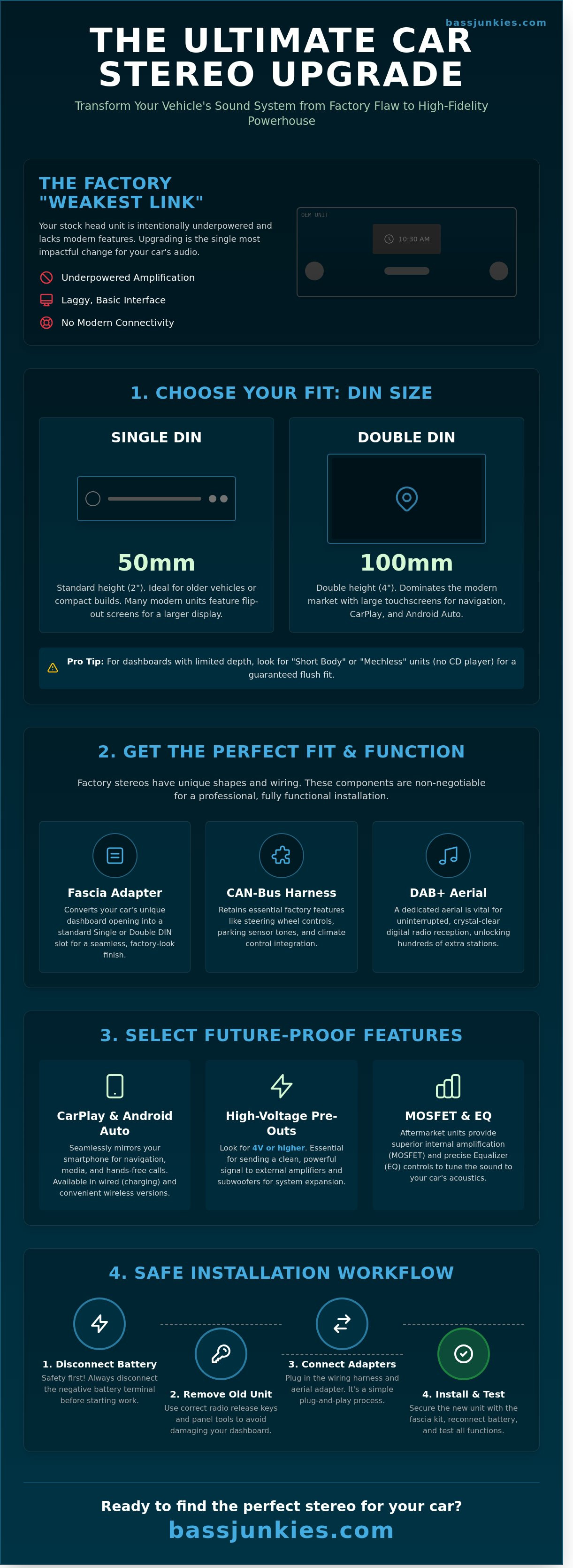
Your factory-fitted head unit is intentionally designed to be the weakest link in your vehicle's performance. To fix this, a car stereo car upgrade requires matching your dashboard to either a Single DIN or Double DIN unit using a vehicle-specific fascia adapter. You must use a CAN-bus wiring harness to retain essential factory features like steering wheel controls and parking sensor tones. Selecting a head unit with integrated DAB+ and Apple CarPlay ensures your system is future-proof and delivers the crystal-clear audio quality you crave.
It's a common frustration to feel stuck with a basic, laggy interface just to keep your car's original functions working. We'll show you exactly how to choose a high-performance replacement that integrates perfectly with your existing electronics. You'll learn the difference between various fitting kits and why a dedicated DAB+ aerial is vital for uninterrupted signal. We're breaking down the technical requirements to help you achieve a professional-grade installation with massive sound improvements.
Key Takeaways
- Determine whether your vehicle requires a single or double DIN head unit to ensure a flush, professional fitment within your dashboard.
- Upgrade to a modern car stereo car setup that prioritises smartphone integration like Apple CarPlay for seamless access to navigation and media.
- Identify the specific wiring harnesses and fascia kits needed to convert unique factory connections to the universal ISO standard.
- Follow a safe installation workflow, from disconnecting the battery to using the correct radio release keys for a damage-free head unit swap.
- Explore how to enhance your system's performance by integrating external amplifiers and fine-tuning the internal EQ for your vehicle's specific acoustics.
Understanding Car Stereo Sizes and Vehicle Compatibility
To choose the correct car stereo car enthusiasts must first determine the DIN size of their vehicle's dashboard aperture. DIN refers to the international standard for head unit dimensions, ensuring a universal fit across different manufacturers. A Single DIN unit measures 50mm in height, whereas a Double DIN unit provides 100mm of height for larger displays. Modern Vehicle audio systems often integrate these units behind custom-moulded plastic panels, making a dedicated fascia kit essential for any upgrade. Identifying these physical constraints before you buy ensures a seamless installation and professional finish.
Replacing your factory head unit is the fastest way to inject power and modern features into your ride. Most OEM systems are underpowered and lack the processing capabilities of high-end aftermarket brands. By switching to a dedicated unit, you gain superior MOSFET amplification and precise EQ controls. This upgrade transforms your cabin into a high-performance listening environment.
- DIN sizes are standardised at 50mm (Single) and 100mm (Double) heights.
- Fascia adaptors are required for most vehicles post-2000 to maintain interior aesthetics.
- Short-body units provide a solution for dashboards with limited internal depth.
- Aftermarket units offer higher power output than standard factory head units.
Single DIN vs Double DIN Explained
Single DIN units are 2 inches tall and were the standard for decades. These are perfect for older cars or budget-conscious builds. Many Single DIN models now feature "flip-out" motorised screens to provide a big-screen experience in a small slot. They are compact, efficient, and offer a classic look.
Double DIN units are 4 inches tall and dominate the modern market. They offer massive touchscreens, integrated navigation, and seamless Apple CarPlay or Android Auto connectivity. The larger surface area makes it easier to control your music and maps while driving. It's the ultimate choice for a tech-heavy cockpit.
Always check the mounting depth before you buy. Some vehicles have shallow dashboards with internal obstructions like heater pipes. In these cases, look for "short body" or "mechless" chassis. These units lack a CD player, reducing their depth to as little as 75mm to ensure a flush fit.
Checking Your Dashboard for a Factory-Look Finish
Factory radios are rarely a perfect rectangle. Car manufacturers design uniquely shaped head units to discourage theft and create a proprietary look. To fix this, you need a vehicle-specific fascia adaptor. These kits convert the irregular opening of your dashboard into a standard 1-DIN or 2-DIN slot.
Matching the plastic texture and colour is vital for a clean aesthetic. A high-quality adaptor ensures your new gear looks like it came from the factory, not a DIY project. You can explore our massive range of car stereos to find the perfect match for your vehicle's configuration. Bass Junkies provides expert advice to help you secure the right fit the first time.
Identifying the Essential Features for Your New Head Unit
Choosing the right head unit requires focusing on connectivity and expansion. Your new car stereo car setup must include Apple CarPlay or Android Auto for seamless app integration. Wireless connectivity offers daily convenience while wired options provide consistent charging for long journeys. High-voltage pre-outs, specifically those rated at 4V or higher, are essential for future-proofing if you plan to add external amplifiers or subwoofers. DAB+ digital radio ensures access to hundreds of UK stations with crystal-clear reception.
Apple CarPlay and Android Auto Integration
These interfaces put your phone's power directly on the dash. You get real-time navigation via Waze or Google Maps without touching your handset. Voice-controlled messaging and hands-free calling keep your eyes on the road and your hands on the wheel. It's the ultimate safety upgrade for any older vehicle. Explore the latest stereo screens with full smartphone mirroring to transform your driving experience immediately.
Modern units support both wired and wireless versions of these platforms. Wireless is perfect for short commutes where you don't want to dig your phone out of your pocket. Wired connections are better for long trips to keep your battery topped up. Check a car stereo buying guide to see which connection type fits your daily routine best.
DAB+ Digital Radio and Bluetooth Streaming
DAB+ digital radio is a non-negotiable upgrade for UK drivers seeking interference-free audio. It delivers a massive range of digital stations that standard FM simply cannot match. You get better signal stability and more variety, from specialist music stations to live sports. This is a core component of a modern car stereo car upgrade.
Bluetooth 5.0 is another essential for high-quality audio streaming. It ensures stable connections and allows for multi-device pairing, so you and your passengers can swap DJ duties instantly. Browse our DAB and Bluetooth collections for high-performance options that deliver studio-quality sound. These units often feature advanced MOSFET power for cleaner output at higher volumes.
If you want a system that hits hard, look at the rear of the unit before buying. High-voltage pre-outs provide a cleaner signal to your amplifiers, which reduces floor noise and increases dynamic range. This is vital if you plan to install thumping subwoofers to round out your low-end frequencies. Don't settle for standard 2V outputs if you're serious about sound quality.
How to Choose the Correct Fitting Kit and Wiring Harness
Choosing the correct fitting kit requires matching your vehicle's specific make, model, and year to a dedicated wiring harness, fascia panel, and aerial adaptor. A wiring harness converts your car's proprietary factory plug into the standard ISO format used by almost every aftermarket unit. You must identify if your vehicle uses a CAN bus system to provide ignition signals or if you need a steering wheel interface to retain factory button functionality. Without the right components, a 30-minute installation can turn into hours of frustrating wire-splicing that risks damaging your vehicle's electronics.
Modern vehicles built since 2005 typically rely on CAN bus technology to communicate between the engine and the dashboard. This digital network handles signals like illumination, reverse gear triggers, and speed pulses. A dedicated CAN bus decoder is essential for your new car stereo car setup to function correctly. These decoders translate digital data into analogue signals that your new head unit understands, ensuring the screen dims when you turn on your headlights.
The Role of Connects2 and Steering Wheel Interfaces
Connects2 interfaces are the industry standard for maintaining the link between your car and your new hardware. These kits allow you to retain factory features that would otherwise be lost, such as parking sensor tones and vehicle setting menus. You must select the correct patch lead for your specific brand, whether it's Pioneer, Alpine, or Kenwood, to ensure the interface communicates with the stereo. This secondary lead is the final piece of the puzzle that makes the system truly "Plug and Play."
Retaining steering wheel controls isn't just about convenience; it's a critical safety measure. Keeping your eyes on the road reduces the dangers of distracted driving, as you can adjust volume or skip tracks by feel alone. Professional kits eliminate the need to cut into the original loom, preserving your car's resale value. In over 90% of installs, using a high-quality interface saves significant time and prevents blown fuses caused by incorrect wiring.
Essential Accessories for a Professional Install
A fascia panel is the frame that surrounds your new stereo to fill the gap left by the larger factory unit. You can choose between matt black, gloss, or silver finishes to match your dashboard's original trim exactly. Getting a perfect colour match is the difference between a "DIY look" and a factory-standard finish. Most 2-DIN installs require a cage kit to securely lock the stereo into the dashboard, preventing rattles and theft.
Aerial adaptors are often overlooked but vital for clear signal reception. Most European cars use a FAKRA or ISO connection that won't fit a standard aftermarket port without a converter. If you're upgrading to DAB+, a glass-mount aerial is a quick solution, but a roof-mount upgrade offers 30% better signal strength in low-coverage areas. You can find all necessary installation accessories to complete your project and get your system thumping in no time.
Step-by-Step Guide to Installing Your New Car Stereo
Installing a new car stereo car requires a systematic approach to ensure electrical safety and a flush fit. You must start by disconnecting the negative battery terminal to eliminate the risk of short circuits or blown fuses. Use professional-grade trim removal wedges and manufacturer-specific release keys to extract the factory unit without damaging the dashboard. Wiring involves matching ISO harness colours and securing all connections before testing the system's full functionality. This process ensures your high-performance head unit operates at its peak potential without technical glitches.
Preparation is the difference between a pro-tier finish and a botched job. Gather your toolkit before you start. You need nylon trim tools, a screwdriver set (usually Phillips or Torx T20), and wire strippers if you aren't using a plug-and-play harness. 95% of installation errors stem from rushed preparation or using the wrong tools for delicate plastic clips.
Removing the Original Head Unit
Factory units in 90% of UK vehicles like Ford, Vauxhall, or Volkswagen require specific release keys. Insert these into the designated slots until you hear a click. Apply even, outward pressure to the keys while pulling the unit forward. This releases the internal locking tabs without snapping the surrounding plastic trim. Once the unit is out, depress the locking tabs on the factory looms to unplug them. Never pull directly on the wires, as this can de-pin the connectors and cause intermittent power loss later.
Wiring and Mounting the New System
Connect your new wiring harness by matching the standardised ISO colours. Ensure every plug creates a physical "click" when joined to prevent vibrations from loosening the connection. For a stealth look, route microphone cables and DAB aerial leads behind the dashboard panels. Avoid pinching these thin cables behind the metal chassis of the stereo. Secure the mounting cage into the dash aperture by bending the triangular metal tabs outward with a flat-head screwdriver. This creates a rock-solid foundation for your new kit.
Don't slide the unit into the cage for the final time until you've run a full system check. Reconnect the battery and verify that the MOSFET power is driving the speakers correctly. Check the DAB+ signal strength and ensure steering wheel control interfaces are fully responsive. If your vehicle has a reverse camera, test the trigger wire to ensure the screen switches automatically. Once confirmed, push the unit home until it locks and replace the dashboard trim panels.
Ready to overhaul your in-car entertainment? Bass Junkies stocks the UK's biggest range of audio tech to get your cabin thumping. Explore our latest car stereos and grab the ultimate upgrade for your ride today.
Why Professional Integration Beats a Basic DIY Swap
Professional integration ensures your car stereo car setup delivers maximum performance by matching the head unit's output to your vehicle's specific cabin acoustics. Expert installers use advanced EQ tuning to eliminate standing waves and frequency cancellations that a basic DIY swap misses. This process prevents common electrical faults like parasitic battery drain or CAN-bus interference while providing the necessary high-voltage signal for future expansion.
Optimising the internal EQ is critical for a high-fidelity experience. Every car cabin has unique reflective surfaces and absorption points. Professional integration uses real-time analysers to flatten the response curve and time-align the speakers. This creates a solid foundation for your car stereo car project, integrating car amplifiers to drive your system's thumping performance. Without this precise calibration, even the most expensive hardware will sound muddy and unbalanced.
Vehicle electronics are increasingly complex. Modern head units must communicate with steering wheel controls, factory cameras, and even climate settings. Expert advice ensures every component works in perfect harmony with your vehicle’s sensitive data networks. Professional fitting avoids the £150+ repair costs associated with damaged wiring looms or shorted circuits. You get total peace of mind knowing the install is fused correctly and won't compromise your car's warranty.
Scaling Your System with Subs and Amps
A premium head unit acts as the brain of your audio build. It provides the clean, low-distortion signal required for car subwoofers to hit those deep notes without clipping. High-voltage RCA pre-outs, typically 4V or higher, ensure your amps receive a strong signal with a low noise floor. You must also correctly wire the remote turn-on leads to prevent unwanted battery drain when the ignition is off. Check our Car Audio Buying Guide 2026 for the complete technical roadmap.
The Bassjunkies Advantage
Bassjunkies has reigned as the UK’s No. 1 specialist since 1995. We understand the technical fitment details that general retailers often miss. We stock a massive range of 2-DIN fitments and DAB+ integrated units ready for immediate dispatch. We offer massive savings on elite brands including Pioneer, Alpine, and Kenwood. Visit our Latest Offers to secure a deal on your next high-performance upgrade.
Take Command of Your Vehicle's Audio Performance
Upgrading your factory system is the fastest way to revolutionise your daily commute. You now understand how to navigate DIN sizes and why the right wiring harness is non-negotiable for a seamless fit. Selecting a unit with DAB+ and smartphone integration ensures your tech stays current for years to come. Finding the ideal car stereo car configuration is about balancing technical compatibility with the raw power you crave.
We've been the UK’s No. 1 specialist since 1995, providing the gear and grit needed for world-class installs. Our massive stock features the latest head units from Pioneer, Alpine, and Kenwood, ensuring you never have to settle for second best. You can rely on expert advice from real audio junkies who understand impedance and fitment as well as they know a heavy bassline. Stop dreaming about better sound and start making it happen with components that deliver crystal-clear precision.
Upgrade your ride with the UK’s best car stereos at Bassjunkies
Get behind the wheel and feel the difference that professional-grade audio makes to every journey.
Frequently Asked Questions
Will an aftermarket car stereo drain my car battery?
A correctly installed car stereo car won't drain your battery because it shuts down completely when the ignition is turned off. Problems only occur if the red ignition wire and yellow permanent live wire are swapped during installation. This mistake keeps the head unit in a high-power standby mode. Checking your connections with a multimeter ensures the parasitic draw stays below 50 milliamps when the vehicle is parked.
Can I keep my steering wheel controls with a new car stereo?
You can definitely keep your steering wheel controls by using a vehicle-specific SWC interface. These plug-and-play adapters translate your car's digital signals into commands the new car stereo car understands. Most major brands like Pioneer and Kenwood are fully compatible with these modules. You'll just need to match the correct patch lead to your specific brand of head unit to maintain full control of your volume and tracks.
What is the difference between Single DIN and Double DIN?
The difference is the physical height of the unit inside your dashboard. A Single DIN head unit measures 180mm by 50mm, while a Double DIN is exactly twice as tall at 100mm. Double DIN units are the standard for modern setups because they allow for large touchscreens and Apple CarPlay integration. Most UK cars from the last 20 years feature 2-DIN apertures, but you can use a fascia kit to fit a smaller unit if you prefer.
Do I need a new aerial for a DAB car stereo?
You'll need a DAB-specific aerial or an internal glass-mount antenna to receive digital signals. Standard FM aerials aren't tuned for the higher frequency bands used by DAB+ broadcasts in the UK. Alternatively, you can use an active signal splitter that utilises your existing roof aerial. This setup ensures crystal-clear reception and prevents the signal from dropping out in 98% of covered areas across the country.
Can I install a car stereo myself or should I hire a pro?
DIY installation is a great option for most enthusiasts if you have the correct wiring harness and fascia adapters for your vehicle. If your car features a complex fibre-optic system like MOST, hiring a professional installer is the smarter choice. A pro installation usually takes between 60 and 120 minutes depending on the complexity of the dash. This ensures all connections are fused correctly and prevents any damage to your interior trim.
Will a new car stereo improve my existing speakers?
A new head unit will immediately improve the sound of your factory speakers by providing cleaner power and advanced signal processing. Most aftermarket units feature high-quality MOSFET amplifiers that deliver 50W peak power per channel. This is often 3 times the output of a basic factory radio. You'll also gain access to 13-band graphic equalisers, allowing you to fine-tune the audio to suit your cabin's specific acoustics.
How do I know which wiring harness my car needs?
You find the correct wiring harness by matching your vehicle's make, model, and year of manufacture to a specific ISO adapter. Most UK vehicles built after 2004 use Quadlock or manufacturer-specific plugs instead of standard ISO connectors. Using a vehicle-specific harness means you don't have to cut or solder any original wires. This protects your car's warranty and makes the entire upgrade a simple, reversible plug-and-play process.