

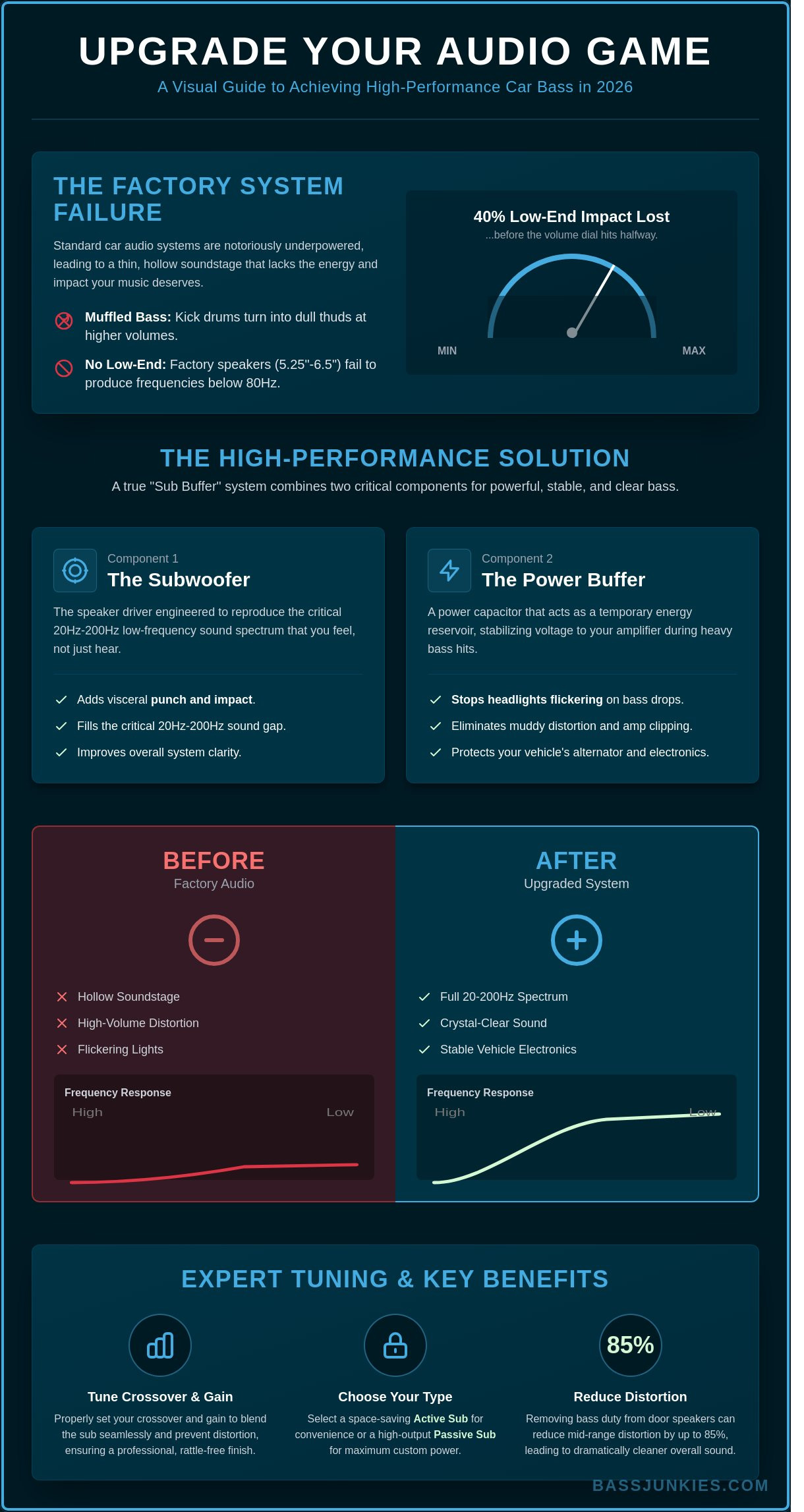
Most factory sound systems lose 40% of their low-end impact before the volume dial even hits halfway. If you want to fix thin, rattling audio, the best sub buffer for car setups in 2026 combines high-excursion active subwoofers with dedicated power capacitors to maintain a steady 14.4V supply. These components stop your headlights from flickering and eliminate the muddy distortion that kills your tracks during heavy bass drops.
You know that frustrating feeling when the kick drum turns into a muffled thud at high volumes. It's a common struggle for UK drivers dealing with restricted OEM head units and underpowered wiring that chokes your amplifiers. We agree that your music deserves better than the hollow, tinny output your car factory delivered, especially when you're looking for that deep, physical punch.
This guide promises to transform your ride into a high-performance bass machine by highlighting the top-rated hardware for the 2026 season. We'll preview the latest active enclosures, massive power buffers, and expert tuning tricks to ensure you get thumping, crystal-clear sound without draining your battery. You'll find everything needed to move from a weak factory setup to a professional-grade audio system that hits hard every time.
Key Takeaways
- Identify the best choice between space-saving active enclosures and high-output passive subwoofers for your specific vehicle and boot space.
- Understand how a sub buffer for car audio stabilises voltage to prevent your amplifier from clipping during massive, low-frequency bass drops.
- Learn to use power capacitors as energy reservoirs to support high-current demands and protect your vehicle's standard alternator.
- Discover expert tuning tips for crossover and gain settings to achieve a professional, rattle-free finish with crystal-clear sound quality.
- Compare the latest 2026 high-performance hardware designed to transform thin factory audio into a high-octane bass machine.
Understanding the Sub Buffer for Car Audio Systems
A sub buffer for car audio is primarily a subwoofer, the heavy-duty speaker driver engineered specifically to reproduce low-frequency sounds between 20Hz and 200Hz. While the term sometimes refers to a power capacitor used to stabilise voltage for high-output amplifiers, most UK drivers use it to describe the physical speaker unit. Installing a dedicated sub buffer for car setups immediately relieves your factory speakers of heavy-lifting duties. This allows your door speakers to focus on delivering crystal-clear mid-range and high-frequency audio without the distortion caused by excessive cone excursion. At Bass Junkies, we specialise in both the high-performance drivers and the power management hardware needed to sustain massive bass levels.
Subwoofer vs Power Buffer: Which Do You Need?
The subwoofer is the component that creates the physical sound waves you feel in your chest. A power buffer, or capacitor, acts as a temporary energy reservoir for your vehicle's electrical system. If your headlights flicker during heavy bass hits, your 12V system is struggling to keep up with the amplifier's current draw. You need a capacitor to stabilise the voltage and protect your alternator. If your music simply lacks depth and impact, the speaker unit is your priority. Most enthusiasts starting their audio journey are looking for the speaker itself to transform their listening experience. Understanding the Sub Buffer and its mechanical design helps you choose the right enclosure for your boot space.
The Role of Low Frequencies in Modern Car Audio
Standard factory speakers generally fail to produce frequencies below 80Hz due to their small 5.25 or 6.5-inch driver sizes. This creates a hollow soundstage that lacks the energy and "thump" found in modern recordings. Subwoofers fill this critical 20Hz to 200Hz gap, providing the weight and scale required for a high-performance system. Adding a sub doesn't just make the music louder; it adds a visceral dimension that standard paper-cone car speakers cannot replicate. This upgrade shifts the workload away from delicate components, ensuring your entire system stays clear even at high volumes.
- Frequency Range: Subwoofers handle the 20Hz-200Hz spectrum that standard drivers miss.
- System Protection: Power buffers prevent voltage drops that can damage sensitive vehicle electronics.
- Sound Clarity: Removing bass frequencies from door speakers reduces 85% of common mid-range distortion.
- Energy Impact: Proper low-end reproduction creates a more immersive and energetic listening environment.
Bass Junkies provides the expert advice and hardware needed to bridge the gap between weak factory sound and a professional-grade setup. Whether you need a compact under-seat active sub or a competition-spec 4-channel amplifier to drive a massive enclosure, we have the UK's largest stock ready for immediate dispatch.
Top-Rated Active Sub Buffers for 2026
Active subwoofers are the most efficient way to add a sub buffer for car systems because they combine a high-excursion driver and a matched amplifier into one pre-tuned enclosure. For 2026, these units are the primary choice for hatchback and SUV owners who need to preserve boot space while demanding high-impact sound. They simplify the installation process by reducing wiring complexity to a power, ground, and signal cable. This plug-and-play nature makes them a favourite for DIY enthusiasts. You get professional-grade bass without the bulk of traditional separate components.
These units use integrated MOSFET amplifiers to drive the woofer with precision. Learning how subwoofers work helps you understand why these active boxes are so effective. By housing the amp and driver together, manufacturers can optimise the internal air volume for the specific speaker. This creates a punchy, controlled sound that factory systems simply cannot replicate.
Active subwoofers are the ultimate space-saving solution for modern vehicles. Most 2026 models from Alpine and Pioneer feature high-level inputs. This allows them to connect directly to factory speaker wires without needing an expensive aftermarket head unit. It is the fastest way to transform a thin, tinny factory setup into a full-range audio powerhouse.
Under-Seat Active Subs: Hidden Power
Under-seat units are the ultimate stealth solution for 2026. The Pioneer TS-WX series leads the market with ultra-slim aluminium designs that fit into gaps as small as 70mm. These units provide a massive boost to mid-bass and low-end presence without visible modifications. While they lack the 20Hz deep extension of a full-sized box, their proximity to the listener creates an immersive, tactile experience. They are perfect for drivers who want a sub buffer for car audio that stays completely out of sight.
Enclosed Active Subwoofers for Maximum Punch
For those who want more air displacement, larger enclosed active boxes are the answer. The Alpine PWE-V80 stands out as a 2026 powerhouse, delivering 160W of peak power from a compact boot-mounted chassis. These units provide the deep, thumping bass required for EDM and hip-hop. They offer a significant step up in SPL compared to under-seat models. You can find these units and more by browsing our latest offers for the best deals in the UK.
If you need more power for a larger vehicle, explore our full range of high-performance subwoofers today.
Choosing Passive Subwoofers for Massive Bass
Sealed vs Ported Enclosures: Tuning Your Sound
Matching Amps to Passive Sub Buffers
Power Buffers and Capacitors: Stabilising Your Bass
A sub buffer for car, commonly referred to as a power capacitor, is an essential component for high-performance audio systems exceeding 500 watts RMS. It functions as a high-speed energy reservoir, discharging instant current to your amplifier when heavy bass notes demand more juice than the vehicle's alternator can provide. This prevents voltage drops that cause dimming headlights and distorted audio output. By smoothing out these intense power spikes, the buffer protects your vehicle's electrical system from premature wear. It is a mandatory upgrade for any system pushing 1,000 watts RMS or more to ensure tight, punchy performance without straining your battery.
Standard UK car alternators are designed for factory electronics; they aren't built for the massive current draw of a thumping subwoofer system. When your amp hits a low-frequency note at high volume, it can pull over 80 amps in a fraction of a second. A power buffer bridges this gap, delivering the necessary current faster than a standard lead-acid battery. This stability prevents your amplifier from clipping, which is the primary cause of blown voice coils. You get cleaner, more accurate bass and a significantly longer lifespan for your alternator and battery.
Do You Need a 1-Farad or 2-Farad Capacitor?
The standard industry rule of thumb is to use 1 Farad of buffering for every 1,000 watts of RMS power. If you are running a 1,500W monoblock system, a 2-Farad unit provides the necessary headroom to handle sustained low-frequency output without depleting the charge. To calculate your system's total draw, divide your total RMS wattage by 13.8, which is the average running voltage. We recommend units with digital displays for real-time voltage monitoring. These screens allow you to see exactly when your system is under stress, ensuring you stay within a safe 13.5V to 14.4V range during operation.
Installation Tips for Power Buffers
Resistance is the enemy of performance, so you must mount your sub buffer for car within 12 to 18 inches of the amplifier. Long cable runs create voltage drops that negate the benefits of the capacitor entirely. Using high-quality accessories and wiring kits ensures maximum conductivity and heat resistance for your setup. Safety is paramount during the initial setup; you must charge the capacitor using the provided resistor or a test light before connecting it to the main power. Connecting a flat capacitor directly to 12V creates a massive current surge that can blow fuses or damage the internal plates of the unit.
Expert Fitting and System Optimisation
A high-performance sub buffer for car audio provides the essential low-end foundation, but it only delivers thumping results through meticulous system optimisation. Professional calibration prevents hardware damage and ensures the bass integrates perfectly with your existing setup. Without correct gain matching and crossover alignment, even the most expensive kit will underperform or suffer from signal clipping.
Bassjunkies provides the technical expertise needed to transform a standard install into a competition-grade sound system. Our fitting services focus on extracting every decibel of clarity while protecting your investment. We ensure your vehicle remains rattle-free and safe, regardless of how much air your new sub is moving.
Setting the Gain and Crossover Points
Setting the Low Pass Filter (LPF) is vital for blending your sub with your car speakers. For most 6.5-inch door speakers, an LPF setting between 80Hz and 100Hz creates a seamless transition. This prevents your sub from attempting to play high frequencies it cannot handle, keeping the vocals crisp and the low-end tight.
Never treat the Bass Boost dial as a secondary volume knob. Cranking this setting introduces massive distortion and can fry your voice coils in minutes. True performance comes from matching the amplifier's input sensitivity to the head unit's output voltage. This creates a crystal-clear soundstage where the bass feels like it is coming from the dashboard rather than just the boot.
Why Professional Installation Wins
DIY wiring often leads to engine hum or alternator whine because power cables are run too close to RCA signal leads. Our expert fitters at Bassjunkies use high-quality shielded cables and strategic routing to eliminate interference. We ensure every connection is rock-solid and fused correctly to protect your vehicle's electrical system from shorts.
Safety is a massive priority that many enthusiasts overlook. A heavy sub buffer for car enclosures becomes a lethal projectile in a 30mph collision if it is not bolted down securely. We use heavy-duty brackets and reinforced mounting points to keep your gear exactly where it belongs, even under heavy braking.
To achieve the ultimate performance, consider adding Dynamat Xtreme during the install. This high-grade damping material kills boot lid vibrations and stops your registration plate from rattling. It keeps the acoustic energy inside the cabin, resulting in a 3dB to 5dB increase in perceived loudness.
- Incorrect gain settings cause 90% of premature subwoofer failures.
- LPF settings should typically sit between 80Hz and 100Hz for best integration.
- Professional cable routing prevents 12V interference and unwanted engine noise.
- Secure mounting is a critical safety requirement for all heavy enclosures.
Lock In Your 2026 Bass Setup
Choosing the right sub buffer for car audio systems transforms a standard drive into a high-octane sensory experience. The 2026 tech landscape proves that active sub buffers are the most efficient way to grab massive low-end response without sacrificing your entire boot. For those chasing maximum SPL, pairing your kit with a dedicated power buffer ensures your voltage stays rock solid during the heaviest bass drops. It's the difference between a system that clips and one that hits with absolute precision.
Bass Junkies has been the UK's No. 1 specialist since 1995, providing expert advice from real enthusiasts who live for high-performance sound. We hold a massive stock of industry-leading brands like Pioneer and Alpine, ready for immediate dispatch. Whether you're looking for a compact active solution or a full-scale passive beast, we've got the gear to make your car shake. Don't let weak factory speakers ruin your tracklist when professional-grade power is just a click away.
Shop the UKs Largest Range of Car Subwoofers at Bassjunkies
Get your system sorted today and feel every beat exactly how the artist intended.
Frequently Asked Questions
What is a sub buffer for a car?
A sub buffer for car audio, more accurately known as a subwoofer, is a dedicated speaker designed to reproduce low-frequency sounds between 20Hz and 200Hz. It handles the deep, thumping bass notes that standard factory door speakers are too small to produce. Adding a sub buffer for car setups transforms your listening experience by providing the physical impact and depth essential for high-performance audio.
Does a car subwoofer need a separate amplifier?
Every subwoofer requires an amplifier to provide the massive power needed to move its large cone. Passive subwoofers need an external mono or bridgeable multi-channel amp to function. Active subwoofers come with a built-in amplifier, making them a compact, all-in-one solution for those who want to save space in the boot. Without a dedicated power source, you won't get the crystal-clear, heavy bass you're looking for.
Will a big subwoofer drain my car battery?
A high-power subwoofer system can drain your battery if the total current draw exceeds your alternator's output, usually occurring at levels above 500 watts RMS. You should consider a stiffening capacitor or an upgraded AGM battery if your system pushes past 1,000 watts to maintain a steady 14.4V supply. Always keep the engine running during heavy sessions to ensure your voltage doesn't drop below the critical 12.6V resting mark.
What is the difference between an active and passive subwoofer?
An active subwoofer features an integrated amplifier built into the enclosure, offering a plug-and-play solution that's easy to hide under a seat. Passive subwoofers are just the driver and box, requiring a separate external amplifier to provide power. While active units are simpler to install, passive setups give you 100% control over impedance matching and power levels for a truly bespoke sound.
How much does it cost to have a subwoofer fitted in the UK?
Professional installation for a subwoofer in the UK typically costs between £80 and £150 for labour. You also need to factor in approximately £30 to £60 for a high-quality 8-gauge or 4-gauge wiring kit. Total costs for a basic professional fit-out usually start around £110 at specialist car audio shops, ensuring your 12V system is safe and fused correctly.
Where is the best place to put a subwoofer in a car?
The boot is the ultimate location for a subwoofer because the larger air volume allows low-frequency waves to develop properly. Pointing the subwoofer towards the rear of the car often increases bass response by 2dB or 3dB through a phenomenon called corner loading. If you drive a pickup or a small city car, a compact under-seat active sub is the best way to add punch without losing your storage space.
Can I add a subwoofer to my factory car stereo?
You can definitely add a subwoofer to a factory head unit by using a Line Output Converter (LOC) to grab the signal from existing speaker wires. Many modern amplifiers and active subs now include high-level inputs, which means you don't even need an external converter. This allows you to keep your original DAB+ dashboard features while massiveley upgrading your system's power and impact.
What size subwoofer is best for deep bass?
A 12-inch or 15-inch subwoofer is the best choice for deep, vibrating bass because the larger surface area moves more air at lower frequencies. While 8-inch or 10-inch subs are punchy and fast, they often struggle to hit the sub-30Hz notes found in heavy hip-hop or electronic music. For most UK hatchbacks, a single 12-inch driver in a ported enclosure provides the perfect balance of ground-shaking depth and usable boot space.