

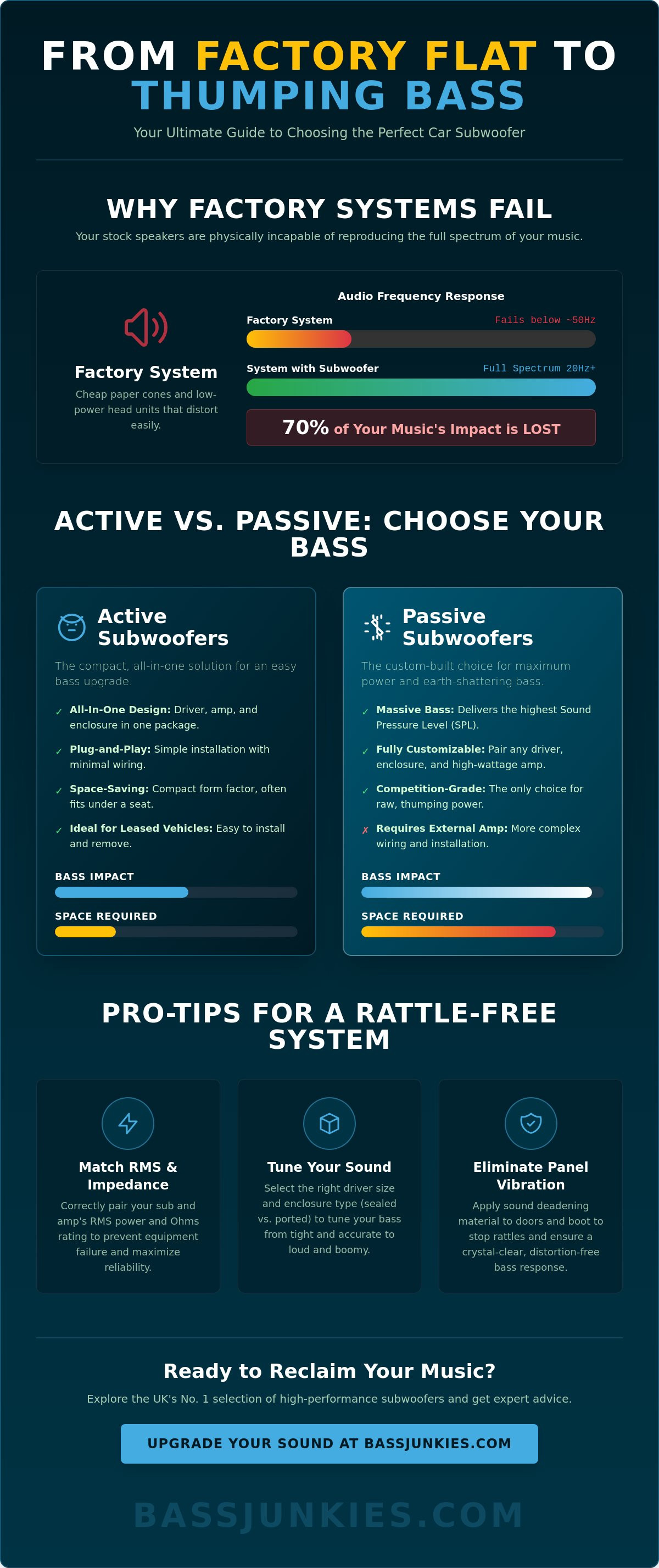
Your factory audio system is effectively muting 70% of your music's impact by failing to reproduce any frequencies below 50Hz. To reclaim that lost energy, you need to integrate high-performance subwoofers; subwoofer technology now allows for massive bass response without sacrificing your entire boot. We know that thin, rattling factory sound is a nightmare, and technical terms like RMS or Ohms can feel like a barrier to the sound you want.
This guide will show you exactly how to choose and install the perfect car subwoofer to transform your factory audio into a high-performance system. As the UK’s No. 1 specialist, we'll provide the expert advice you need to navigate enclosure types and wiring configurations. You're about to move from a weak factory setup to a professional-grade system that delivers crystal-clear, thumping bass on every journey.
Key Takeaways
- Understand why factory speakers lack depth and how dedicated subwoofers reproduce the low-frequency signals (20Hz-200Hz) essential for high-performance audio.
- Compare active and passive subwoofers; subwoofer selection depends on whether you want a compact all-in-one solution or a custom-built system for massive bass.
- Select the right driver size and enclosure type to perfectly tune the character of your sound, from tight accuracy to raw thumping power.
- Avoid equipment failure by correctly matching RMS power ratings and impedance (Ohms) between your sub and amplifier for maximum reliability.
- Discover professional installation techniques like sound deadening to eliminate panel vibration and ensure a crystal-clear, rattle-free bass response.
What is a car subwoofer and why does your factory audio sound thin?
A car subwoofer is a specialised speaker engineered to reproduce low-frequency audio signals, typically ranging between 20Hz and 200Hz. While standard factory speakers handle a broad range of sounds, they lack the physical scale and surface area to move the air required for deep, resonant bass. Integrating high-output subwoofers subwoofer systems into your vehicle offloads the heavy lifting from your door speakers, which immediately cuts distortion and sharpens mid-range clarity. A subwoofer is the foundation of any high-performance 12V audio system.
Installing a dedicated sub transforms a flat, tinny soundstage into a massive, immersive experience. It allows your existing speakers to focus on high and mid frequencies where they perform best. This separation of labour is the secret to achieving crystal-clear audio at high volumes without the speakers "bottoming out." If you want your music to have physical impact, a sub isn't an option; it's a requirement.
The difference between standard speakers and subwoofers
Standard door speakers are "jacks of all trades" that struggle to balance delicate vocals with heavy low-end impact. Subwoofers require much larger cones and heavy magnets to displace the massive volumes of air needed for low frequencies. Most factory drivers are 6.5-inch units, while a dedicated sub usually starts at 8 or 10 inches to provide the necessary surface area. According to the technical overview of What is a Subwoofer?, these drivers are specifically tuned for the bottom three octaves of the audible spectrum.
The voice coil in a subwoofer is also built much tougher to handle high-power signals without overheating. This allows the sub to maintain its composure during long, heavy bass sessions. You can feel the difference in the physics of the sound. A mid-bass driver provides a rhythmic "punch" in your chest, but a true subwoofer delivers the "rumble" that vibrates the entire chassis of the car.
Why factory systems fail at low frequencies
Most UK factory systems rely on cheap paper-cone speakers and low-power head units that clip as soon as you turn up the volume. These flimsy components cannot physically reproduce frequencies below 60Hz, leaving your digital music files sounding hollow and incomplete. Manufacturers often use software to roll off the bass to prevent the speakers from blowing, which chokes the life out of your favourite tracks. A dedicated subwoofer adds the missing dimension that factory systems simply ignore.
Modern digital files contain layers of low-end detail that only a high-performance driver can reveal. By adding a sub, you reclaim the full dynamic range of your music, from the subtle kick of a drum to the deepest synth lines. For a deeper look at specific setups and power requirements, check out the Ultimate Subwoofer Buying Guide. Upgrading your subwoofers subwoofer configuration is the fastest way to turn a boring commute into a front-row concert experience.
Active vs Passive subwoofers: Which setup delivers the hardest bass?
Passive subwoofers deliver the hardest bass and highest Sound Pressure Level (SPL) because they allow for larger enclosures and high-wattage external amplifiers. Active subwoofers provide a convenient, all-in-one solution with a built-in amp, but they cannot match the raw air-moving power of a dedicated passive setup. For maximum performance, a passive sub paired with a high-current mono-block amplifier is the superior choice. Bassjunkies recommends active subs for space-saving and passive subs for competition-grade volume. The choice depends on whether you value boot space or sheer acoustic impact.
Active subwoofers: The compact, plug-and-play choice
Active subwoofers are the fastest way to upgrade thin factory sound without a massive overhaul. These powered units house the driver and the amplifier in a single, tuned enclosure. This design eliminates the need for separate amp mounting and reduces the amount of wiring required. Choosing high-quality subwoofers subwoofer units from top brands like Pioneer and Kenwood ensures reliable performance in tight spaces.
These units are ideal for leased vehicles in the UK. You can add a significant punch to your audio system with minimal modification to the car's interior. Installation is straightforward; it often involves a single power cable and a signal tap from your existing speakers. While they lack the earth-shattering volume of larger boxes, they provide a balanced, high-quality low-end that completes the soundstage.
Passive subwoofers: For those who want to feel the beat
Passive subwoofers are the industry standard for enthusiasts who demand total system customisation. These speakers require an external power source, giving you the flexibility to choose a specific car amplifier that perfectly matches the sub's RMS rating. This setup allows for much higher wattage and deeper excursion, which is necessary for those massive, thumping basslines that you can feel in your chest.
Using separate components allows for better heat dissipation and more precise tuning. According to Understanding Car Audio Systems, correctly matching your amplifier to your subwoofers subwoofer configuration is essential for system longevity. Large passive boxes dominate the boot space but offer the best performance for serious audiophiles.
If you are ready to build a system that turns heads, view our latest subwoofer collection for the best passive options in the UK. Our expert team can help you calculate the correct impedance and power handling to ensure your setup hits hard without blowing your kit.
How to choose the right subwoofer size and enclosure for your car
To choose the right subwoofer size and enclosure, you must first define your goals for sound quality versus raw volume. Smaller 8-inch or 10-inch drivers offer fast, accurate bass ideal for tight spaces, while 12-inch and 15-inch models move more air for deeper low-end extension. The enclosure type dictates the character of the sound; sealed boxes provide tight, musical bass, while ported boxes offer massive volume and efficiency. Always measure your boot space and check your amplifier's power output before selecting a specific model to ensure compatibility. When comparing different subwoofers subwoofer size determines the balance between speed, accuracy, and raw thumping power.
Understanding subwoofer sizes: 8-inch to 15-inch
Subwoofer size is the primary factor in how your system handles different music genres. Smaller subs are agile, while larger ones are about pure displacement. As the UK’s No. 1 specialist, we see enthusiasts often struggle to choose between a single large sub or dual smaller units. Your choice should reflect your listening habits and your vehicle's layout.
- 8-inch subs: These are fast, punchy, and perfect for rock or jazz. They fit in tight spaces and provide a subtle low-end reinforcement that factory systems lack.
- 10-inch subs: A great middle ground that offers more depth than an 8-inch without requiring a massive box. They stay accurate during fast bass lines.
- 12-inch subs: This is the industry standard. It balances deep frequency response with a decent response time, making it the most versatile option for most UK cars.
- 15-inch subs: For those who want earth-shaking bass and have the boot space to spare. These move massive amounts of air for a physical, sensory impact.
Sealed vs Ported vs Bandpass enclosures
The enclosure is just as important as the speaker itself. It acts as the "instrument" that the driver plays. Without a properly tuned box, even the most expensive subwoofers subwoofer performance will suffer. You must match the box volume to the manufacturer's specifications to avoid damaging the voice coil.
- Sealed Enclosures: These have the smallest footprint and offer the most accurate sound. They provide tight, "snappy" bass that doesn't linger, though they require more power from your amplifier to hit high decibel levels.
- Ported Enclosures: These use a vent to redirect sound from the back of the cone. They are much louder and more efficient than sealed boxes, making them ideal for hip-hop and electronic music.
- Bandpass Enclosures: These feature a dual-chamber design that produces maximum output in a specific frequency range. They are bulky and complex but deliver the ultimate "boom" for show cars.
Space is the final frontier for any car audio build. Measure your boot twice before committing to a 15-inch beast. If you're short on room, consider a shallow-mount driver or a compact powered subwoofer that combines the amp and sub into one sleek unit. Our expert advice is to always prioritise a high-quality enclosure over a larger speaker if space is tight. A well-built 10-inch setup in a custom-tuned box will often outperform a 12-inch sub squeezed into a generic, undersized container. You can view our range of subwoofers to find the perfect fit for your vehicle's dimensions and your power requirements.
Matching RMS power and impedance: How to pair subwoofers with amplifiers
Matching your subwoofers and amplifiers requires focus on two specific metrics: RMS power and impedance. You must ignore "Peak" or "Max" power stickers because these figures are marketing fluff that don't reflect real-world performance. The RMS (Root Mean Square) rating tells you how much continuous power a sub can handle without burning out. For a high-performance system, select an amplifier that matches or slightly exceeds the subwoofer's RMS rating at its rated impedance. Impedance, measured in Ohms, acts as electrical resistance; if the amp isn't stable at the sub's Ohm rating, you risk total equipment failure. Underpowering a sub is often more dangerous than overpowering it because it forces the amp into clipping.
RMS Power: The real measure of performance
Your amplifier's RMS output should ideally match or slightly exceed the subwoofer's rating by about 10 percent to 20 percent. This headroom ensures the amp runs cool while delivering clean power for those massive bass drops. If you use an underpowered amp, you'll likely turn the gain up too high to compensate for low volume. This causes "clipping," where the clean sine wave of the audio signal is flattened into a square wave. Clipping generates massive amounts of heat that can melt a subwoofer's voice coil in minutes. You can find a matching unit in our car amplifiers category to ensure your sub gets the clean power it deserves. As the UK's No. 1 car audio specialist, we only stock amps that deliver true, rated power.
Understanding Ohms and Wiring
Impedance is the resistance your subwoofers subwoofer configuration presents to the amplifier. A 4-ohm load is the industry standard for most single-sub setups, providing a balance of stability and power. However, 2-ohm loads allow the amplifier to push more current, effectively increasing the wattage output. Class D mono-block amplifiers are the gold standard for driving subwoofers because they are highly efficient, converting more power into sound rather than heat. These units are specifically built to handle the heavy current demands of low-frequency reproduction. When selecting subwoofers subwoofer combos, always check the Ohm rating first.
If you're using dual voice coil (DVC) subs, you can wire them in parallel to drop the impedance or in series to increase it, giving you total control over your system's output. Always use high-quality Connects2 accessories for your wiring kits. Cheap, thin cables increase resistance and cause voltage drops, which starves your amp of the juice it needs to hit those thumping lows. Our expert team recommends using the thickest gauge wire your amplifier can accept to maintain maximum current flow.
Professional car subwoofer installation and the Bassjunkies advantage
Professional car subwoofer installation requires a combination of robust power delivery and vibration control to achieve maximum SPL and sound quality. To ensure your subwoofers subwoofer setup performs at its peak, you must use high-current power cables and shielded RCA leads to prevent engine noise interference. Proper mounting and enclosure security are vital to prevent energy loss through physical movement. Bassjunkies provides the technical expertise and massive inventory required to execute a high-performance audio upgrade correctly.
Proper installation ensures your sub hits hard without rattling your car to pieces. When a subwoofer moves, it creates immense pressure inside the cabin. If the enclosure isn't secured or the panels aren't treated, you lose acoustic energy to mechanical vibration. High-quality RCA cables and thick power leads are essential for a clean, noise-free signal. Cheap wiring causes voltage drops that starve your amplifier, leading to distortion and potential hardware damage.
The importance of sound deadening
Vibration is the absolute enemy of deep, accurate bass. When a high-powered driver moves, it generates pressure that causes thin metal panels to flex and rattle. This physical movement cancels out low-frequency waves and ruins your soundstage. Installing Sound Deadening is the first step for any serious sub install. Dynamat is the industry standard for killing these rattles, turning your car into a solid acoustic chamber that improves bass response by up to 3dB in some vehicles.
Sound deadening also lowers the noise floor of your vehicle. By reducing road and tyre noise, you can hear the subtle details in your music at lower volumes. It makes your subwoofers subwoofer system sound tighter and more controlled. Without it, you are effectively wasting a portion of your amplifier's power on vibrating your boot lid instead of moving air.
Why expert advice beats a DIY guess
Guesswork leads to blown voice coils and underwhelming performance. We bring over 30 years of experience in the UK car audio industry to every customer interaction. Our team understands the complex relationship between enclosure volume, port tuning, and amplifier impedance. We help you avoid common mistakes like mismatched power ratings or poor grounding points that can cause electrical fires. You can check our latest offers for complete bass packages designed to work perfectly together.
Bassjunkies is the UK’s No. 1 specialist for a reason. We maintain massive stock levels of the world's best audio brands, ensuring you get the gear you need without the wait. Our technical authority means we don't just sell boxes; we provide the blueprint for the ultimate audio system. We focus on the specifications that matter, like RMS power and excursion limits, to ensure your system lasts for years. Upgrade your ride with the ultimate car subwoofer today and experience the raw power of professional-grade audio.
Ready to Transform Your Drive with Massive Bass
Don't settle for thin, factory audio when you can experience the full impact of your favorite tracks. Achieving high-performance sound requires more than just picking a box; it's about matching RMS power and impedance to your amplifier for maximum efficiency. Whether you choose a compact active unit or a hard-hitting passive subwoofers subwoofer setup, the right enclosure will define your car's acoustic character.
We've been the UK’s No. 1 car audio specialist since 1995, helping thousands of drivers build systems that turn heads. You'll find huge savings on top-tier brands like Pioneer, Alpine, and JL Audio, all backed by our expert technical support. Our team provides the advice you need to ensure every component works in perfect harmony, delivering crystal-clear lows and reliable performance.
It's time to stop compromising on your sound quality and start building the system you've always wanted. Shop the UK’s largest range of car subwoofers at Bassjunkies and get the expert advice you need to hit those deep notes with confidence.
Grab your gear today and get ready to feel every beat.
Frequently Asked Questions
Can I add a subwoofer to my factory car stereo?
Yes, you can add a subwoofer to any factory car stereo by using a Line Output Converter (LOC). This essential piece of kit taps into your existing speaker wires to create the RCA signal your amplifier needs. Alternatively, many modern active subwoofers feature high-level inputs, allowing you to connect them directly to the factory wiring. It is the fastest way to get massive bass without the expense of a new head unit.
What is the best size subwoofer for deep bass?
A 12-inch or 15-inch subwoofer is the best choice for hitting those ultra-low, deep bass frequencies. While 8-inch or 10-inch subwoofers offer tighter and more responsive kicks, the larger surface area of a 12-inch driver moves significantly more air. This displacement is vital for the physical, thumping impact that enthusiasts demand. If you have the space in your boot, a larger driver delivers the ultimate low-end extension for your music.
What is the difference between RMS and Peak power?
RMS power represents the continuous wattage a subwoofer can handle safely, whereas Peak power refers to the maximum burst it can take for a fraction of a second. You should always match your amplifier to the RMS rating to prevent blowing your voice coils or damaging the equipment. Peak power is often used as a marketing figure and does not reflect real-world performance. For a reliable and loud system, focus strictly on the RMS specifications.
Do I need a capacitor for my car subwoofer?
You only need a capacitor if your headlights dim during heavy bass hits, but it is often a temporary fix for a larger power issue. A 1-farad capacitor stores energy to support your battery during sudden, massive demands from the amplifier. However, for high-powered systems exceeding 1000W RMS, upgrading your alternator or your battery is more effective. Most UK car audio builds benefit more from the "Big 3" wiring upgrade than a standalone capacitor.
How much boot space will a subwoofer take up?
Boot space usage depends on whether you choose a sealed or ported enclosure for your subwoofers. A compact sealed box for a 10-inch sub might only occupy 0.7 to 1.0 cubic feet of space, leaving plenty of room for shopping. Ported boxes are much larger, often requiring 1.5 to 2.5 cubic feet to allow for proper airflow and tuning. If you need to keep your boot entirely clear, an active underseat subwoofer is a stealthy alternative.
Why is my car subwoofer making a rattling sound?
Rattling is usually caused by loose interior trim or the subwoofer reaching its physical limits due to an incorrect gain setting. Check your boot lid, number plate, and plastic panels for vibration; applying sound deadening material can solve 90% of these annoying noises. If the sound comes from the driver itself, the voice coil might be bottoming out or the surround could be torn. Inspect the cone carefully to ensure it hasn't separated from the basket.
What is an active underseat subwoofer?
An active underseat subwoofer is an all-in-one solution that combines a slimline driver and a built-in amplifier in one compact chassis. These units are designed to slide directly under the driver or passenger seat, making them perfect for hatchbacks or smaller vehicles with limited boot space. While they won't win any SPL competitions, they provide a crystal-clear low-end fill that factory speakers can't match. It is a plug-and-play solution for high-performance sound without the bulk.
Is a 12-inch sub better than two 10-inch subs?
Two 10-inch subwoofers generally outperform a single 12-inch sub because they provide more total cone surface area. Two 10s have roughly 157 square inches of surface area compared to about 113 square inches for a single 12-inch driver. This allows the pair to move more air and handle more power, resulting in higher volume and more punch. However, a single 12-inch sub is often more efficient at hitting the lowest frequencies while taking up less total room.