
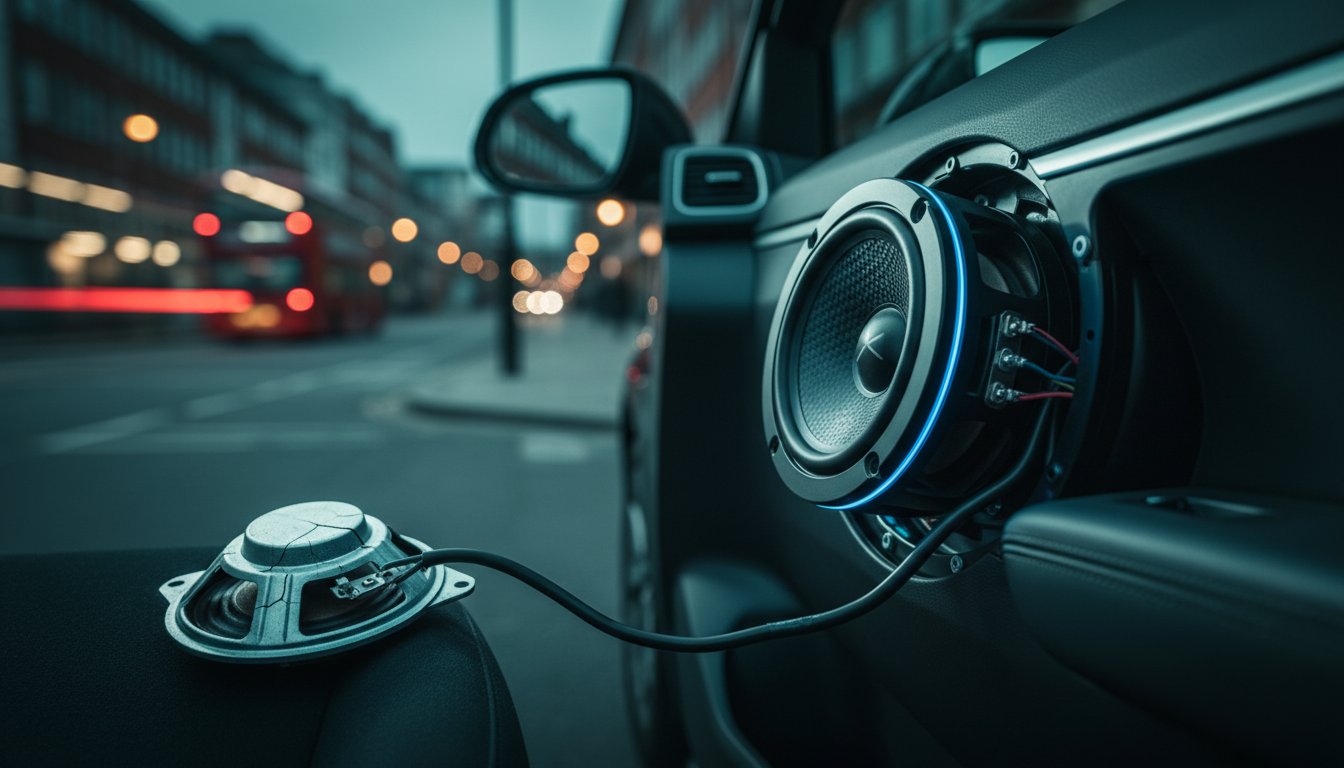
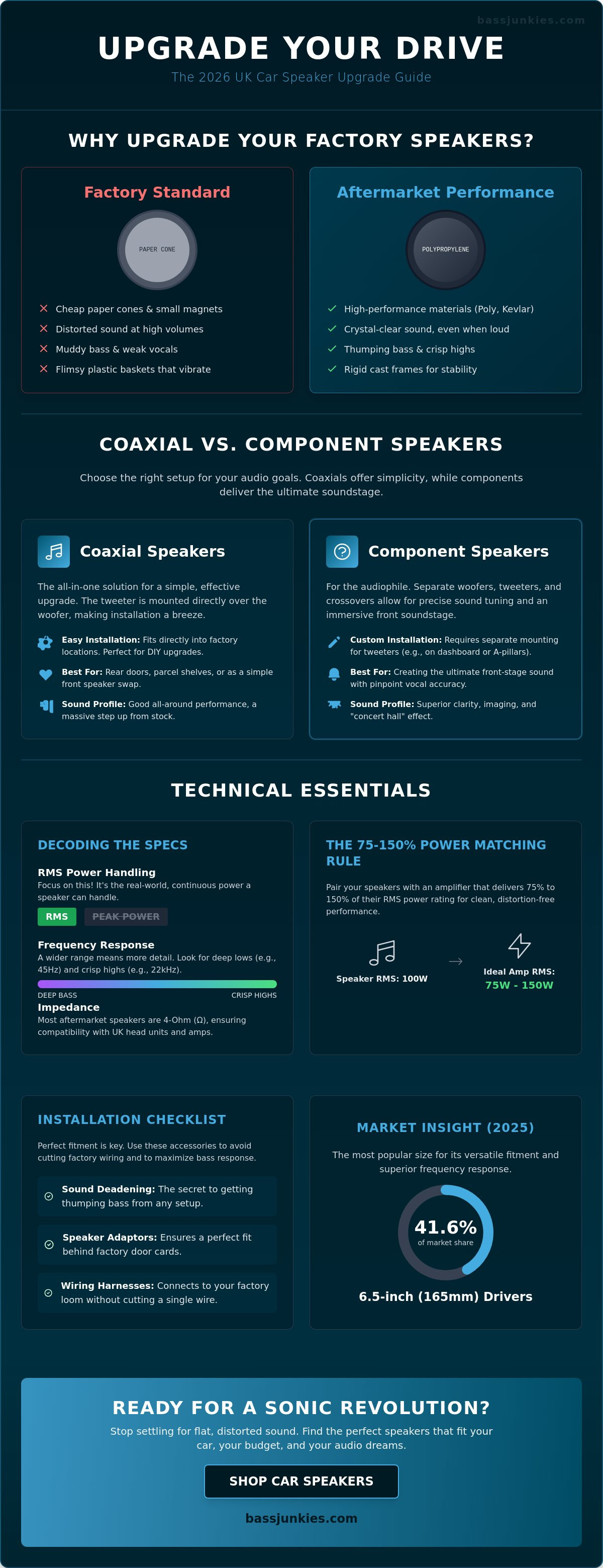
Your factory audio system is held back by cheap paper cones that physically cannot handle high-performance output. The best car speakers UK drivers can choose in 2026 range from the entry-level JL Audio C1-650x at £129.99 to the elite BLAM Signature 165 S300 at £1,207.99. Most professional installs utilize 6.5-inch (165mm) drivers, a segment that represented 41.6% of the European market in 2025 due to their versatile fitment and superior frequency response.
You shouldn't have to settle for distorted vocals or a muddy low-end when you're behind the wheel. It's a common frustration to invest in a great vehicle only to find the sound quality is flat, thin, and lacks the punch of a live performance. We understand the fear of buying expensive gear only to find it doesn't clear your window glass or fit behind the factory door cards.
This guide gives you the technical confidence to upgrade your system with the UK's best car speakers using our expert performance-driven selection guide. You'll learn how to match your drivers to a 4-channel amplifier, identify the right mounting brackets, and understand why sound deadening is the secret to getting thumping bass from any setup.
Key Takeaways
- Choose between coaxial "all-in-one" designs for simple swaps or component systems with separate tweeters and crossovers for an ultimate front-stage sound.
- Apply the 75-150% power matching rule to pair your new car speakers uk with an amplifier that delivers enough RMS wattage for crystal-clear performance.
- Ensure perfect fitment behind factory door cards by identifying the correct vehicle-specific speaker adaptors and wiring harnesses to avoid cutting your factory loom.
- Upgrade from weak factory paper cones to high-performance materials like polypropylene or Kevlar to eliminate high-volume distortion and muddy bass.
- Select the right gear for your specific audio goals, from the budget-friendly Pioneer TS-G series to high-excursion Alpine S-Series speakers built for thumping bass.
What are the best car speakers in the UK for a 2026 upgrade?
The best car speakers UK drivers can select for a 2026 upgrade must balance high sensitivity, appropriate RMS power handling, and precise physical fitment for specific vehicle door cards. Factory speakers almost always fail because they rely on cheap paper cones and tiny magnets that physically cannot produce the punch of aftermarket polypropylene or Kevlar drivers. High-performance speakers from brands like Pioneer, Alpine, and Focal use superior materials to eliminate distortion and deliver the thumping bass you crave. At Bass Junkies, we provide over 1000 speaker options to ensure you find a solution that fits your car and your budget perfectly.
Defining your audio goal is the first step toward a successful installation. Some enthusiasts want a simple drop-in replacement to fix a blown factory driver, while others are planning a custom audiophile build with sound deadening and external amplification. Your choice between these paths determines whether you should focus on high-efficiency coaxial speakers or more complex component systems. Our expert team is obsessed with sound quality and helps you navigate these technical hurdles to ensure your purchase delivers an immediate sensory impact.
The difference between factory and aftermarket audio
Standard vehicle audio has evolved significantly since the early history of in-car sound, but manufacturers still prioritize cost-cutting over performance. Factory units typically feature flimsy plastic baskets that vibrate under pressure. High-end car speakers uk specialists recommend aftermarket drivers because they utilize rigid cast aluminium frames to provide a stable platform for the cone. These premium materials often require more power to reach their full potential, but the result is a massive increase in clarity and volume. Sensitivity is the measure of how much sound a speaker produces from the power it receives.
Key technical specs you must check before buying
You should always ignore "Peak Power" ratings found on flashy packaging and focus strictly on continuous RMS (Root Mean Square) values. RMS tells you the real-world power a speaker can handle day-in and day-out without failing. Matching this to your source is critical. Most aftermarket speakers feature a 4-ohm impedance, which ensures they are compatible with the majority of UK head units and 4-channel amplifiers. Finally, look at the frequency response. A wider range, such as 45Hz to 22kHz, ensures more natural sound reproduction by capturing the deep lows and crystal-clear highs that factory speakers simply ignore.
Coaxial vs Component speakers: Which setup do you need?
Coaxial speakers are the ultimate all-in-one solution for UK drivers who want a massive sound upgrade without the hassle of custom mounting. These units feature a tweeter mounted directly over the woofer cone, allowing them to fit into standard factory locations like rear doors or parcel shelves. Component speakers offer a more advanced setup by separating the woofer, tweeter, and crossover. This design allows you to place the tweeters higher on the dashboard, which lifts the soundstage and creates a crystal-clear "concert hall" effect. If you’re looking for the best car speakers uk has to offer for a simple drop-in replacement, coaxials are your go-to. If you want a front-stage that delivers thumping bass and pinpoint vocal accuracy, you need a component set.
Deciding between these two depends entirely on your installation goals and budget. Coaxials are generally more affordable and easier to wire up, making them perfect for rear-fill or basic upgrades. Component sets require more effort because you have to find a home for the separate tweeters and crossovers, but the sonic payoff is undeniable. Most enthusiasts choose a "hybrid" approach, installing high-end components in the front for imaging and coaxials in the rear for passengers.
Coaxial speakers: The ultimate convenience
These units are designed for rapid installation and immediate impact. Most 2-way coaxials use a built-in capacitor to split frequencies, while 3-way designs add a dedicated midrange driver for extra depth in the vocals. They are the perfect choice for 4-inch to 6x9-inch locations where you're keeping the factory head unit. Because they usually have high sensitivity ratings, they don't always require an external amplifier to sound punchy. You can view our full range of coaxial speakers to find the perfect fit for your vehicle today.
Component sets: The audiophile’s choice
Component sets are built for enthusiasts who refuse to compromise on sound quality. The dedicated external crossover is the most critical part of this kit. It filters the signal with precision, ensuring the woofer only handles the mid-bass while the tweeter focuses on crisp highs. This separation eliminates the muddy interference often found in cheap factory systems. By mounting the tweeter separately, you can control the "imaging" of your music so it feels like the band is performing right on your dashboard.
The Focal PS 165 FXE is a legendary example of this technology, using unique Flax cones to provide a natural, high-fidelity experience. As UK vehicle radio standards continue to push DAB+ as the baseline for new cars, having a speaker system that can resolve that digital detail is vital. High-performance component sets ensure you don't miss a single beat of that high-resolution audio, making them the superior choice for any serious car speakers uk upgrade.
How to match car speakers to your head unit and amplifier
Matching your audio gear correctly requires aligning the continuous RMS power of your source with the power handling of your drivers. An underpowered system is just as dangerous as an overpowered one because it forces the source into clipping, which sends a distorted square-wave signal to your voice coils. For the best car speakers uk results, follow the 75-150% rule. This means choosing an amplifier that provides between 75% and 150% of the speaker's rated RMS wattage. If you are sticking with a factory head unit, prioritize high-sensitivity speakers (90dB or higher) to ensure they produce high volume without straining the low-output internal chip.
Understanding how car speakers work is vital for matching impedance and power correctly. Speakers are transducers that convert electrical energy into mechanical movement through a voice coil and magnet assembly. If that electrical signal is distorted because the amplifier is struggling to keep up, the coil overheats and eventually fails. This is why our expert team always emphasizes technical specs over flashy "Peak Power" numbers that don't reflect real-world performance. We focus on system synergy to ensure every component in your signal chain works in total harmony.
Driving speakers with an aftermarket stereo
Most high-quality aftermarket head units provide between 15W and 22W RMS per channel. While this is a massive improvement over basic factory gear, it still limits your choice of high-performance drivers. If you want to keep your installation simple, look for car stereos featuring built-in MOSFET power circuitry. This technology delivers a much cleaner signal with less heat, keeping your music crystal-clear even at high volumes. We also recommend units with high-voltage pre-outs, usually 4V or higher, to provide a clean signal for future expansion.
The benefits of external amplification
If you want the ultimate sensory impact, car amplifiers are the "lungs" of your speaker system. A dedicated 4-channel amplifier provides the massive headroom needed to handle dynamic peaks in your music without breaking a sweat. This ensures that a sudden drum hit or heavy bassline remains punchy and precise rather than falling flat or sounding muddy. Clipping is the #1 cause of speaker failure, not "too much power." By using an amp that comfortably powers your car speakers uk, you keep the signal clean and protect your investment from thermal damage while enjoying unbeatable sound quality.
Essential fitting accessories and sound deadening for UK vehicles
Installing high-performance car speakers uk requires a system approach that goes beyond the drivers themselves. To achieve a professional finish, you must use vehicle-specific speaker adaptors to avoid drilling into your chassis and wiring harnesses to maintain a plug-and-play connection. Acoustic treatment is the final essential step. Applying a butyl-based sound deadener like Dynamat Xtreme to the inner door skin can increase mid-bass impact by 3-5dB by eliminating panel resonance. High-power component builds also require an upgrade to oxygen-free copper speaker cable to ensure maximum signal transfer without voltage drop.
You're making a massive mistake if you bolt premium speakers directly onto thin, vibrating metal. Most UK vehicles feature door panels that act like a bell, cancelling out the sound waves from your new drivers. This leads to a thin, "tinny" sound regardless of how much you spent on your gear. By treating the door as a sealed enclosure, you allow the speaker to perform as the manufacturer intended, delivering the thumping bass and crystal-clear mids you've been missing.
Why sound deadening is non-negotiable
Dynamat Xtreme Sound Deadening Kits turn flimsy door panels into a rigid, acoustically dead surface. You can perform a simple "tap test" on your door to see the difference. A hollow "ting" indicates a high resonant frequency that will muddy your audio, while a dull "thud" after treatment proves the panel is solid. This foundation is what allows aftermarket drivers to deliver massive impact without annoying rattles. We recommend 50-80% coverage on the inner door skin for the best results in most UK cars.
When selecting your adaptors, prioritize high-density plastic or MDF rings over cheap, thin alternatives. These provide the mass necessary to reduce speaker back-wave interference. If you're running a high-power 4-channel amplifier, standard 18-gauge factory wiring will bottleneck your performance. Upgrading to 14-gauge oxygen-free copper ensures your speakers receive the full current they need for those massive dynamic peaks.
Connects2 and vehicle-specific integration
Integration is about more than just fitting the speaker in the hole. Using Connects2 Steering Wheel Control Interfaces ensures you don't lose factory functionality when upgrading your system. You also need to consider physical clearance. Baffle rings and spacers are vital to ensure the magnet of your new speaker doesn't interfere with the window glass when it's lowered. This is a common pitfall for DIY installers that can lead to expensive damage.
Finally, using foam fast rings creates a perfect seal between the speaker and the door card. This directs 100% of the sound into the cabin rather than letting it bleed into the door cavity. It's a small accessory that makes a massive difference in perceived volume and clarity. Don't settle for a sub-par install when the right parts are a click away. Shop our massive range of fitting accessories to get your installation right the first time.
Top car speaker picks from the Bassjunkies collection
The top car speakers uk enthusiasts should choose in 2026 depend on your specific power source and acoustic goals. For a massive entry-level upgrade, the Pioneer TS-G Series offers unbeatable value for those on a budget. Drivers seeking thumping bass and high-excursion performance should look at the Alpine S-Series. Audiophiles requiring a natural, high-fidelity soundstage will find the Focal PS 165 FXE flax cone technology superior. If you want aggressive audio that cuts through road noise, the Vibe Audio BlackAir is the ultimate powerhouse. You can browse all 1000+ car speakers in our collection here to find your perfect fit.
Selecting the right brand is about matching the speaker's "voice" to your musical taste. Pioneer is famous for a balanced, all-round sound that works with any genre. Alpine focuses on "High Amplitude Multi-Roll" (HAMR) surrounds that allow for more cone movement and deeper low-end impact. Focal is the choice for purists who want to hear every breath and string pluck in their high-resolution tracks. Vibe Audio is designed for those who want their music loud, punchy, and unapologetically energetic.
We've hand-picked these models because they represent the best of 2026 technology. Whether you're swapping out a blown factory driver or building a competition-grade system, these picks deliver the sensory impact you're looking for. Our team of junkies has tested these units in real-world UK vehicles to ensure they handle the power and environment of a daily drive. Don't settle for mediocre audio when world-class brands are ready for a drop-in install.
Best speakers for factory head unit upgrades
If you aren't adding an external amplifier, you must prioritize high-sensitivity models from brands like JBL and Hertz. These speakers typically feature a sensitivity rating over 90dB, meaning they produce more volume with less power. You also need to check your impedance. Some factory systems from Bose or Harman Kardon use 2-ohm speakers rather than the standard 4-ohm. Installing the wrong impedance can damage your factory amp or result in extremely low volume levels. Check our latest offers for speaker bundles designed for factory integration.
Marine and rugged speakers for specialist builds
Open-top vehicles and specialist builds require speakers that can survive the unpredictable UK weather. Brands like Kicker and Alpine Marine produce UV-resistant and waterproof drivers that handle salt, spray, and direct sunlight without sacrificing sound quality. These units feature sealed motors and synthetic cones to prevent moisture from rotting the internals. They are built for pure durability and massive projection to overcome wind noise. You can often find end-of-line marine bargains in our clearance section if you're building a rugged system on a budget.
Upgrade Your Audio and Transform Your Drive Today
Upgrading your factory audio is the most effective way to improve your daily driving experience. You now have the technical blueprint to choose between space-saving coaxials and high-fidelity component sets while matching them to the correct RMS power. Acoustic treatment and vehicle-specific adaptors are what separate a basic swap from a professional-grade installation that delivers real impact.
Bass Junkies has been the UK's leading specialist in-car tech retailer providing expert technical advice since 1995. We carry over 1,000 speakers in stock from world-class brands to ensure you find the perfect car speakers uk fitment for your specific vehicle. Our team is obsessed with performance and ready to help you move from distorted factory sound to thumping, crystal-clear audio.
View the UK’s No. 1 Collection of Car Speakers
Stop settling for thin, muddy sound and start enjoying every beat of your journey with a system built for massive power.
Frequently Asked Questions
Do I need an amplifier for my new car speakers?
You need an external amplifier if your speakers have a low sensitivity rating or a high RMS requirement that exceeds the 22W output of a standard head unit. While high-sensitivity drivers can run off a stereo, a dedicated 4-channel amplifier provides the headroom for dynamic peaks. This prevents clipping and ensures your mid-bass remains punchy and controlled even at high volumes.
What size speakers fit my car?
Most modern UK vehicles use 6.5-inch (165mm) speakers in the doors, but sizes can range from 4-inch dash units to 6x9-inch rear shelf drivers. You must check your specific vehicle's depth and mounting diameter before purchasing. Using vehicle-specific adaptor rings ensures a perfect fit behind factory door cards without needing to drill into the metal chassis of your car.
Is it worth upgrading just the front speakers?
Upgrading the front speakers is the most effective way to improve your car's soundstage because they provide the primary audio imaging for the driver. Since you sit closer to the front, high-quality component sets here deliver much more impact than rear-fill replacements. Many enthusiasts allocate 70% of their speaker budget to the front stage to ensure crystal-clear vocals and sharp highs.
What is the difference between 2-way and 3-way speakers?
A 2-way speaker uses a woofer and a tweeter to split frequencies, while a 3-way speaker adds a dedicated midrange driver for better vocal clarity. 3-way systems provide a more detailed sound reproduction by allowing each driver to focus on a narrower frequency band. This reduces the workload on the woofer, resulting in less distortion during complex musical passages with heavy bass.
Can I install car speakers myself?
You can install car speakers uk drivers yourself if you have basic tools and a vehicle-specific wiring harness to avoid cutting the factory loom. Most installs require removing door cards and using adaptor rings to secure the new units. While DIY is common, professional installation is recommended for complex component sets that require custom tweeter mounting or high-power amplifier wiring.
Why do my new speakers sound worse than the factory ones?
New speakers often sound thin or weak because they are underpowered by a factory head unit or lack a proper acoustic seal against the door. High-performance aftermarket speakers require more current to move their stiffer cones compared to cheap factory paper versions. If you don't use foam fast rings or sound deadening, the sound waves from the back of the speaker will cancel out the bass from the front.
Does sound deadening really make a difference to car speakers?
Sound deadening is essential because it stops thin metal door panels from vibrating and acting like a second, unwanted speaker. Applying butyl sheets can increase perceived mid-bass response by 3dB to 5dB just by creating a more rigid enclosure. This treatment also lowers the noise floor of your cabin by reducing road roar, allowing you to hear more detail at lower volumes.
What is RMS power and why does it matter for speakers?
RMS power represents the continuous wattage a speaker can handle safely, whereas peak power is a marketing number that only measures short bursts. You must match the RMS output of your amplifier to the RMS rating of your car speakers uk to prevent thermal damage. For optimal performance, choose an amp that provides slightly more than the speaker's rating to ensure a clean, undistorted signal.