

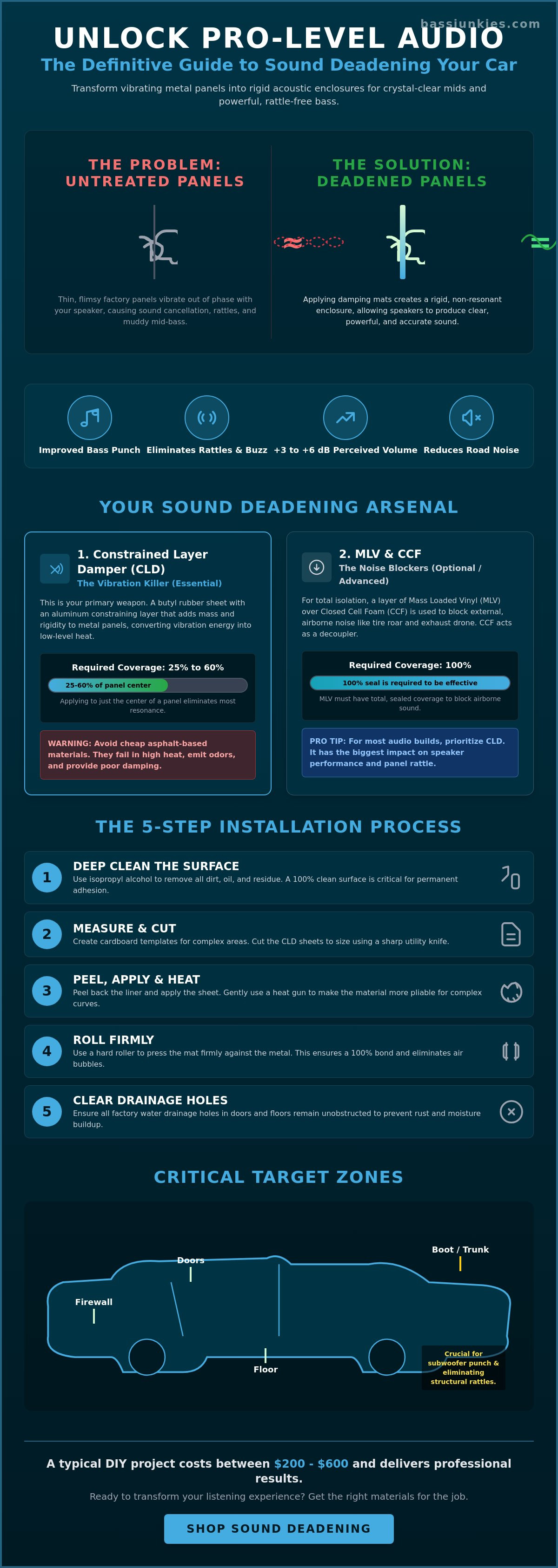
Your high-end speaker upgrade is essentially useless if you mount it to a vibrating tin can. To effectively learn how to sound deaden a car for audio, you must apply Constrained Layer Damper (CLD) mats to 25% to 60% of metal panels to kill structural vibrations. For total isolation, install a 100% coverage layer of Mass Loaded Vinyl (MLV) over the floor and firewall to block external road noise. This combination transforms your vehicle doors into rigid acoustic enclosures, allowing your car speakers to deliver crystal-clear mids and thumping bass without annoying rattles.
You've likely spent a fortune on gear only to have it drowned out by tire roar and buzzing plastic. We promise to help you eliminate those distractions and achieve a "luxury car" quiet cabin using professional techniques. This expert guide breaks down the exact steps to install materials like Dynamat Xtreme, ensuring your DIY project stays within the $200 to $600 range while hitting professional performance standards. Follow this guide to prepare your vehicle for the ultimate audio experience.
Key Takeaways
- Use Constrained Layer Damping (CLD) as your primary vibration-killing layer and avoid cheap asphalt-based materials that peel in high temperatures.
- Master how to sound deaden a car for audio by prioritizing deep surface cleaning to ensure a permanent, 100% contact bond with the metal.
- Target the boot and rear parcel shelf specifically to eliminate structural rattles and maximize the punch of high-powered car sub woofers.
- Apply heat to the damping sheets during installation for better flexibility and ensure you leave drainage holes clear to prevent moisture build-up.
- Transform thin metal panels into rigid acoustic enclosures to allow your car speakers to deliver crystal-clear audio without distortion.
What is Sound Deadening and Why Does Your Audio Need It?
To master how to sound deaden a car for audio, you must apply specialized high-mass damping materials to your vehicle's metal panels to eliminate structural resonance. Most factory doors are thin, vibrating sheets that act like a second speaker out of phase, which causes massive sound cancellation and kills your mid-bass. By adding professional-grade damping mats, you transform those flimsy panels into rigid, sealed enclosures that allow your car speakers to produce the punchy, accurate sound they were designed for. This process is the secret to achieving crystal-clear audio even at high volumes.
Sound deadening isn't just about silence; it's about total acoustic control. When a powerful car sub woofer hits a low note, it sends massive energy through the entire vehicle frame. Without treatment, those panels rattle and buzz, which muddies your soundstage and ruins the listening experience. Professional deadening increases the perceived volume and clarity of your system by 3dB to 6dB simply by lowering the noise floor and stopping energy loss through the chassis. It's the most cost-effective way to make a mid-range system sound like a premium competition build.
The Difference Between Deadening and Blocking
Vibration deadening and sound blocking are two distinct stages of a pro build. Deadening focuses on the principles of soundproofing related to damping, where you use heavy butyl sheets to stop metal from ringing like a bell. Blocking involves using a dense barrier, like Mass Loaded Vinyl (MLV), to stop external air-borne noise from entering the cabin. For audio enthusiasts, killing the vibration is the absolute priority because it directly impacts speaker performance and stops the annoying buzz of plastic trim panels.
Why Factory Sound Insulation Fails
Car manufacturers build vehicles for the masses, which means they cut weight to meet fuel efficiency targets and keep production costs low. You might find a small patch of felt or a thin bit of foam inside your door, but these are typically designed for thermal insulation or minor wind noise reduction. They do nothing to support the massive air pressure generated by high-performance car amplifiers. Sound Deadening is the essential foundation for any professional car audio build because it corrects these structural weaknesses before you even install your first component.
Choosing the Right Materials: CLD vs. CCF vs. MLV
To successfully execute how to sound deaden a car for audio, you must select high-mass materials that specifically target vibration and air-borne noise. Constrained Layer Damping (CLD) is the most critical component for any audio build. You must use butyl rubber sheets with an aluminum constraint layer to stop metal panels from ringing like a bell. Avoid asphalt-based products; they fail in high temperatures, emit toxic odors, and eventually peel off your door skins. For a professional result, the Dynamat Xtreme Sound Deadening Kits are the industry gold standard for maximizing speaker performance and cabin silence.
Selecting the wrong material can ruin your interior and provide zero acoustic benefit. High-quality butyl rubber offers superior damping without the excessive weight of older asphalt technologies. It remains flexible across a wide temperature range, ensuring your car speakers always have a rigid, non-resonant mounting surface. If you want to stop the buzz and hear the music, check out our massive range of sound deadening accessories to find the right kit for your vehicle.
CLD Sheets (The Vibration Killer)
CLD sheets consist of a sticky butyl layer topped with a heavy aluminum foil. This aluminum layer adds massive rigidity to the butyl, forcing vibration energy to convert into low-level heat rather than noise. Use the "tap test" by knocking on your car's exterior panels before installation. If it sounds like a hollow tin can, it needs treatment. While a 100% coverage layer provides the ultimate silence, applying CLD to just 25% to 50% of the center of a panel often eliminates 90% of resonant noise. The Dynamat Xtreme Bulk Pack, which includes 9 sheets covering 36 sqft, is the perfect starting point for most door and trunk projects.
Closed Cell Foam (The Decoupler)
Closed Cell Foam (CCF) doesn't stop vibrations on its own, but it is essential for stopping high-frequency plastic squeaks. It acts as a "decoupler" between the metal door skin and the plastic door card. By placing a sandwich layer of CCF between these surfaces, you prevent the two panels from rubbing together during heavy bass hits. This is the secret to a rattle-free cabin when pushing massive power from your car amplifiers. CCF also provides a secondary thermal barrier, helping to keep your cabin temperature stable while you enjoy crystal-clear audio.
How to Install Sound Deadening: A 5-Step Process
To master how to sound deaden a car for audio, you must follow a systematic installation process focused on surface preparation and mechanical bonding. Start by removing all interior trim and cleaning the bare metal with a high-strength degreaser like Isopropyl alcohol to ensure the butyl adhesive sticks permanently. Measure and cut your CLD sheets to fit the flattest, most resonant areas of the door's outer skin. Apply the material firmly and use a metal roller to flatten the foil pattern, which indicates a 100% airtight bond. This technical approach stops panel vibration and creates a solid acoustic environment for your car speakers.
Preparation is 90% of the job. If you apply high-end damping sheets to a dusty or oily surface, they will eventually peel off, especially in the heat of a UK summer. Work in manageable sections rather than trying to apply one massive sheet at once. This ensures you get 100% contact with the metal and allows you to work around internal door braces and window tracks. Focus your efforts on the outer skin of the door first, as this is the primary source of resonance that interferes with your mid-bass drivers.
Tools Required for the Job
Don't start this project without the right gear. You'll need a set of nylon panel removal tools to pop door cards without snapping the plastic clips. A high-quality degreaser is non-negotiable for surface prep. For the application itself, a heavy-duty metal or wooden roller from our car audio accessories range is essential to activate the pressure-sensitive adhesive. Finally, keep a sharp utility knife and a tape measure handy for precise cuts.
The Step-by-Step Application
- Step 1: Strip and Clean. Remove the door cards and carefully peel back the factory weather shield. Use your degreaser to wipe down every inch of the inner metal until your cloth comes away clean.
- Step 2: Measure and Cut. Use card templates or a tape measure to size up the flat sections of the metal. Cut your CLD sheets into smaller, workable rectangles to make placement easier inside tight door cavities.
- Step 3: Peel, Stick, and Roll. Press the sheet onto the metal and use your roller to push out all air bubbles. You must roll the material until the embossed pattern on the foil is completely flat, ensuring the butyl is fully bonded.
- Step 4: Reassemble and Test. Reinstall your speakers and trim panels. Perform a "bass test" using a high-output track to check for any missed rattles or loose cables that need securing with foam tape.
By following these steps, you ensure your car amplifiers are driving the air, not the metal. A properly treated door should sound like a solid thud when you tap the exterior, rather than a hollow ring. This foundation is what separates a basic install from a professional, high-fidelity sound system.
Targeting Critical Areas for Maximum Bass Impact
To maximize bass impact, you must target the boot floor, the boot lid, and the inner door baffles. Applying CLD mats to these specific areas stops the metal from flexing under the pressure of high-output car subwoofers. This prevents energy loss and ensures every watt of power is converted into sound rather than panel vibration. Sealing the door baffles turns your door into a dedicated enclosure, which is the secret to getting a thumping mid-bass response from your car speakers.
The boot area is the primary battleground for any subwoofer build. When a sub hits, it creates massive air pressure that forces the metal panels to expand and contract. This flexing effectively subtracts from your total bass output by wasting energy. Treating the boot floor and wheel arches with heavy-duty damping sheets kills this resonance. It tightens up the low-end and makes your bass feel more immediate and punchy.
The Boot Lid and Number Plate
The boot lid is often the loudest rattle on a modified car because it's a large, unsupported sheet of metal. Applying sound deadening to the boot lid tightens car subwoofers response by preventing the lid from acting like a massive, out-of-tune diaphragm. Don't forget the back of the number plate. This is the most common cheap rattle source that ruins a high-end build. Use a small scrap of butyl or foam tape from our installation accessories to decouple the plate from the car body.
Sealing the Door Baffles
Most car doors have large access holes in the inner metal skin for window regulators and locks. These holes allow the "back wave" of the speaker to meet the "front wave," causing phase cancellation that destroys your mid-bass. When you learn how to sound deaden a car for audio at a professional level, you realize that sealing these inner holes is vital. Use sound deadening sheets to cover these large openings completely. This seals the door cavity and creates a rigid box for your mid-bass drivers, resulting in a massive increase in vocal clarity and impact.
Rear parcel shelves are also notorious for rattling under heavy low-end pressure. Secure these with a mix of CLD and closed-cell foam to stop high-frequency plastic buzzes. For high-SPL builds, you must also address the roof. A flexing roof panel can actually cause a drop in measurable decibels during a competition. Adding structural damping to the roof prevents this "oil-canning" effect and keeps all that thumping sound energy inside the cabin.
Check out our professional sound deadening kits to start sealing your vehicle for maximum performance.
Bassjunkies Pro Tips for a Flawless Finish
Professional sound deadening requires heating butyl sheets to at least 20 degrees Celsius for maximum pliability during cold-weather installations. To master how to sound deaden a car for audio, you must double-layer the area directly behind your mid-bass drivers to neutralize back-wave energy and stop panel flex. Always maintain a 10mm clearance around drainage holes and door latch cables to prevent mechanical failure or water ingress. Use a high-density Closed Cell Foam (CCF) on the back of the plastic door card to decouple it from the treated metal skin. These finishing touches ensure your car speakers perform with maximum efficiency and zero rattles.
If you're tackling a full-vehicle project, check out our latest offers for bulk deadening packs. Buying in volume is the best way to get professional results while securing huge savings on premium materials. A single bulk pack can often cover four doors and a boot floor, providing enough material to transform your cabin's acoustic profile completely. We recommend using a heat gun or hair dryer to warm the sheets if you're working in a cold UK garage to ensure the adhesive reaches its maximum bonding strength.
Common Mistakes to Avoid
Never cover moving parts like window tracks or door latch rods with damping material. This leads to mechanical jams and expensive repairs that require stripping the door down again. Failing to roll the material properly is another critical error that many DIYers make. Trapped air pockets between the butyl and the metal can collect condensation, which eventually leads to hidden rust. Always roll from the center outward until the foil is completely smooth and the embossed pattern is flattened.
Many installers ignore the plastic door card itself. Even if the metal is deadened, the plastic panel will still vibrate against the door skin under the pressure of a high-power car amplifier. Apply a layer of CCF or egg-crate foam to the back of the trim to kill high-frequency squeaks. This creates a silent, luxury car feel that lets your music shine without interference.
When to Call the Experts
Modern vehicles are packed with side-impact sensors, complex airbag wiring, and delicate fiber-optic cables. If you're worried about triggering a dashboard error or damaging a clip, it's time to call in the pros. Bass Junkies provides expert advice and professional installation services for those who want a guaranteed rattle-free ride without the DIY stress. We understand the intricate details of vehicle disassembly and high-end integration.
Visit our Wolverhampton workshop for a full system tuning and professional deadening install. Our team can integrate high-performance car sub woofers and car stereos with precision damping to ensure your system sounds its absolute best. We don't just sell the gear; we're the UK's No. 1 specialist for making it perform at a competition level.
Ready to Kill the Rattles and Boost Your Bass?
Mastering how to sound deaden a car for audio is the single most effective way to unlock the true potential of your high-end system. By killing structural resonance with butyl-based CLD sheets and decoupling trim with closed-cell foam, you create the perfect acoustic environment. This technical foundation ensures your car speakers deliver crystal-clear mids while your subwoofers provide a thumping, tight response without the distraction of vibrating metal or road noise.
Bass Junkies has been the UK’s No. 1 specialist providing expert advice since 1995. We stock massive inventory levels of the industry's best materials, ensuring you get professional results every time. You'll find huge savings on top-tier brands like Dynamat and more in our online store. Don't let thin factory metal ruin your audio experience any longer.
Grab your roller and get to work on your build today. Shop the Ultimate Range of Sound Deadening Kits at Bassjunkies and start enjoying the high-performance sound you deserve. Your ears will thank you when those bass lines hit harder than ever before.
Frequently Asked Questions
Does sound deadening actually make my car audio louder?
Sound deadening increases the perceived volume of your system by 3dB to 6dB by significantly lowering the cabin's noise floor. It doesn't increase the raw wattage of your car amplifiers, but it prevents energy from being wasted on vibrating metal panels. By eliminating this structural resonance, your speakers don't have to fight against background noise, resulting in a much more powerful and clear audio experience.
How much sound deadening do I need for a standard car door?
You typically require between 4 and 6 square feet of material to treat a single standard car door skin effectively. While applying CLD mats to just 25% of the panel surface kills the majority of structural resonance, 100% coverage is recommended for those seeking a total acoustic seal. This full coverage turns the door cavity into a dedicated speaker enclosure, which is essential for maximizing mid-bass response.
Will adding sound deadening make my car significantly heavier?
A full-vehicle sound deadening project typically adds between 20kg and 35kg to the total weight of the car. This is roughly equivalent to carrying a single suitcase or half a tank of fuel in the boot. For most drivers, this minimal weight gain is unnoticeable in terms of fuel economy or acceleration, especially compared to the massive improvement in cabin silence and audio fidelity.
Can I install sound deadening myself or do I need a pro?
Most enthusiasts can successfully master how to sound deaden a car for audio as a DIY project using basic tools like a roller and degreaser. It is a straightforward process of stripping trim, cleaning surfaces, and rolling down the damping sheets. However, if your vehicle features complex side-impact sensors or fiber-optic door wiring, our Wolverhampton workshop provides professional installation to ensure your factory electronics remain untouched.
What is the best sound deadening material for bass?
High-mass butyl rubber sheets, known as Constrained Layer Dampers (CLD), are the best materials for controlling heavy bass. These mats are specifically designed to stop metal panels from flexing when car sub woofers move large volumes of air. Using a premium product like Dynamat Xtreme ensures the material won't peel or lose its damping properties even when exposed to the extreme vibrations of a high-SPL system.
Does sound deadening help with road noise on the motorway?
Sound deadening significantly reduces motorway noise by stopping the floor pan and wheel arches from vibrating like a drum. While CLD sheets kill the structural "hum" of the road, adding a secondary layer of Mass Loaded Vinyl (MLV) is the most effective way to block external wind and tire roar. This multi-layer approach can reduce interior noise levels by as much as 10dB on rougher road surfaces.
Can sound deadening cause rust inside my car doors?
Sound deadening only causes rust if it is installed poorly, leaving air pockets where condensation can collect against the bare metal. You must use a heavy-duty metal roller to ensure a 100% airtight bond between the butyl and the door skin. Always leave the factory drainage holes at the bottom of the door clear to allow moisture to exit the vehicle naturally.
How do I stop my boot from rattling when the sub hits?
Stop boot rattles by applying CLD mats to the flattest areas of the boot lid and the spare wheel well. These panels flex the most under the intense air pressure generated by high-output car sub woofers. You should also check the mechanical latch and the number plate, as these often require a small piece of closed-cell foam to decouple them from the vibrating bodywork.