

Successful car audio system planning for beginners requires a modular approach that prioritizes the signal source and power foundation before buying flashy components. You must match the RMS power output of a 4-channel amplifier to your speakers' handling capacity to prevent hardware failure and ensure crystal-clear sound. In 2026, entry-level systems start around £120, while mid-range setups featuring 5G connectivity or Pioneer SPHERA Dolby Atmos receivers range from £450 to £800. This structured strategy ensures total vehicle compatibility and stops you from wasting money on mismatched hardware.
You're likely worried about blowing expensive speakers with the wrong amp or ending up with a rattling mess after spending your hard-earned money. It's a common fear, but 70% of UK enthusiasts now prioritize sound clarity and ease of use over raw volume. We promise to help you build a high-performance system that integrates perfectly with your smartphone and delivers thumping bass. This guide previews the ultimate shopping list, from Kenwood DMX908S head units to Dynamat Xtreme sound deadening kits, to get your install right the first time.
Key Takeaways
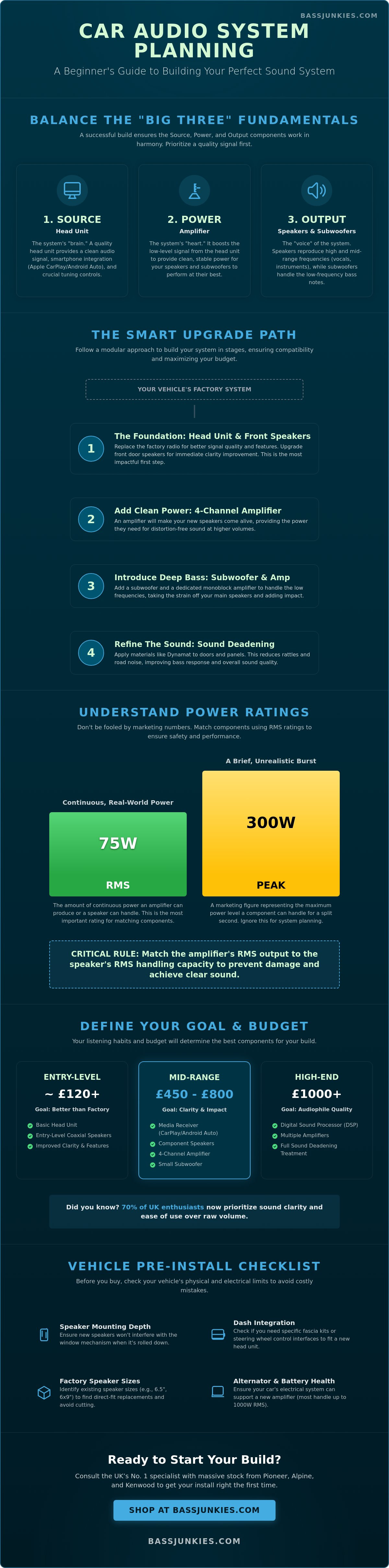
- Define your primary audio goals by balancing the "Big Three" fundamentals: Source, Power, and Output.
- Master car audio system planning for beginners by prioritizing a high-quality head unit to improve signal quality and smartphone integration.
- Calculate all power requirements using RMS ratings instead of Peak values to ensure your amplifier safely matches your speaker handling.
- Follow a modular upgrade path by replacing the factory head unit and front door speakers before adding subwoofers or external amplification.
- Consult with the UK’s No. 1 specialist to ensure total vehicle compatibility with massive stock levels from brands like Pioneer, Alpine, and Kenwood.
How do you start car audio system planning for beginners?
Successful car audio system planning for beginners starts by auditing your current factory setup and defining a clear performance goal: crystal-clear clarity, raw volume, or thumping bass. You must focus on the "Big Three" of car audio: the Source (head unit), Power (amplifiers), and Output (speakers and subwoofers). A professional plan ensures all components share compatible RMS power ratings to avoid blowing hardware. By taking a modular approach, you can upgrade in stages, starting with a new head unit to improve signal quality before adding amplification. This prevents wasted spend on mismatched gear and ensures your system integrates perfectly with your vehicle's electrical capacity.
Planning involves assessing your factory system, setting a budget, and choosing components that share compatible power ratings (RMS). Most beginners make the mistake of buying a massive subwoofer without considering how the factory radio will send it a signal. We recommend a modular strategy. Replace the "brain" of the system first by browsing our range of car stereos to unlock better equalization and smartphone features. This foundation allows you to add power later without replacing parts you've already bought.
Defining your sound profile
Your music taste dictates your hardware. Audiophiles seeking accuracy should prioritize car speakers with high-quality crossovers and silk-dome tweeters. If you want a street machine that rattles mirrors, your plan must include a high-excursion car sub woofer and a dedicated monoblock amplifier. For those starting out in the UK, a realistic budget for a stage-one upgrade often begins around £150 for a basic receiver and entry-level speakers. Understanding this comprehensive guide to vehicle audio helps you see how different frequencies require specific hardware to replicate sound faithfully.
Assessing your vehicle's limitations
Don't buy gear until you've checked your car's physical and electrical limits. Modern UK vehicles often have integrated dash screens that require specific Connects2 fascia kits or steering wheel interfaces to maintain factory controls. You need to identify factory speaker sizes, commonly 6.5-inch or 6x9-inch, to avoid drilling new holes. Check your alternator's output; most standard cars handle up to 1,000W RMS before requiring a "Big Three" wiring upgrade or a second battery. Use fitting accessories like Dynamat Xtreme to stop panels from vibrating, which is a common issue in smaller hatchbacks.
- Check mounting depth: Ensure your new speakers don't hit the window glass when it's rolled down.
- Battery health: A tired battery won't support a high-current car amplifier.
- Signal path: Decide if you're keeping the factory head unit using a Line Output Converter or going for a full aftermarket swap.
What are the essential components of a modern car audio system?
A modern car audio system relies on four core hardware categories: the head unit, speakers, subwoofers, and amplifiers. The head unit acts as the "brain," processing the audio signal and providing the user interface for your music. Speakers reproduce the mid and high frequencies for vocal clarity, while subwoofers handle the low-end thumping bass that standard drivers can't reach. Amplifiers provide the raw voltage required to drive aftermarket gear to its full potential. Effective car audio system planning for beginners requires understanding how these parts interact to create a balanced, high-performance soundstage.
Your hardware choices determine the final impact of your install. While factory systems often use cheap materials, aftermarket components use superior magnets and cones to handle more power. Integrating these parts correctly ensures you don't blow a speaker or clip your signal. We recommend focusing on the signal source first, as even the best speakers will sound poor if they're receiving a distorted signal from a low-quality head unit.
Choosing a head unit with smartphone integration
The head unit is the most critical part of your signal chain. In 2026, wireless Apple CarPlay and Android Auto are essential features for safe, hands-free navigation and high-resolution streaming. You'll need to choose between a Single-DIN (2-inch tall) or Double-DIN (4-inch tall) fitment depending on your dashboard aperture. Upgrading to a modern receiver like the Sony XAV-AX3250 ensures your system has the processing power to deliver crystal-clear audio. You can view our latest range of stereos to find the perfect fit for your dash.
Speakers: Coaxial vs. Component
Replacing factory paper cones with high-quality aftermarket speakers provides immediate vocal clarity. Coaxial speakers are the easiest upgrade for beginners because they feature the tweeter mounted directly over the woofer in a single unit. For enthusiasts seeking a better soundstage, component speakers separate the tweeter from the woofer. This allows you to mount high-frequency drivers at ear level for better imaging. Always check your door's mounting depth before buying. High-performance models like the Focal PS 165 FXE offer massive improvements in detail but often require more space than basic factory units.
The role of the car subwoofer
A dedicated car subwoofer reproduces the deep frequencies that smaller door speakers simply cannot handle. Adding a sub takes the mechanical strain off your speakers, allowing them to play mid-range frequencies with less distortion. If space is tight in a small UK hatchback, an active (powered) subwoofer includes a built-in amp for a compact solution. Passive subs require an external amplifier but offer more customization for enclosure types. Explore our subwoofers collection to find the right balance of power and boot space.
Once you've selected your core components, ensure you have the right wiring and fitting accessories to keep the signal clean and the installation professional.
How do you calculate power and wiring requirements?
Calculating power and wiring requirements involves matching the Continuous Power (RMS) of your amplifier to the handling capacity of your speakers. For car audio system planning for beginners, you must ignore "Peak" or "Max" power ratings because these figures represent short bursts rather than sustainable performance. A high-performance setup requires a 4-channel amplifier or monoblock that delivers between 75% and 150% of your speakers' rated RMS. Use 100% Oxygen-Free Copper (OFC) wiring to ensure maximum current flow without dangerous voltage drops. This technical precision prevents equipment failure and ensures your system stays crystal-clear at high volumes.
Your power strategy determines the longevity of your gear. If you provide too little power, you'll likely turn the gain up too high, causing "clipping" that destroys speaker voice coils. Providing slightly more power than the speaker is rated for is actually safer. It provides headroom, allowing the amplifier to run efficiently without straining. This balance is the secret to achieving that thumping, effortless sound found in professional builds.
Matching RMS for system synergy
RMS is the continuous power a component can handle without distortion. Following the 75% to 150% rule ensures your amplifier isn't working at its absolute limit, which reduces heat and improves sound quality. If you're running a 100W RMS speaker, an amp delivering 125W RMS is ideal. This setup allows for "clean" peaks in your music. It stops the signal from flattening out and sounding muddy when the bass hits.
Selecting the right wiring and accessories
High-quality cables are the most underrated part of any install. Copper-Clad Aluminium (CCA) is common but has higher resistance and can corrode in the UK's damp climate. Always choose 100% Oxygen-Free Copper (OFC) for your power and ground leads. You must also install a fuse within 12 inches of the battery to protect your vehicle from electrical shorts. Check out essential accessories for professional wiring kits that include the correct gauge wire and fuse holders for your specific power draw.
The foundation: Sound deadening
Even the best speakers sound thin if they're mounted in a vibrating metal door. Sound deadening is the essential foundation for car audio system planning for beginners. It converts panel vibration into low-grade heat, effectively turning your car door into a sealed speaker cabinet. Using sound deadening kills road noise and stops the annoying rattles that ruin high-end audio. We recommend Dynamat Xtreme for treating door skins and boot floors. It makes your mid-bass punchy and your cabin significantly quieter on the motorway.
What is the best upgrade path for a factory sound system?
The best upgrade path for a factory sound system follows a four-step modular process starting with the head unit. Replacing the factory radio improves signal quality and adds modern features like DAB+ and wireless smartphone integration. Next, upgrading the front door speakers provides immediate vocal clarity. The third stage involves adding a dedicated 4-channel amplifier and a subwoofer for thumping bass. Finally, applying sound deadening kits refines the output by eliminating rattles. This structured approach to car audio system planning for beginners prevents you from buying redundant hardware while allowing for budget-friendly development.
By following this sequence, you ensure that every new component has a high-quality signal to work with. Jumping straight to a subwoofer without upgrading the head unit often results in muddy, distorted bass. We recommend focusing on the front soundstage first because that's where you'll hear the most detail. This method is far more effective than trying to install a full system in a single weekend without a clear plan. It allows you to appreciate the incremental improvements in sound quality as you build toward your ultimate setup.
Phase 1: Improving the source
A modern head unit is the foundation of your signal chain. Most factory units are underpowered, often delivering less than 15W RMS per channel. Upgrading to a Pioneer or Alpine receiver increases the clean power sent to your speakers, reducing distortion at high volumes. You also gain essential 2026 tech like DAB+ digital radio and Bluetooth 5.0 for seamless streaming. For a deeper look at how to structure your build, read our car audio buying guide.
Phase 2: Adding the punch
Once your signal is clean, you need the raw power to drive high-quality aftermarket drivers. An external amplifier is mandatory if you want to experience the full dynamic range of your music. You can choose a 4-channel amplifier to power your front and rear speakers, or a dedicated monoblock for a heavy-hitting subwoofer. This stage transforms your vehicle from a basic commuter into a high-performance sound machine. Explore our amplifiers to find the right power match for your system's RMS requirements.
Building in stages ensures each component complements the next. Start your journey today and upgrade your dashboard with a new stereo screen to take control of your audio. We hold massive stock levels of the UK's top brands to help you get the job done right.
Why choose Bassjunkies for your beginner car audio project?
Bassjunkies is the UK’s No. 1 specialist for car audio system planning for beginners, providing over 30 years of technical authority to help you build the ultimate setup. We maintain massive stock levels of premium hardware from Pioneer, Alpine, and Kenwood, ensuring immediate availability for your project. Our team offers direct access to expert advice, helping you navigate complex vehicle compatibility and RMS power matching to prevent equipment failure. We provide nationwide delivery and unbeatable savings on the latest DAB+ receivers, high-performance amplifiers, and bespoke fitting kits. This combination of industry expertise and massive inventory makes us the only choice for enthusiasts seeking crystal-clear sound and thumping bass.
Reliability is critical when you're modifying your vehicle's electrical system. We aren't a faceless corporate retailer; we're a team of enthusiasts who are just as obsessed with sound quality as you are. This means we only supply genuine UK stock with full manufacturer warranties and dedicated technical support. Our results-oriented approach moves you quickly from a weak factory setup to a professional-grade sound machine. We focus on the specifications that actually matter, from MOSFET power outputs to precise 2-DIN fitments.
Expert advice you can trust
Compatibility is the biggest hurdle for any beginner. Our team helps you navigate complex wiring looms and Connects2 steering wheel interfaces before you spend a penny. We provide the technical specs that big-box retailers ignore, such as impedance matching for 4-ohm speakers and amplifier fuse ratings. This expert guidance eliminates the fear of blowing your new speakers with the wrong power source. Visit our brands page to see our authorized partners and explore the ultimate range of car audio technology.
The complete solution
We provide every component of the signal chain in one place. Whether you need a Nextbase dash cam for safety or a JL Audio CP112-W0v3 for massive bass, we have it ready for dispatch. Our inventory includes everything from Dynamat Xtreme sound deadening kits to high-resolution Sony head units. We also offer professional installation services for those seeking a factory-perfect finish that eliminates rattles and vibrations. Check out our latest offers for massive savings on beginner kits and start your high-performance audio journey today.
Ready to Transform Your Factory Sound?
Mastering car audio system planning for beginners means moving beyond cheap factory paper cones and underpowered head units. You've learned that matching RMS ratings and using 100% Oxygen-Free Copper wiring prevents equipment failure while delivering crystal-clear audio. By treating your doors with sound deadening and upgrading in logical stages, you avoid wasted spend and achieve that thumping bass you crave. This modular approach ensures your system remains compatible with your vehicle's electrical limits as it grows.
Since 1995, we've helped thousands of UK enthusiasts build high-performance systems. We're an authorised UK dealer for Pioneer, Alpine, and Kenwood, offering nationwide delivery on massive stock levels. We're ready to provide the expert advice you need to get your installation right the first time. Build your dream system with the UK’s No. 1 car audio specialists at Bassjunkies.
Don't settle for flat, lifeless sound during your commute. Take the first step today and turn your car into a high-octane concert hall on wheels.
Frequently Asked Questions
Can I keep my steering wheel controls with an aftermarket stereo?
Yes, you can maintain your factory steering wheel functions by using a Connects2 Steering Wheel Control Interface. These vehicle-specific adapters bridge the gap between your car's digital CAN-bus system and the new head unit's input. It's a critical part of car audio system planning for beginners to ensure you don't lose the convenience of volume and track skipping buttons after the upgrade.
What is the difference between peak power and RMS power?
RMS power measures the continuous wattage a component handles safely, whereas peak power refers to the maximum burst it can survive for a fraction of a second. You should always ignore the "Peak" numbers on the box, as they're often inflated for marketing. Successful system planning relies 100% on matching the RMS output of your amplifier to the RMS handling of your speakers to prevent thermal failure.
Do I need a new battery for a high-powered car audio system?
Most standard UK car batteries can support systems up to 1,000W RMS without needing a replacement. If your total current draw exceeds this, or if your headlights dim during heavy bass tracks, you should upgrade to a high-performance AGM battery. For extreme builds, a "Big Three" wiring upgrade to the alternator and ground points is more effective than just adding a second battery.
Will a new head unit make my factory speakers sound better?
A new head unit provides a massive improvement in sound quality because it delivers a cleaner, more powerful signal than factory receivers. Most aftermarket stereos feature built-in MOSFET amplifiers that provide around 20W to 22W RMS per channel, which is often double the output of a standard factory radio. You'll also benefit from advanced 13-band graphic equalisers to fine-tune the audio for your specific cabin.
What is the best way to stop my car doors from rattling with bass?
Applying a Dynamat Xtreme Sound Deadening Kit to the inner and outer door skins is the most effective way to eliminate rattles. This material adds mass to the thin metal panels, reducing road noise by up to 3dB and stopping the vibrations caused by high-excursion speakers. It effectively turns your hollow door into a sealed speaker cabinet, which significantly tightens the mid-bass response.
Can I install a car audio system myself as a beginner?
You can definitely install a system yourself by using plug-and-play wiring harnesses and vehicle-specific fascia kits. Car audio system planning for beginners is much easier in 2026 because manufacturers now produce "T-harnesses" that avoid the need for cutting any original factory wires. However, if your project involves drilling into the firewall for heavy-gauge power cables, professional installation is recommended to ensure safety.
What gauge power wire do I need for a 500W amplifier?
An 8-gauge 100% Oxygen-Free Copper (OFC) cable is the industry standard for a 500W RMS amplifier. You must avoid cheap Copper-Clad Aluminium (CCA) wires because they have 40% higher resistance and can overheat under heavy loads. Using the correct gauge ensures your amplifier receives the full 14.4V from the alternator, which is essential for maintaining thumping, distortion-free bass.
Is a 2-DIN stereo compatible with my older car model?
A 2-DIN stereo is compatible if your dashboard aperture measures approximately 100mm tall by 180mm wide. Many older UK models originally fitted with 1-DIN slots can be converted using a custom fascia panel, though some require minor internal dash trimming. If a full 2-DIN conversion isn't possible, "floating" screens like the Alpine Halo series provide a massive display that fits into a standard 1-DIN slot.