
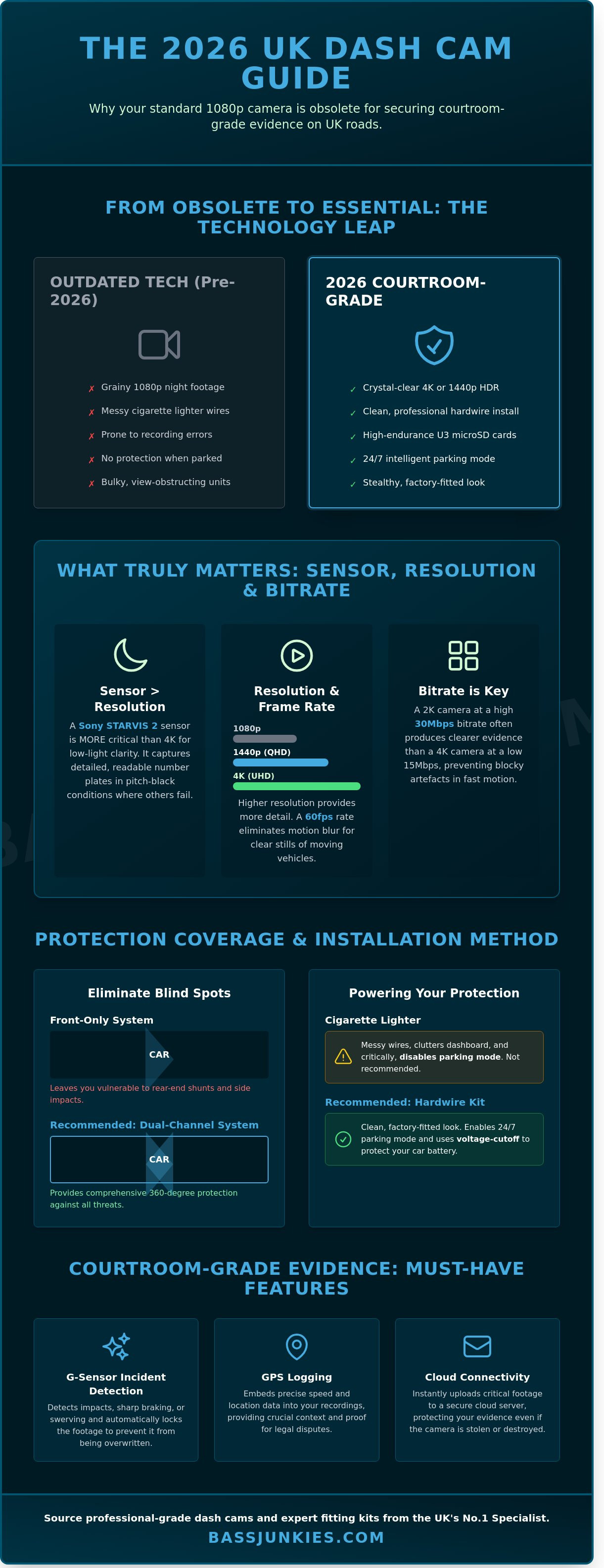
A standard 1080p camera is no longer enough to protect your no-claims bonus on UK roads in 2026. To secure courtroom-grade evidence, a reliable dash cam for car must feature a Sony STARVIS 2 sensor for low-light clarity and a hardwire kit with a built-in voltage-cutoff to prevent battery drain. High-endurance U3 microSD cards are essential to stop the recording errors that plague cheap setups. Professional installation via the fuse box eliminates messy hanging wires and enables 24/7 parking mode protection.
You're likely fed up with grainy night-time footage and bulky units that clutter your windscreen view. It's time to move past basic hardware and invest in a system that delivers crystal-clear results during an insurance claim. This guide reveals the technical specifications and sensor technology required to choose a unit that stands up to legal scrutiny.
You'll discover how to master 4K bitrate settings, select the right lens apertures, and execute a stealthy installation for ultimate on-road protection.
Key Takeaways
- Understand why Sony Starvis sensors and HDR technology are more critical than raw 4K resolution for capturing crystal-clear footage in low-light conditions.
- Compare front-only setups against dual-channel systems to eliminate blind spots and secure 360-degree protection against rear-end shunts.
- Master the benefits of hardwiring your dash cam for car to achieve a clean, factory-fitted look while enabling essential parking mode features.
- Identify the technical specifications, such as G-sensor incident detection and GPS logging, required to provide undeniable, courtroom-grade evidence.
- Discover how to source professional-grade Nextbase hardware and expert fitting kits from the UK’s No. 1 specialist for a high-performance install.
What is the best dash cam for a car in 2026?
The best dash cam for car owners in 2026 is a high-performance 4K unit that integrates AI-driven incident detection and real-time cloud connectivity. These dedicated digital video recorders capture every second of your journey to provide irrefutable evidence for insurance claims and legal disputes. Modern units provide 4K resolution, GPS logging, and G-sensor incident detection as standard features to ensure total road protection. High-end models prioritising cloud uploads ensure your footage is secure even if the device is stolen or damaged during a collision. Bass Junkies provides the UK's most reliable security and safety hardware to keep your vehicle protected 24/7. This technology is the ultimate shield for your No Claims Bonus and provides massive peace of mind on congested British roads.
Why resolution and frame rate matter
Resolution is your primary weapon against insurance fraud and hit-and-run incidents. While 1080p was once the standard, it is now the bare minimum for road safety in 2026. Enthusiasts and serious drivers demand 1440p (Quad HD) or full 4K resolution, which offers 3840 x 2160 pixels of clarity. High frame rates of 60fps are superior for freezing video frames to read moving number plates clearly at motorway speeds. Lower-quality sensors often suffer from motion blur, which makes critical evidence useless during high-speed incidents. Crystal-clear optics are the only way to guarantee you have the proof you need when it matters most.
- 4K Resolution: Provides four times the detail of standard HD for identifying faces and small details.
- 60fps Frame Rate: Eliminates stutter and allows for smooth slow-motion playback of accidents.
- Night Vision Sensors: Utilise massive dynamic range to capture clear footage in pitch-black conditions.
The role of the G-Sensor and GPS
A G-sensor is a vital internal component that detects sudden physical movements like heavy braking, sharp swerving, or a direct collision. It automatically locks the current footage file to prevent it from being overwritten by the loop recording system. GPS logging adds another layer of protection by recording your precise speed and location data throughout your journey. This information is crucial for legal evidence in UK courts to prove you were not at fault. Dashcam technology and history shows how these devices have evolved from simple cameras into sophisticated data loggers that track every metric of a drive. Loop recording ensures your memory card never runs out of space by overwriting the oldest unprotected files, keeping the system active without manual maintenance.
The 2026 market prioritises AI-driven alerts that can predict potential collisions before they happen. These systems use advanced algorithms to scan the road for lane departures or rapid closing distances. When combined with cloud connectivity, your dash cam for car security can send instant notifications to your smartphone if someone bumps your vehicle while it is parked. This proactive approach to vehicle safety ensures that you are always in control of your car's security, whether you are behind the wheel or away from the vehicle.
Choosing between 4K resolution and high-dynamic range sensors
Selecting the right dash cam for car use requires a balance between raw pixel count and light sensitivity. 4K resolution provides 8.3 million pixels for crystal-clear daytime footage, but High Dynamic Range (HDR) is the critical specification for capturing readable details at night. While 4K looks impressive on paper, a high-bitrate 1440p camera often produces superior evidence because it processes more data per second. Industry-standard sensors like the Sony Starvis 2 are now the benchmark, offering massive improvements in low-light clarity over generic alternatives.
Bitrate is the unsung hero of video quality. A 4K camera with a low bitrate of 15Mbps will suffer from blocky artefacts during fast motion. Conversely, a 2K camera pushing 30Mbps keeps every frame sharp and usable for insurance claims. Viewing angles also play a role. Most experts recommend a 140-degree field of view. While 170-degree lenses capture more of the periphery, they often introduce fisheye distortion that makes distant objects look smaller. According to Car and Driver's 2026 dash cam tests, the best balance of field-of-view and clarity comes from premium glass lenses rather than cheap wide-angle plastic optics.
Night vision and low-light performance
Standard night vision often relies on software to artificially brighten the image, which creates digital noise and blur. True HDR sensors function differently by taking multiple exposures of the same frame and merging them instantly. HDR is the ability to retain detail in high-contrast lighting scenarios. This technology stops bright headlights from blowing out the image, ensuring reflective licence plates remain legible in pitch-black conditions. If you drive frequently after sunset, prioritising a Sony Starvis sensor over raw 4K resolution is the smarter move.
Memory card requirements for high-bitrate video
High-performance dash cams demand specialised storage to survive the heat and constant data flow. Standard SD cards fail quickly because they aren't designed for the relentless write cycles of high-definition video. You must use High Endurance microSD cards with U3 or V30 speed ratings to handle the data stream without corruption. A 128GB card typically holds 4 hours of 4K footage at high bitrate, while a 256GB card doubles that capacity to 8 hours before looping. Upgrading your storage is essential to ensure your dash cam for car doesn't drop frames during a critical incident.
Should you choose a front-only or front and rear dash cam system?
A front and rear dash cam system is the ultimate choice for total road protection, providing 360-degree evidence of any incident. While a front-only dash cam for car is easier to install, it leaves you vulnerable to the 25% of UK accidents that are rear-end collisions. Dual-channel systems record both angles simultaneously, ensuring you have the footage needed to fight "crash for cash" scams. For rideshare and taxi drivers, adding a third cabin-facing camera is essential for internal security and passenger management.
Front-only cameras are the entry-level standard for most drivers. They plug directly into the 12V socket or hardwire into the fuse box in minutes. However, these units leave a massive gap in your security. If a driver hits you from behind and claims you reversed into them, a front-facing lens cannot prove your innocence. You need that rear perspective to show the full context of the road.
The benefits of dual-channel coverage
Dual-channel systems record high-definition footage from the front and back of the vehicle at the same time. This creates a synced narrative that is vital for insurance claims. If you are targeted by a tailgating scam, the rear camera captures the aggressive driving behaviour before the impact. This level of detail is exactly what the Tom's Guide review of the Viofo A329S highlights as a game-changer for modern road safety.
Many drivers also want to improve their vision while reversing. If you need help with tight parking spots alongside your recording, check out our Reversing Camera Guide 2026 for the best hardware upgrades. Combining a dash cam with a dedicated parking camera provides the ultimate safety net for any UK driver.
Discreet vs. screen-based designs
Stealth cameras are the top pick for enthusiasts who want a clean, factory-look interior. These screenless units hide behind the rearview mirror and don't distract the driver with bright displays at night. You control the settings and view footage through a smartphone app. WiFi-enabled cams allow you to download crystal-clear 4K clips directly to your phone in seconds.
Screen-based units usually feature a 3-inch display that allows for instant playback without a phone. While helpful, these units have a larger footprint on the windscreen. UK MOT regulations are strict about obstructing the driver's view, so a small footprint is essential. Always mount your camera high up to ensure it stays outside the swept area of the windscreen wipers.
- Dual-channel systems cover the 25% of UK accidents that occur from the rear.
- Stealth designs offer a factory-look finish and reduce driver distraction.
- WiFi-enabled cameras allow for instant footage downloads at the roadside.
- Cabin cameras are a mandatory security upgrade for professional taxi and Uber drivers.
Frequently Asked Questions
Is a rear dash cam harder to install than a front one?
Yes, it requires more effort because you must run a cable from the front unit to the back window. Most enthusiasts tuck this cable under the roof lining or door seals for a hidden finish. It typically adds about 30 to 45 minutes to the total installation time.
Do I need a screen on my dash cam?
A screen is not necessary if the camera has built-in WiFi and a dedicated app. Screenless "stealth" models are often preferred because they are smaller and less likely to be spotted by thieves. You can still view, edit, and download all your footage via your smartphone.
Can a rear dash cam be used as a reversing camera?
Most rear dash cams are designed for recording only and do not provide a real-time parking feed. If you want a camera that helps with parking, you should look for a dedicated reversing camera kit. These systems trigger a live video feed on your head unit when you select reverse gear.
Hardwired vs cigarette lighter: How to install a dash cam properly
Hardwiring a dash cam for car is the most effective way to secure your vehicle and maintain a factory-standard interior. While cigarette lighter plugs provide a temporary solution, they leave trailing wires and fail to power the camera when the engine is off. Hardwiring involves connecting the unit directly to the fuse box with a dedicated hardwire kit. This method enables 24/7 Parking Mode, ensuring the camera records impacts even when the car is unattended. It also keeps the cabin clutter-free by hiding cables behind the vehicle trim. Professional installation is recommended to avoid interfering with curtain airbags and complex electrical systems.
- Hardwiring enables 24/7 Parking Mode surveillance.
- Cigarette lighter plugs occupy 12V ports and leave visible cables.
- Voltage cut-off sensors prevent vehicle battery drainage.
- Professional installation avoids interference with curtain airbags.
Cigarette lighter plugs are the entry-level choice for quick setups. They're fast to install but look amateur and untidy. The cables often dangle across the dashboard, which can distract drivers and ruin the aesthetic of a high-end cabin. Most UK vehicles cut power to the 12V socket when the ignition is off, meaning your camera dies the moment you park. Hardwiring eliminates these issues by creating a "stealth" install where no wires are visible, freeing up your charging ports for phones or sat-navs.
Understanding Parking Mode and battery protection
Parking Mode is the primary reason to hardwire your dash cam for car. High-quality hardwire kits feature an intelligent voltage cut-off, typically adjustable between 11.6V and 12.4V, which automatically shuts down the camera if the vehicle battery drops too low. This prevents a flat battery while allowing for motion-activated or time-lapse recording. Impact detection uses an internal G-sensor to lock footage if a collision is detected while the car is parked. This provides indisputable evidence for insurance claims involving "hit and run" incidents in car parks.
DIY vs Professional Fitting
Installing a kit yourself requires a circuit tester, nylon trim removal tools, and compatible fuse taps like Mini, ATO, or Micro2 types. You must locate a constant power source for the G-sensor and a switched ignition source for standard driving mode. Modern European cars often use CAN-bus wiring which is notoriously sensitive to DIY modifications. A single mistake can lead to expensive ECU errors or compromised safety systems. Professional installers ensure all wiring is tucked safely behind A-pillar trim, avoiding any interference with side-curtain airbags. For the best hardware, explore our security and safety collections to find kits designed for high-performance vehicles.
Upgrade your vehicle security with professional dash cam hardware here
Where to buy professional-grade dash cams and fitting kits in the UK?
Bassjunkies is the UK's premier destination for professional-grade dash cams and precision fitting kits. We stock the country's most comprehensive range of Nextbase models alongside high-spec dashboard cameras engineered for 2026 road conditions. Every dash cam for car purchase is backed by expert advice to ensure the hardware integrates perfectly with your specific vehicle and driving habits. You can access massive savings through our exclusive bundles which include high-speed endurance SD cards and professional hardwire kits. We guarantee fast national delivery on all in-stock security hardware to get your vehicle protected immediately.
The Bassjunkies Advantage
We aren't just another faceless retailer; we are industry specialists with over 30 years of hands-on installation experience. Our team understands the intricate details of vehicle electronics, from complex CAN-bus systems to 12V power management. You can find the latest accessories and fitting kits in our store to ensure a clean, "OEM-plus" installation. This means no messy wires trailing across your dashboard and a permanent, reliable power source for your camera. Our UK-based support team is always ready to provide technical guidance that generic retailers simply cannot match.
Choosing the right hardware is only half the battle. We help you select the ultimate memory solution, focusing on U3-rated endurance cards that handle constant overwrite cycles without failing. Our hardwire kits feature built-in battery protection to prevent your camera from draining your car's power during parking mode. This level of technical specificity ensures your investment actually works when you need it most. We pride ourselves on being the UK's No. 1 specialist for enthusiasts who demand performance and reliability.
Upgrading your total in-car experience
A professional dash cam for car installation is often the gateway to a full cabin transformation. You can combine your new security setup with a stereo screen upgrade to bring modern connectivity to an older cockpit. Many of our customers find that integrating a high-definition dash cam works best alongside a crystal-clear Apple CarPlay or Android Auto head unit. Safety and sound are the twin pillars of a great drive, and we have the gear to deliver both.
Don't settle for factory-standard limitations when you can have a high-performance sanctuary on wheels. Check our latest offers for unbeatable prices on security hardware and thumping audio components. Whether you're looking for a simple front-facing camera or a full 4K multi-channel surveillance system, we have the stock and the expertise to make it happen. Secure your vehicle today with the pros who live and breathe car technology.
Secure Your Ride With Professional 2026 Dash Cam Tech
Choosing a dash cam for car protection in 2026 means prioritising 4K resolution and high-dynamic range sensors to capture every plate detail. Dual-camera systems are essential for eliminating blind spots; while hardwiring ensures your vehicle stays protected 24/7. Don't settle for grainy footage when professional-grade optics are available for immediate dispatch.
Bass Junkies has been the UK's No. 1 specialist since 1995. We're a team of genuine car tech junkies who live for high-performance upgrades. We offer expert advice and next-day delivery on top-tier brands like Nextbase, ensuring you get the best tech without the wait. Our massive stock levels mean you'll find the perfect security solution for any vehicle type.
Protect your ride with our massive range of professional dash cams. Get your vehicle kitted out today and enjoy the peace of mind that comes with total on-road protection.
Frequently Asked Questions
Is it legal to have a dash cam in my car in the UK?
Yes, it's 100% legal to use a dash cam for car recording on UK roads. You must ensure the device doesn't obstruct your view; it shouldn't intrude more than 40mm into the swept area of your windscreen wipers. If the police deem your placement dangerous, you could face a £2,500 fine and three penalty points for driving a vehicle in a dangerous condition.
Do dash cams record when the car is parked and turned off?
Your dash cam will only record while parked if it's hardwired to your vehicle's fuse box or connected to an external battery pack. Standard 12V cigarette lighter sockets usually lose power when the ignition is killed. By using a hardwire kit, you enable "Parking Mode" which uses G-sensors to trigger recording if someone bumps your car or moves in front of the lens.
Will a dash cam lower my car insurance premium?
Several UK insurers offer direct discounts of up to 15% when you install a high-quality dash cam for car security. Providers like Adrian Flux and AXA recognise that video evidence fast-tracks claims and identifies "crash for cash" fraudsters instantly. Even if your specific insurer doesn't offer a discount, having crystal-clear 4K footage is the ultimate way to protect your hard-earned No Claims Discount after an accident.
Can dash cam footage be used against you in court?
Yes, dash cam footage is legally admissible in UK courts and can be used as evidence against you. Police have the power to seize your memory card if they believe it contains proof of a driving offence. While the camera is your best witness during a non-fault accident, it also records your speed and road positioning with absolute precision, leaving no room for excuses.
How long does a 128GB SD card last in a 4K dash cam?
A 128GB SD card typically stores between 120 and 240 minutes of 4K footage before the loop recording kicks in. High-bitrate 4K files are massive, often consuming 60GB of data for every hour of driving. To handle these intense write speeds, you must use a U3-rated high-endurance card designed for constant video looping, otherwise, you risk file corruption during a critical moment.
Do I need to tell people I am recording with a dash cam?
You don't need to inform passengers or pedestrians if you're recording for private use on public roads. However, if you use your vehicle for business, such as a taxi or delivery van, you're legally required to display a sign stating that CCTV is in operation. This ensures you stay on the right side of the UK Data Protection Act 2018 and GDPR requirements for commercial surveillance.
What happens to the footage when the SD card is full?
Modern dash cams use a "loop recording" feature that automatically overwrites the oldest unprotected files once the storage is maxed out. This creates a continuous cycle so your camera never stops filming mid-drive. Any footage captured during an impact is automatically "locked" by the internal G-sensor, preventing the system from deleting the most important evidence of a collision.
Can I install a dash cam myself or do I need a professional?
You can easily install a basic dash cam yourself by mounting it to the glass and plugging it into the 12V socket. However, for a clean, professional finish, we recommend a hardwired installation to hide all cables behind the interior trim panels. Hardwiring is the only way to get a permanent power feed for 24/7 parking protection without having messy wires dangling across your dashboard.