
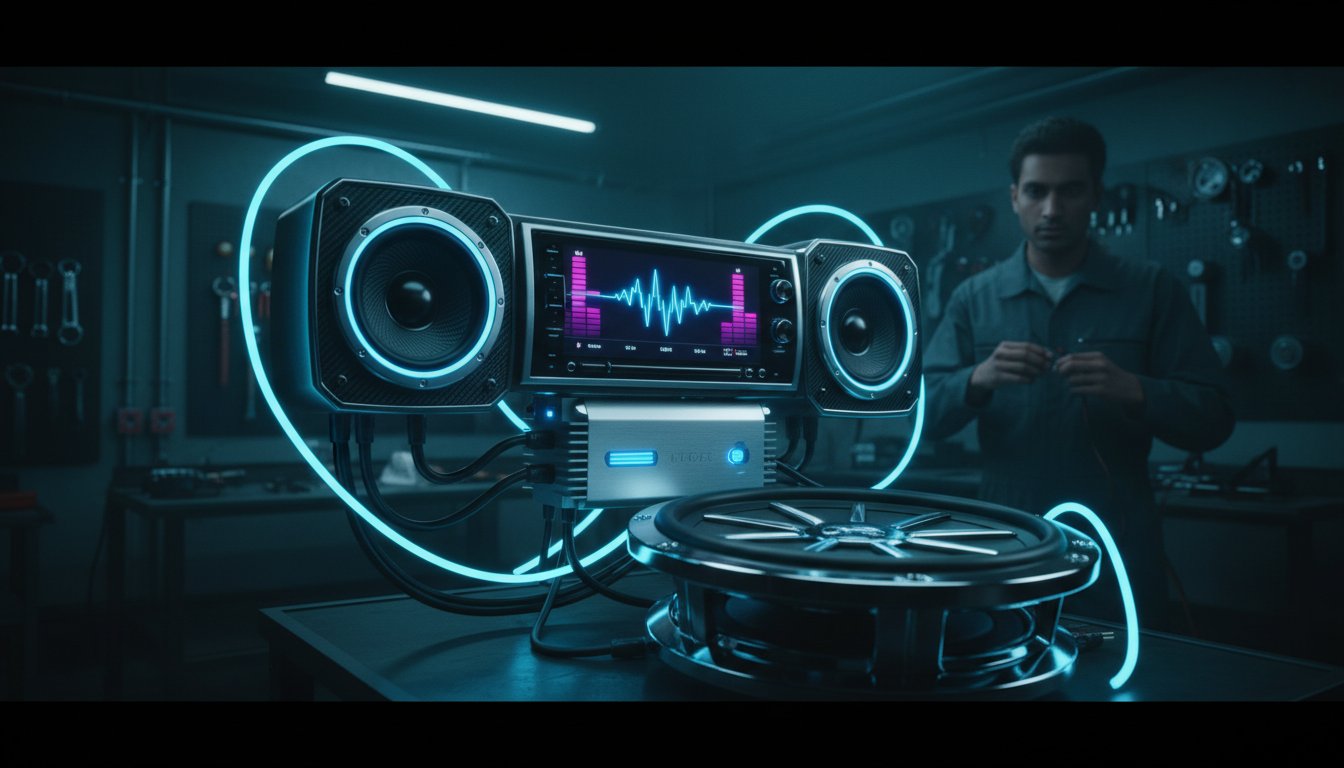
92% of factory-fitted car audio systems fail to deliver true high-fidelity sound because of low-wattage head units and cheap paper-cone speakers. To build the ultimate system in 2026, you must upgrade to a high-voltage DAB+ head unit, install component speakers with a minimum of 60W RMS, and integrate a dedicated 4-channel MOSFET amplifier. This specific hardware combination provides the power needed for crystal-clear clarity and thumping bass while adding modern smartphone connectivity like Apple CarPlay and Android Auto.
You already know that factory sound is muddy and lacks the raw impact your favourite tracks deserve. This guide promises a factual roadmap for choosing compatible fitting kits and high-performance subwoofers to overhaul your vehicle's acoustics completely. We'll preview the essential hardware needed to move from a flat factory signal to a professional-grade masterpiece; including expert advice on wiring and system integration specifically for the UK market.
Key Takeaways
- Master the "Brain, Detail, Power" framework to build your system modularly, starting with the head unit before adding speakers and amplification.
- Select the perfect head unit by identifying your dashboard fitment size and prioritising wireless Apple CarPlay or Android Auto for seamless connectivity.
- Compare component and coaxial speakers to find the ultimate balance of detail and convenience for standard 6.5-inch UK car audio fitments.
- Unlock high-performance sound by pairing a 4-channel amplifier with a dedicated subwoofer for thumping low-end and crystal-clear clarity.
- Finish your install like a pro using Oxygen-Free Copper (OFC) wiring kits and sound deadening to stop rattles and block out road noise.
What is the Best Way to Upgrade Car Audio?
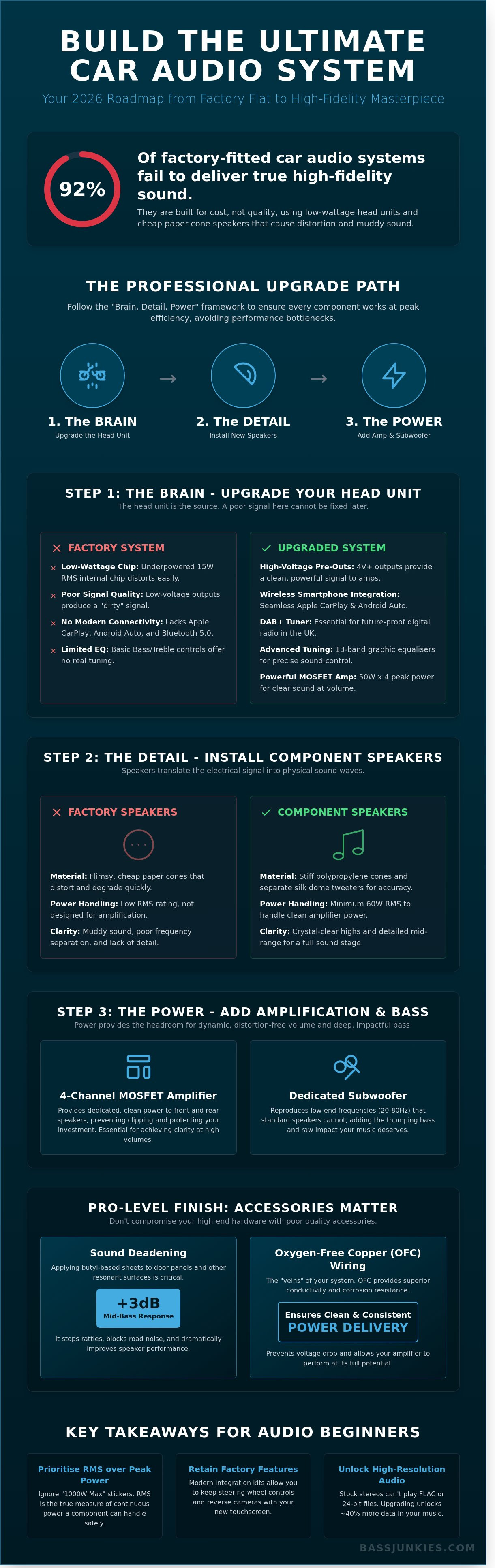
The best way to upgrade a car audio system is to follow a modular "Brain, Detail, Power" framework. You should start by replacing the factory head unit to improve signal quality and modern features; next, upgrade the speakers to capture lost detail; finally, add amplifiers and subwoofers for raw power. This sequence ensures that every component works at its peak efficiency without creating bottlenecks. Most factory systems are designed for cost, not quality, using underpowered 15W RMS internal chips that distort at moderate volumes. By following this professional upgrade path, you transform your vehicle from a tinny commuter box into a high-fidelity listening environment.
The "Brain" of your system is the head unit, which dictates the quality of the audio signal before it even reaches your ears. Many enthusiasts make the mistake of adding powerful speakers to a weak factory radio, but you cannot fix a poor signal with better drivers. Historically, Vehicle audio systems have relied on basic AM/FM receivers, but modern builds require high-voltage pre-outs to feed clean data to your hardware. Once you view the latest head units and install a quality source, the "Detail" stage involves swapping out cheap factory speakers for component sets. These aftermarket units use stiff polypropylene or silk dome tweeters rather than the flimsy paper cones found in 90% of standard UK vehicles.
The final "Power" stage is where the real excitement happens. Factory stereos lack the current to move large speaker magnets effectively, leading to flat, lifeless sound. Adding external amplifiers provides the headroom needed for dynamic peaks and crystal-clear volume. This professional approach prevents the common "clipping" that kills voice coils and ruins your investment. At Bass Junkies, we see thousands of drivers waste money on massive subs while keeping stock tweeters; don't be that person. Balance is everything when you want the UK's No. 1 sound experience.
Key Takeaways for Audio Beginners
- Prioritise RMS over Peak: Ignore "1000W Max" stickers and look for the RMS rating, which represents the continuous power a component can actually handle.
- Install Sound Deadening: Applying butyl-based sheets to your door skins is as vital as the speakers themselves; it can improve mid-bass response by up to 3dB.
- Keep Your Features: Modern integration kits mean you don't have to sacrifice your steering wheel controls or factory reverse cameras when you upgrade to a touchscreen.
Why You Should Upgrade Your Factory System Now
- Boost Resale Value: Equipping your car with 2026-ready DAB+ and wireless smartphone integration makes it far more attractive to future buyers in the UK market.
- Protect Your Hearing: Factory systems produce "dirty" power and harmonic distortion that causes ear fatigue; clean, amplified sound is much safer at higher volumes.
- High-Resolution Ready: Stock stereos cannot process FLAC or 24-bit audio files, meaning you are currently missing 40% of the data in your favourite tracks.
How to Choose the Right Car Stereo or Head Unit?
Selecting the right head unit requires matching the physical fitment to your vehicle dashboard, typically categorised as Single DIN (50mm high) or Double DIN (100mm high). High-performance builds demand wireless Apple CarPlay and Android Auto integration for seamless smartphone connectivity without messy cables. Sound quality enthusiasts must look for units with 13-band graphic equalisers and high-voltage pre-outs, specifically 4V or higher, to drive external amplifiers without signal distortion. In the UK, a DAB+ tuner is essential for future-proof digital radio reception and access to hundreds of additional stations. These technical specs are the baseline for any serious car audio upgrade in 2026.
Essential Features for Modern Head Units
Modern head units are moving away from traditional CD mechanisms. Choosing a "mechless" unit allows manufacturers to fit larger, sharper 7-inch or 10-inch capacitive touchscreens into the chassis. This design provides better heat dissipation and more room for high-end internal components. Look for Bluetooth 5.0 support to guarantee stable music streaming and crystal-clear hands-free calling. Internal MOSFET amplifiers are another non-negotiable feature. They provide 50W x 4 peak power with significantly lower total harmonic distortion than standard integrated circuit chips found in entry-level units. When choosing a car stereo, these hardware specs determine the longevity and performance of your entire system.
Compatibility and Fitting Kits
Fitting a modern stereo into a factory dashboard requires more than just a screwdriver. You need a vehicle-specific fascia plate to ensure the new unit sits flush and maintains the original interior aesthetics. Modern cars rely on complex data networks, so a CAN-bus interface is vital for retaining steering wheel controls and vehicle settings like parking sensor tones or climate displays. Without the correct wiring harness, you risk losing factory functionality or damaging the vehicle's electrical system. You can view our latest collection of high-end car stereos to find units that integrate perfectly with the latest UK fitting kits.
- Single DIN: Best for older vehicles or restricted dashboard space.
- Double DIN: Ideal for housing large touchscreens and reverse camera displays.
- 4V Pre-outs: Essential for sending a clean, powerful signal to external car audio amplifiers.
- DAB+ Digital Radio: Provides crystal-clear reception across the UK without the hiss of FM.
If you want to transform your driving experience, upgrading the source unit is the most effective first step. Check out our latest offers on head units to get the best tech for your budget.
Which Car Speakers Offer the Best Sound Quality?
Component speakers provide the best sound quality because they separate high and low frequencies into dedicated drivers. This design allows for precise tweeter placement at ear level, creating a realistic soundstage that factory setups cannot match. For 85% of modern UK vehicles, a 6.5-inch (16.5cm) speaker is the standard fitment for front doors. Choosing between silk dome tweeters for smooth, natural tones or metal domes for crisp, aggressive highs depends on your music taste. Every upgrade requires careful power matching to ensure your new car audio gear handles your amplifier's RMS output without distortion.
Component Speakers: The Audiophile Choice
Component systems use separate woofers and tweeters to elevate the music above your knees. By mounting the tweeters on the dashboard or A-pillars, you bring the "sweet spot" directly to your ears. This physical separation is vital for creating a wide, immersive soundstage that makes it feel like the band is performing on your bonnet.
External crossovers are the secret weapon of any component set. These dedicated units act as a traffic warden for your music, sending deep bass to the woofer and sharp highs to the tweeter. This prevents your drivers from trying to play frequencies they weren't built for, which drastically reduces distortion at high volumes. It's the essential choice for front-door upgrades where vocal clarity and detail are the priority.
Coaxial Speakers: The Easy Upgrade
Coaxial speakers, or full-range speakers, mount the tweeter directly on top of the woofer cone. This creates a compact, all-in-one unit that drops straight into your factory mounting points without any drilling or custom fabrication. They're a cost-effective solution for adding rear-fill or replacing blown factory drivers in a parcel shelf. You can Explore professional-grade car speakers to find the perfect fit for your specific vehicle model.
While they lack the pinpoint imaging of components, high-quality coaxials still offer a massive leap over paper factory cones. When upgrading older car audio systems, these speakers provide an immediate boost in clarity without the complexity of a full custom install. They are the go-to choice for hobbyists who want better sound without tearing their entire interior apart.
Material Selection and Power Handling
The materials used in your speaker construction dictate the final "colour" of your sound. Silk dome tweeters are a favourite for long listening sessions because they provide a smooth, warm response that isn't fatiguing. If you prefer heavy metal or electronic music, metal dome tweeters made from aluminium or titanium offer the biting crispness needed to cut through road noise.
Power matching is the final piece of the puzzle. Always look at the RMS rating rather than the "Peak" or "Max" power figures, as the RMS tells you what the speaker can handle continuously. If you're running a high-output 4-channel amplifier, ensure your speakers are rated to handle that specific wattage. Underpowering a high-end speaker can be just as damaging as overpowering it, as a clipping amplifier signal will quickly destroy your voice coils.
Do I Need a Car Amplifier and Subwoofer for Better Bass?
Yes, you need a dedicated car amplifier and subwoofer to achieve high-quality bass. Standard head units usually provide less than 22 watts RMS per channel, which lacks the electrical current needed to move large speaker cones effectively. Without an external amp, attempting to boost bass via the EQ will only result in signal clipping and potential speaker damage. Adding a subwoofer removes the low-frequency burden from your smaller door speakers, allowing the entire car audio system to play louder and clearer.
A 4-channel amplifier serves as the backbone of a high-performance setup by driving your front and rear door speakers to their full potential. While a head unit struggles to maintain clarity at high volumes, an external amplifier provides the headroom needed for crystal-clear mids and highs. This ensures that your vocals don't get drowned out once you add a powerful sub to the mix.
Active subwoofers are a compact, all-in-one solution for drivers with limited boot space in smaller hatchbacks. These units feature a built-in amplifier, making installation straightforward and keeping the footprint minimal. If you have more room and want maximum SPL, a passive subwoofer paired with a separate mono-block amplifier is the superior route for raw power and customisation.
For the ultimate thumping experience, mono-block amplifiers are the industry standard for driving subwoofers. These single-channel units are designed specifically to handle high current demands and remain stable even at 1-ohm or 2-ohm loads. They focus all their energy on the low-end frequencies, ensuring your car audio system has the "muscle" required for deep, sustained bass notes.
Adding Massive Bass with Subwoofers
Selecting the right driver size depends on your musical taste and vehicle size. 10-inch subwoofers are the go-to for listeners who prioritise tight, punchy response for rock or metal. If you want deep, thumping air movement for hip-hop or EDM, a 12-inch or 15-inch driver is essential. Sealed enclosures offer the most accuracy and take up less space; however, ported enclosures provide up to 3dB of extra output for maximum volume. Check out our thumping car subwoofers to find the perfect fit for your boot.
Amplifiers: The Muscle of the System
Class D amplifiers are the modern standard for car enthusiasts because they offer over 90 percent efficiency. Their compact size allows for hidden installations under seats or behind panels without the risk of overheating. Proper setup is vital, as the Gain control is not a volume knob; it is a level match designed to align the amplifier's input sensitivity with the head unit's output voltage. Setting this incorrectly is the primary cause of blown equipment in the UK. Browse high-performance car amplifiers from the UK’s No. 1 specialist to get the power your system deserves.
What Accessories Are Required for a Professional Car Audio Install?
A professional car audio installation requires Oxygen-Free Copper (OFC) wiring kits, butyl-based sound deadening, and vehicle-specific integration interfaces like Connects2. You must install a main power fuse within 30 centimetres of the battery terminal to ensure vehicle safety and prevent electrical fires. High-quality OFC cabling is vital because it prevents voltage drop, ensuring your amplifiers deliver their rated power without overheating. To maintain factory steering wheel functions and dashboard data, you need a dedicated interface. Sound deadening is the final essential accessory, as it stops panel resonance and increases mid-bass response by up to 3dB.
Safety is the priority when running high-current power cables. Always position your primary fuse holder close to the battery. This protects the entire length of the cable running through the car chassis. If a short circuit occurs, the fuse blows instantly, preventing potential cable meltdowns. We recommend using heavy-gauge OFC kits rather than cheaper Copper Clad Aluminium (CCA) alternatives. CCA is less conductive and prone to corrosion, which can starve your car audio system of the current it needs for peak performance.
Modern vehicles rely on complex CAN-bus data systems. You can't simply "snip and twist" wires if you want to keep your steering wheel controls working. Using a Connects2 interface allows for a plug-and-play installation. These modules translate the car's digital signals into commands your new head unit understands. It’s the only way to retain volume, track skip, and phone buttons while keeping the factory wiring loom intact.
The Importance of Sound Deadening
Applying butyl-based sheets like Dynamat to your door skins is the single most effective way to improve sound quality. This process adds mass to the thin metal panels, stopping them from vibrating like a drum. It increases mid-bass output by up to 3dB and significantly lowers road noise. You'll lose that "tinny" factory sound and gain a premium, solid "thud" every time you close the door. For more technical tips, check out our guide on Professional Car Audio Installation.
Wiring and Connectivity Essentials
Cheap cables invite unwanted noise. Triple-shielded RCA cables are mandatory for clean signal transfer, as they block electromagnetic interference and "alternator whine." When it's time to mount your new drivers, always use vehicle-specific speaker adapters. These allow you to bolt aftermarket speakers directly into factory locations without drilling new holes or cutting the original looms. You can view our full range of essential car audio accessories to find the exact fit for your vehicle make and model.
Ignite Your In-Car Experience Today
Building the ultimate sound system in 2026 requires a strategic approach to component selection. Start by replacing restrictive factory head units with high-performance Pioneer or Alpine DAB+ systems to secure a clean digital signal. Integrating a 4-channel amplifier and a dedicated subwoofer is the only way to achieve the thumping bass and crystal-clear highs that define a premium car audio setup. Always prioritise vehicle-specific installation accessories to ensure a seamless fit and professional finish without damaging your interior.
Bass Junkies has provided expert advice since 1995; we understand the technical demands of modern vehicles. Our massive stock includes the latest gear from Kenwood, Alpine, and Pioneer, all available with nationwide UK delivery. If you're not comfortable with the wiring, our professional installation services are available to handle the heavy lifting for you. We've got the hardware and the knowledge to turn your car into a high-performance soundstage that hits every note with precision.
Upgrade your ride today with the UK's No.1 car audio specialists. It's time to stop settling for average factory sound and start feeling every beat of your favourite tracks.
Frequently Asked Questions
Can I install a new car stereo myself?
You can install a new car stereo yourself if you have basic mechanical skills and the correct vehicle-specific fitting kit. Most modern UK vehicles require a bespoke fascia plate and an ISO wiring harness to bridge the gap between the factory loom and your new head unit. Using plug-and-play adaptors prevents you from cutting wires, which saves time and protects your car's resale value. Check out our range of stereo fitting kits to find the exact match for your dashboard.
What is the difference between peak power and RMS?
RMS represents the continuous power an amplifier or speaker can handle, while peak power refers to the maximum burst it can manage for a fraction of a second. You should always match your components based on RMS ratings to ensure long-term reliability and avoid blowing your voice coils. A 500W RMS amplifier provides consistent performance, whereas a "1000W Peak" rating is often just a marketing figure. Focus on RMS to build a high-performance car audio system that stays crystal-clear at high volumes.
Will an aftermarket car audio system void my warranty?
An aftermarket system does not void your entire vehicle warranty, as protected under the Consumer Rights Act 2015. The manufacturer can only refuse a warranty claim if they prove that your specific installation caused a fault in the vehicle's electrical system. Using professional-grade wiring kits and avoiding "vampire" clips ensures your modifications remain safe and compliant. If you're worried, stick to plug-and-play harnesses that allow you to revert to factory settings instantly.
Do I need to upgrade my car battery for a large amplifier?
You generally need a battery upgrade or a power capacitor if your total system output exceeds 1,000W RMS. Massive amplifiers pull heavy current that can cause your headlights to flicker and strain your factory alternator. Installing a high-output AGM battery or performing the "Big 3" wiring upgrade ensures your system gets the juice it needs for those heavy bass drops. For most mid-range setups, a dedicated 4-gauge wiring kit provides enough flow without needing a second battery.
What is a Double DIN head unit?
A Double DIN (2-DIN) head unit is a standard car stereo size measuring 180mm wide by 100mm tall, which is twice the height of a traditional single DIN radio. These units usually feature large 6.75-inch or 7-inch touchscreens, making them perfect for Apple CarPlay, Android Auto, and reversing camera displays. They offer a massive upgrade in both functionality and aesthetics compared to dated factory units. You can view double DIN head units to see how these screens transform your driving experience.
Why do my new speakers sound quiet or distorted?
New speakers often sound quiet or distorted because they're being underpowered by a weak factory head unit or are wired out of phase. High-performance aftermarket speakers often have lower sensitivity ratings than cheap factory paper cones, meaning they need a dedicated 4-channel amplifier to reach their full potential. If the sound is thin and lacks bass, check that the positive and negative terminals aren't swapped on one side. Adding an amp will fix the clipping and deliver the punchy audio you're chasing.
How do I keep my steering wheel controls with a new radio?
You can retain your factory steering wheel buttons by installing a vehicle-specific steering wheel control (SWC) interface. These boxes translate the signals from your car's CAN-bus system into a language your new Alpine, Pioneer, or Kenwood head unit understands. You'll need a brand-specific patch lead to connect the interface to the back of your new radio. It's a simple plug-and-play solution that ensures you don't lose the convenience of volume and track skipping while driving.
Is sound deadening really worth the extra cost?
Sound deadening is the single most effective way to improve your car audio quality for a relatively small investment. Applying butyl-based sheets to your door skins reduces road noise by up to 3dB and stops metal panels from vibrating along with your mid-bass drivers. This creates a silent enclosure for your speakers, making them sound tighter and more expensive than they actually are. It's the secret weapon for turning a loud system into a truly high-end acoustic environment.