
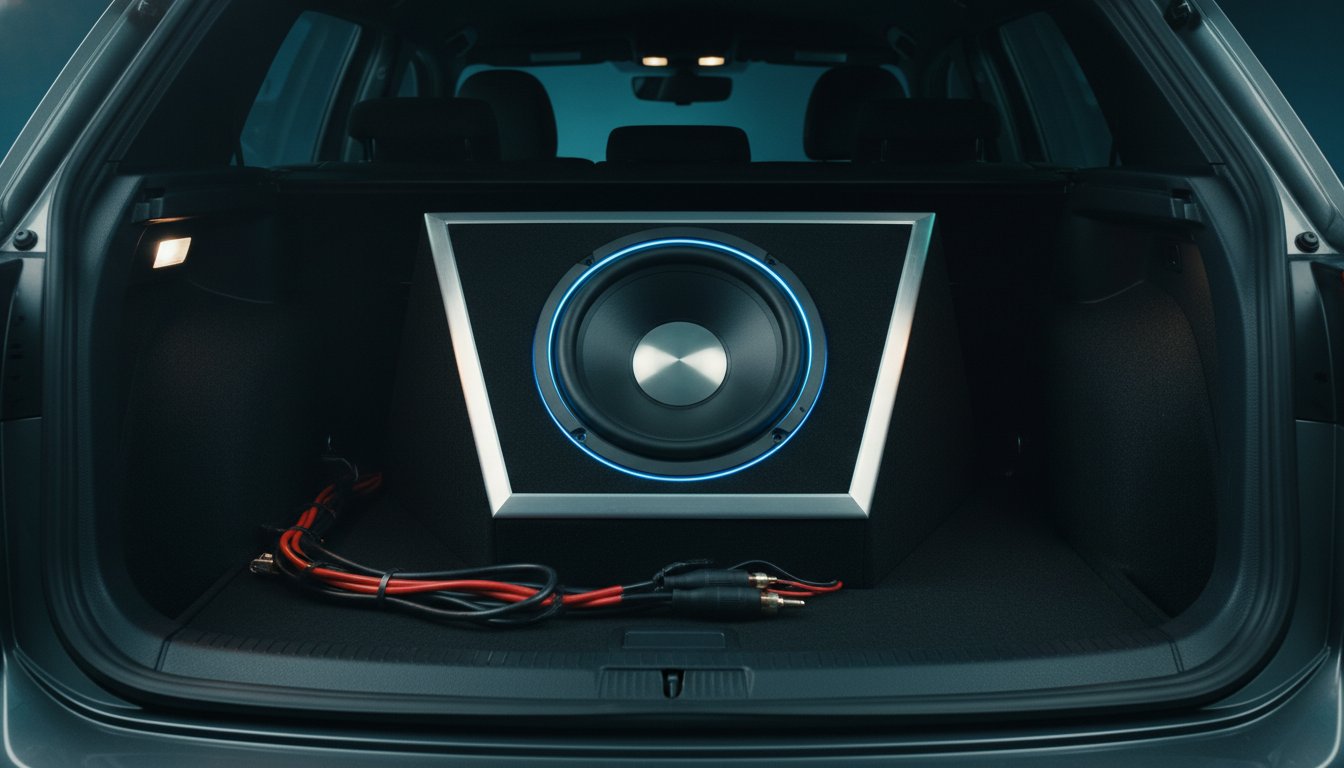
Choosing the right subwoofer for your car is a technical calculation of matching RMS power ratings and enclosure volume to your boot's physical limits. You must ignore peak power marketing; instead, pair an amplifier that delivers 75-125% of the sub's continuous RMS rating to prevent speaker failure. In 2026, the trend favors compact, high-excursion drivers that provide thumping bass without sacrificing your entire storage area. Whether you opt for a sealed box for tight accuracy or a ported enclosure for maximum volume, your choice must align with your vehicle's available air space.
We know the fear of buying a massive 12-inch sub only to find it won't fit your vehicle's dimensions or draws too much current. It's a common worry, but you deserve a system that delivers crystal-clear low end without the guesswork. This guide promises to help you navigate active versus passive setups and enclosure types to find your perfect match. You'll learn exactly how to balance air space, electrical current, and music style for the ultimate audio upgrade while staying within the 2026 UK noise regulations.
Key Takeaways
- Choosing the right subwoofer for your car requires balancing your available boot dimensions with your current amplifier's RMS output.
- Active subwoofers simplify installation by integrating the amplifier into the enclosure, making them ideal for compact hatchbacks or under-seat mounting.
- Sealed enclosures provide the most accurate response for detailed listening, while ported boxes are necessary for achieving maximum sound pressure and deep bass.
- You must match the RMS power of your amplifier to the subwoofer's continuous rating to prevent speaker damage and ensure optimal performance.
- Subwoofer cone size dictates air displacement, with 8-inch drivers offering speed and 15-inch options delivering the deepest low-frequency extension.
How do I choose the right subwoofer for my car?
Choosing the right subwoofer for your car requires a technical evaluation of your available boot volume, your amplifier's RMS power output, and your specific musical preferences. You must match the subwoofer's physical dimensions to your vehicle's air space while ensuring your electrical system can handle the current draw. The goal is to reproduce the low-frequency spectrum between 20Hz and 200Hz that standard factory speakers cannot physically reach. A successful upgrade isn't just about buying the biggest cone; it's about the synergy between the driver, the enclosure, and the power source.
Standard car speakers typically struggle below 50Hz, which results in thin, hollow sound. To solve this, you need to understand What is a Subwoofer? and how its specialized design allows for massive air displacement. Achieving that thumping, crystal-clear bass requires a system-wide approach. You'll need a high-quality driver, a rigid enclosure to prevent energy loss, and a dedicated car amplifier to provide stable power. Simply dropping a massive speaker into a boot without the correct wattage or air volume will result in distorted, muddy performance.
Identifying your bass goals
Decide if you're chasing Sound Quality (SQ) or Sound Pressure Level (SPL). SQ enthusiasts want accurate, "tight" bass that perfectly replicates every kick drum hit, which usually requires a sealed enclosure and a high-excursion 10-inch driver. If you're looking for maximum volume and ground-shaking impact for EDM or Hip-Hop, you're looking for SPL. This typically involves larger 12-inch or 15-inch car sub woofers housed in ported boxes. Don't fall for the common myth that bigger is always better; a premium 10-inch sub in a custom-tuned box will often outperform a cheap, entry-level 12-inch unit in terms of both speed and depth. Be realistic about your boot space. If you need room for groceries or luggage, a shallow-mount sub or a compact under-seat unit is your best path.
The three main subwoofer formats
- Component Subwoofers: These are raw drivers sold without a box. They offer the ultimate flexibility for custom builds but require you to calculate internal air volume and choose a separate amplifier.
- Enclosed Subwoofers: These are pre-mounted in a factory-tuned enclosure. They take the guesswork out of the installation and ensure the box volume is perfectly matched to the driver's specifications.
- Powered (Active) Subwoofers: These are the "all-in-one" solution featuring a built-in amplifier. They're incredibly space-efficient and ideal for modern vehicles where mounting a separate amp rack isn't an option.
By focusing on these technical foundations, you'll avoid the common mistake of buying a mismatched system that either sounds weak or risks blowing your voice coils. Whether you're integrating into a factory head unit or a high-end aftermarket setup, the right choice starts with understanding your vehicle's physical and electrical limits.
Active vs Passive subwoofers: Which configuration suits your vehicle?
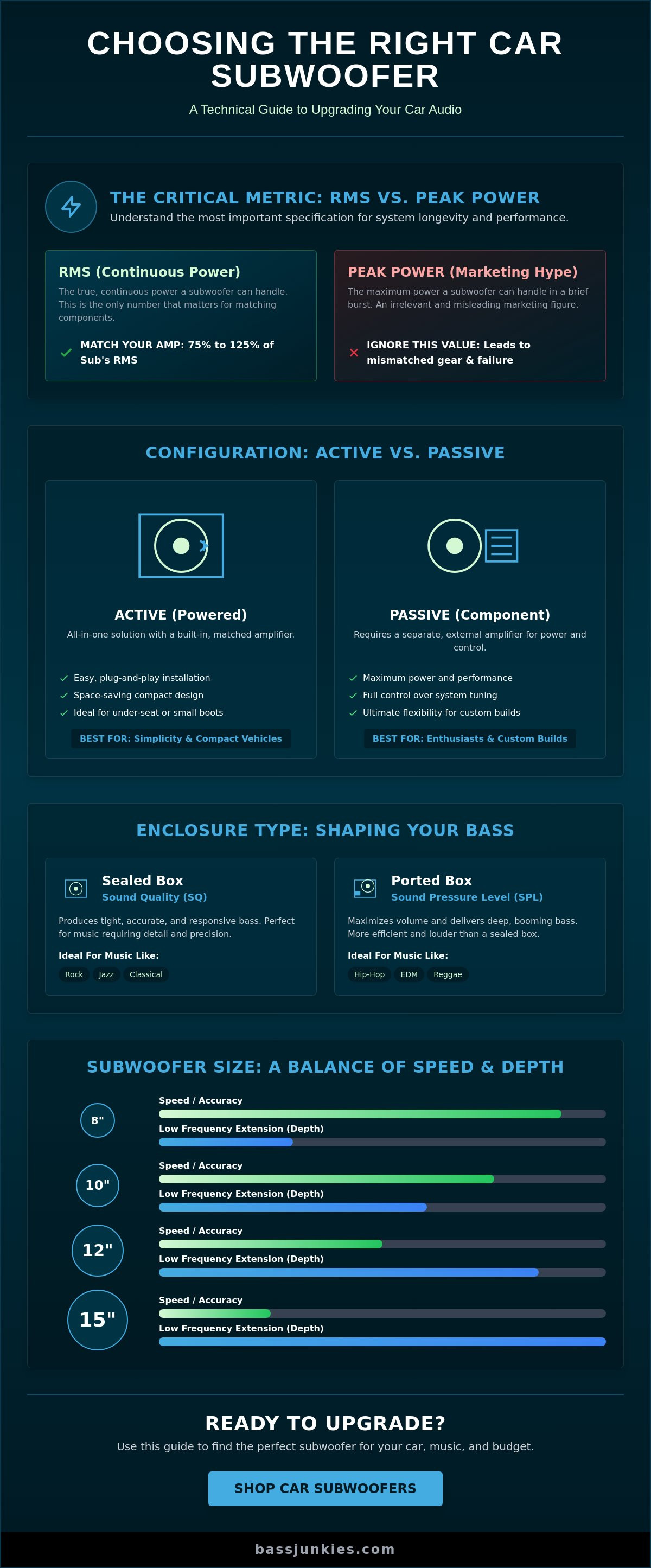
Active subwoofers are self-contained units that house both the driver and the amplifier in a single enclosure. They are the go-to choice for space-saving installations in hatchbacks or under-seat locations. Passive subwoofers are high-performance components that lack internal power, meaning they require a separate, external car amplifier to function. Choosing the right subwoofer for your car means weighing the simplicity of a plug-and-play active unit against the raw, massive output of a technical passive build. Amplified bass is the most efficient way to upgrade a modern car with limited space.
Installation complexity varies significantly between these two formats. Active subwoofers generally use a single wiring harness for power and signal, making them accessible for DIY enthusiasts. Passive systems require more planning, specifically understanding RMS power and impedance matching to avoid blowing the voice coils. While active units offer a "set it and forget it" experience, passive setups give you total control over crossover frequencies and gain settings. If you want to see the performance difference for yourself, browse our latest car sub woofers to find a unit that fits your boot and your budget.
When to choose an Active (Powered) Sub
Active subs are perfect for leased cars or vehicles where you want to maintain the original factory head unit. These units excel at filling out the audio spectrum and adding warmth to your music without occupying the entire boot. They don't aim to rattle the windows of neighbouring cars, but they provide a significant upgrade over factory paper cones. Under-seat active subwoofers are particularly effective in sports cars or small cabins where every centimetre of space matters. Most modern active units include high-level inputs, allowing them to tap directly into existing speaker wires without needing RCA converters.
When to go Passive with a separate amplifier
Enthusiasts craving massive, thumping bass must choose a passive setup. This configuration is essential for high-wattage output that can handle deep low-end transients at high volumes. Passive systems allow for a modular approach; you can upgrade your driver later without replacing your entire power source. This versatility is why serious audio junkies prefer it. You'll need to view car amplifiers to find a dedicated mono-block or multi-channel unit that provides enough current for your chosen driver. This path requires more boot space for the enclosure and amp rack but delivers the ultimate sensory impact.
Selecting the right subwoofer size and enclosure for your music taste
Choosing the right subwoofer for your car is a technical decision that dictates how your music feels, not just how it sounds. You must match the cone's surface area and the enclosure's internal air volume to the specific genres you play most. Smaller 8-inch or 10-inch drivers offer the lightning-fast response required for rock and metal, while 12-inch and 15-inch cones move the massive air volume essential for hip-hop and EDM. Your enclosure type then refines this output, acting as a mechanical filter that either tightens the punch or boosts the raw volume.
For a deep dive into specific models and configurations, check out The Ultimate Subwoofer Buying Guide to see how different brands tune their drivers for maximum performance. Selecting the wrong size or box type will result in muddy sound or wasted boot space.
Size guide: 8-inch to 15-inch
An 8-inch subwoofer is the king of speed and stealth. These compact drivers fit almost anywhere, including under-seat enclosures, and provide a fast response that keeps up with complex double-kick drums or intricate jazz basslines. They don't dig into the sub-harmonic depths of larger units, but they deliver a crystal-clear low-end that factory speakers cannot physically touch. This is the ideal choice if you want to enhance your system without losing any storage capacity.
Moving up to a 10-inch driver gives you the "Goldilocks" balance. It's large enough to move significant air for a physical "thump" in your chest while remaining small enough to stay accurate during fast musical passages. If you want a versatile system that handles everything from pop to heavy rock, a 10-inch sub is often the smartest technical choice. It offers the best compromise between footprint and power handling.
For those who want ground-shaking impact, 12-inch and 15-inch car sub woofers are the industry standard. These massive cones displace huge volumes of air, making them perfect for low-frequency genres like dubstep, rap, or R&B. However, these larger drivers require significantly more boot space and a high-current car amplifier to maintain control over the heavy cone. If you choose a 12-inch or larger unit, using sound deadening is mandatory to prevent your boot lid and registration plate from rattling under the pressure.
Sealed vs Ported: The enclosure debate
Choosing the right subwoofer for your car also involves selecting between sealed and ported boxes. A sealed box is an airtight enclosure that uses internal air pressure as a "spring" to control the subwoofer's movement. This results in the most accurate, tight, and punchy bass reproduction possible. Audiophiles prefer sealed boxes because they offer a flat frequency response and take up the least amount of space in your boot.
Ported boxes use a tuned vent to reinforce the sound coming off the back of the cone. This design is significantly louder than a sealed box and provides that "boomy" volume associated with high-performance SPL systems. While they are larger and harder to tune correctly, ported enclosures are the best way to get the most decibels out of your setup. Bandpass enclosures take this a step further, offering maximum "slam" within a specific frequency range, making them a popular choice for show cars and extreme builds.
Understanding RMS power and impedance matching for maximum performance
RMS power is the continuous wattage a subwoofer can handle without thermal damage, while peak or "max" power is an irrelevant marketing figure representing a split-second burst. When choosing the right subwoofer for your car, you must match the amplifier's RMS output to the subwoofer's RMS rating at a specific impedance. Mismatched electrical resistance, measured in Ohms, often causes amplifiers to overheat or enter a fail-safe protect mode. A technically balanced system ensures crystal-clear bass and prevents you from blowing expensive voice coils. Don't let marketing fluff dictate your build; stick to the real numbers.
Impedance is the electrical resistance your subwoofer presents to the amplifier. Most car audio components operate at 2-Ohm or 4-Ohm loads. A lower Ohm rating typically allows the amplifier to push more wattage, but it also increases the heat generated within the circuitry. If you wire a driver to an impedance lower than what your amp is rated for, you'll trigger protect mode or cause a permanent hardware failure. Choosing the right subwoofer for your car requires verifying that your car amplifier is stable at your chosen impedance load.
RMS Power: The only number that matters
RMS stands for Root Mean Square and represents the continuous power a subwoofer handles during a standard listening session. Under-powering a sub is often more dangerous than slightly over-powering it because a weak amplifier will "clip" the signal when pushed too hard. Clipping sends a distorted square wave to the driver, which generates excessive heat and destroys the coil. Always look for the "Watts RMS" rating on a spec sheet at a specific Ohm rating to ensure your power source is sufficient. If your sub is rated for 500W RMS, your amplifier should ideally deliver between 500W and 625W of clean power.
Voice Coils: Single vs Dual
Subwoofers come with either a Single Voice Coil (SVC) or a Dual Voice Coil (DVC). SVC drivers are straightforward for beginners; you connect the positive and negative terminals directly to the amp and the impedance remains fixed. DVC drivers offer two separate coils, giving you the flexibility to wire them in series or parallel to change the total impedance. This is critical for getting the maximum wattage out of a mono-block amplifier. If you're ready to build a high-performance system with total wiring flexibility, explore our latest subwoofer offers to find DVC models from top brands like JL Audio and Alpine.
Ready to upgrade? Find the UK’s best car subwoofers at Bassjunkies
Bass Junkies is the UK’s leading specialist for choosing the right subwoofer for your car, providing technical expertise backed by over 30 years of industry experience. We maintain a massive inventory of Pioneer, Alpine, Kenwood, and JL Audio components to ensure your audio system matches your vehicle's specific electrical and spatial requirements. Our expert team provides direct advice on compatibility for every order, preventing common errors like impedance mismatch or enclosure over-sizing. You receive professional-grade hardware delivered UK-wide with a performance guarantee that generic retailers simply cannot match. It's about getting the ultimate thumping bass without the technical guesswork.
Stop settling for the thin, distorted sound of factory paper cones. Our mission is to move you from a poor audio experience to a high-performance solution that hits every low-frequency note with crystal-clear precision. Whether you're looking for a compact under-seat active sub or a massive 15-inch competition driver, we have the stock and the technical knowledge to make it happen. You can view the full car subwoofers collection online right now to find the perfect foundation for your 2026 bass upgrade.
Why shop with the UK’s No. 1 specialist?
Bass Junkies has spent three decades dominating the UK car modification scene. We aren't just a retailer; we're enthusiasts who live for crystal-clear, high-octane sound. Our massive stock levels mean you don't have to wait weeks for the latest hardware to arrive. We also carry all the essential car audio accessories, such as 0-gauge power cables and distribution blocks, to ensure your installation is safe and professional. Every customer gains access to our junkie levels of passion and expert support for complex DIY projects.
Next steps for your bass build
Your bass build depends on more than just the driver. Always measure your boot's height and depth before ordering a pre-enclosed sub to ensure it doesn't block your rear visibility or boot latch. You also need a dedicated wiring kit that can handle the massive current your new amplifier will pull from the battery. If your current system feels dated, you should consider adding DAB or Bluetooth connectivity to your dashboard. Modernizing your source signal ensures your sub receives a clean, high-resolution feed for the ultimate sensory impact.
Ready to Transform Your Drive with Massive Bass?
Choosing the right subwoofer for your car is the difference between a muddy factory setup and a crystal-clear, thumping audio experience. You now have the technical foundation to match RMS power ratings accurately, select between sealed or ported enclosures based on your music, and decide if an active or passive configuration fits your boot. Remember that a successful build relies on precision wiring and impedance matching to keep your hardware safe during high-output sessions. Don't settle for mediocre sound when the ultimate sensory impact is just one upgrade away.
Bass Junkies has been the UK’s No. 1 specialist since 1995, providing expert advice from real car audio junkies who understand the science of sound. As an authorized dealer for industry leaders like Pioneer, Alpine, and JL Audio, we guarantee authentic products and massive performance. Our team is ready to help you navigate technical specs to ensure 100% vehicle compatibility for your specific build. Upgrade your bass today: Shop our massive range of car subwoofers and start feeling the music the way it was intended.
Frequently Asked Questions
What is the best subwoofer size for most cars?
A 10-inch subwoofer is the most versatile choice for the average driver because it balances fast response with physical impact. It typically requires between 0.6 and 1.0 cubic feet of air space, making it easy to install without losing your entire boot. If your priority is maximum air displacement for low-frequency genres like hip-hop, a 12-inch driver is the industry standard. Choosing the right subwoofer for your car involves checking your available depth to ensure the magnet structure fits your chosen enclosure.
Do I need an amplifier for a car subwoofer?
Every subwoofer requires a dedicated power source to move the heavy cone and voice coil assembly. Passive subwoofers need a separate monoblock or multi-channel car amplifier to function correctly. Active subwoofers, often called powered units, have the amplifier built directly into the box for a compact, all-in-one solution. You cannot run a sub directly off the low-wattage output of a standard head unit without risking immediate hardware failure.
What is the difference between peak power and RMS power?
RMS power represents the continuous wattage a speaker handles during a standard listening session, while peak power is a burst figure used for marketing. You should always ignore the "Max Power" label on the packaging and focus strictly on the RMS rating. For example, a sub rated at 500W RMS needs an amp that delivers between 500W and 625W of clean, continuous current. This provides the necessary headroom to prevent signal clipping and thermal damage to the voice coils.
Will a subwoofer drain my car battery?
A subwoofer will not drain your battery if the engine is running and the alternator is providing a steady charge. However, high-power systems pulling over 1,000W RMS can stress a standard 12V battery during long journeys. In these high-output scenarios, installing a stiffening capacitor or a high-output alternator ensures your electrical system remains stable. Always verify that your remote turn-on wire is connected correctly so the system shuts down when you turn off the ignition.
Can I install a subwoofer in a car with a factory stereo?
You can definitely install a subwoofer while keeping your original factory head unit. You will need a Line Output Converter (LOC) to transform the speaker-level signal into an RCA signal for your amplifier. Many modern active subwoofers also feature high-level inputs, which allow you to tap directly into the existing rear speaker wires. This is the most efficient way to upgrade the sound in modern vehicles where the dashboard screen is integrated into the car's computer.
What is better: a sealed or ported subwoofer box?
A sealed box is better for listeners who prioritize "tight" and accurate bass with a flat frequency response. It is the most compact enclosure type, often requiring 30% less boot space than a ported version. A ported box is better if you want maximum volume and a physical "thump" that you can feel in your chest. Ported enclosures use a tuned vent to boost output by approximately 3dB at specific frequencies, making them ideal for heavy EDM or rap tracks.
How much space does a car subwoofer actually take up?
An under-seat active sub takes up zero boot space and usually measures less than 8cm in height. A single 12-inch ported enclosure typically occupies about 1.5 to 2.0 cubic feet, which is roughly 25% of a standard hatchback boot. Choosing the right subwoofer for your car means balancing your audio goals with your daily storage requirements. If you need your boot for luggage, a shallow-mount driver in a custom side-panel enclosure is the best technical compromise.
Can I add a subwoofer to a leased vehicle?
Adding a subwoofer to a leased vehicle is perfectly fine as long as the installation is non-destructive and reversible. You should use "add-a-circuit" fuse taps and high-level signal inputs to avoid cutting or splicing the original factory wiring loom. This allows you to remove the equipment and return the car to its original state at the end of the contract. Active under-seat subwoofers are the most popular choice for leases because they require minimal cabling and no permanent mounting holes.