

Your factory head unit is a digital bottleneck, actively strangling your music before it even reaches the speakers. While 84% of new vehicles now include basic touchscreens, these OEM units are built for profit margins, not for the high-octane performance you demand. You're likely tired of clunky interfaces, outdated maps, and that flat, tinny sound that makes a heavy bassline feel completely lifeless. It's time to stop settling for the factory standard.
We agree that your drive should be an experience, not a chore. Upgrading to a high-performance aftermarket car stereo is the single most effective way to transform your cabin into a high-fidelity sanctuary. This guide will show you exactly why aftermarket tech crushes factory systems, focusing on crystal-clear MOSFET power and seamless Apple CarPlay integration. We're breaking down the top 2-DIN units for 2026 and showing you how to secure the ultimate centrepiece for your dash. As the UK’s No. 1 specialist, we've tested every rig to ensure you get massive sound and unbeatable value.
Key Takeaways
- Ditch the weak factory deck and upgrade to a high-performance aftermarket car stereo to unlock massive MOSFET power and crystal-clear audio quality.
- Discover the technical edge of 31-band graphic equalisers and high-voltage pre-outs that leave basic factory bass and treble settings in the dust.
- Navigate the DIN standard with ease to identify whether a classic Single-DIN or a modern Double-DIN touchscreen is the perfect fit for your dashboard.
- Future-proof your ride by integrating essential tech like Apple CarPlay, Android Auto, and DAB+ digital radio for a seamless, hands-free driving experience.
- Learn why professional installation and expert sound deadening are the ultimate secrets to protecting your investment and achieving a thumping, competition-grade sound.
The Death of the Factory Radio: Why an Aftermarket Car Stereo is Essential
Your factory radio is a bottleneck. It's a weak link in an otherwise decent machine. An aftermarket car stereo is a high-performance, third-party head unit designed specifically to replace the restrictive, low-power equipment installed on the assembly line. While car brands shout about "premium" sound packages, the reality is usually disappointing. Manufacturers often spend less than £40 on the internal components of a standard deck to keep production margins high. They use budget capacitors and entry-level chips that starve your music of its energy.
The Automotive head unit has undergone a radical transformation. In 2026, your dashboard is no longer just a place for an FM tuner. It's a high-speed multimedia command centre. Modern aftermarket units offer modular technology that allows for easy hardware updates. This concept of future-proofing means you don't have to trade in your entire vehicle just to get the latest wireless connectivity or processing power. You stay ahead of the curve without the dealership price tag.
The Limitations of Factory Systems
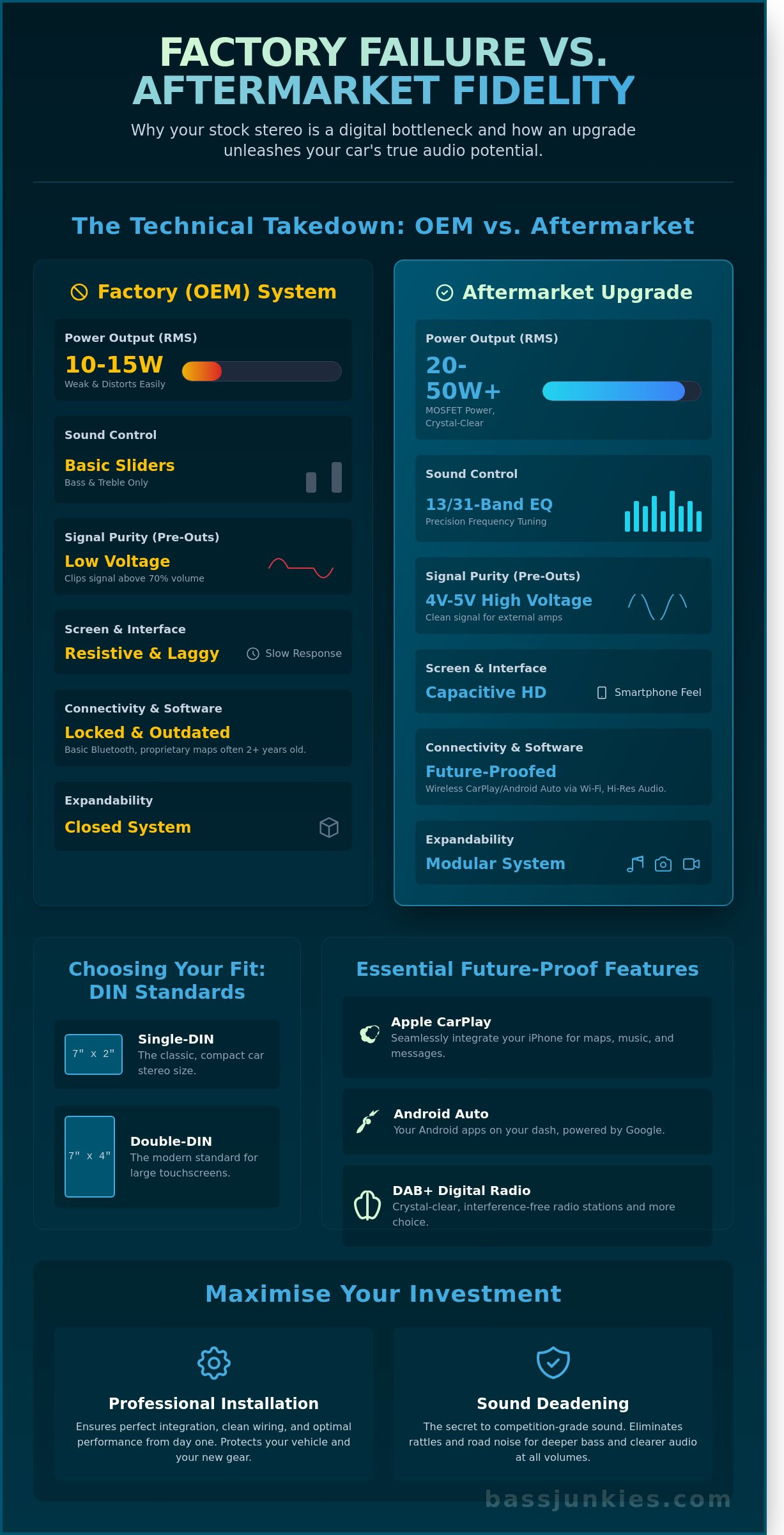
Factory sat-nav systems suffer from baked-in obsolescence. By the time a new car hits a UK forecourt, its proprietary maps and media software are often two years behind the latest smartphone apps. These systems are notoriously underpowered. Most standard internal amplifiers struggle to push more than 15W RMS per channel. This results in flat, distorted audio when you try to crank the volume. Proprietary software locks you out, preventing any meaningful customisation of the user interface or sound stages. It's a closed loop that prioritises manufacturer control over your listening experience.
The Aftermarket Advantage
Upgrading to an aftermarket car stereo introduces high-grade Digital-to-Analogue Converters (DACs) into your signal chain. These 24-bit processors extract every ounce of detail from your digital files, delivering crystal-clear highs and authoritative mids. Expandability is where the aftermarket truly shines. You get dedicated high-voltage RCA pre-outs, making it simple to bolt on thumping subwoofers, massive multi-channel amplifiers, and HD reverse cameras. An aftermarket stereo acts as the high-octane brain of a high-performance audio system, coordinating every beat and frequency with surgical precision.
- Superior Sound: High-voltage pre-outs for cleaner signal transfer.
- Modern Tech: Instant access to 2026's latest wireless integration.
- Full Control: Advanced 13-band or 31-band graphic equalisers for precision tuning.
Aftermarket vs Factory Stereos: The Ultimate Technical Comparison
Factory head units are built to a strict budget. Most standard OEM systems pump out a measly 10W to 15W RMS per channel. That is barely enough power to move a speaker cone without straining. Swapping to a high-performance aftermarket car stereo instantly upgrades you to 20W or even 50W RMS MOSFET power. This creates massive headroom. Your music stays crystal-clear even when you crank the volume to 11.
Control is the next major divide. Most factory setups offer basic "Bass" and "Treble" sliders. That is 1990s technology. Modern aftermarket gear provides 13-band or 31-band Graphic EQs. You can pinpoint specific frequencies to kill door card rattles or boost recessed vocals. Connectivity has also evolved beyond basic Bluetooth. While factory units often compress audio into digital mush, premium upgrades offer Wireless Apple CarPlay and Android Auto. These use high-bandwidth Wi-Fi for superior streaming quality. Data from the Specialty Equipment Market Association shows that driver demand for these integrated mobile technologies is at an all-time high as users ditch clunky OEM interfaces.
Screen tech has seen a total revolution. Factory displays often use resistive touchscreens that feel like mushy plastic. They require a firm press and wash out in direct sunlight. Aftermarket units utilise capacitive glass displays with 1280x720 HD resolution. They are as responsive and sharp as a flagship smartphone.
Audio Fidelity and Signal Purity
Factory internal chips distort at 70% volume. They clip the signal, which eventually destroys your speakers. Premium brands like Pioneer and Kenwood feature 4V or 5V high-voltage pre-outs. This sends a clean, powerful signal to your external amplifiers. You also gain support for FLAC and 24-bit Hi-Res Audio. This allows for 96kHz sampling rates, far exceeding the 44.1kHz limit of a standard CD or low-bitrate MP3.
User Experience and Interface Speed
Nobody likes menu lag. Older factory units take 2 to 3 seconds to respond to a single tap. Modern head units use quad-core processors for instant, snappy feedback. You can customise button colours to match your VW’s red or your BMW’s orange dash lights perfectly. Integrated voice control via Siri or Google Assistant improves safety by keeping your eyes on the road. Explore our latest DAB+ head units to fix your dashboard's performance issues today.
Single-DIN vs Double-DIN: Choosing the Right Fit for Your Dashboard
Size matters. Before you drop your cash on a new aftermarket car stereo, you must understand the DIN standard. This isn't just boring technical talk; it's the difference between a clean install and a total disaster. Established by the Deutsches Institut für Normung in 1984, this universal measurement ensures your head unit actually fits the slot in your dashboard without a fight.
A Single-DIN unit measures 180mm by 50mm, or roughly 2 inches tall. It's the classic rectangle you'll find in legendary 90s builds and smaller hatchbacks. Double-DIN units double that height to 100mm, or 4 inches. These have become the 2026 industry standard for anyone serious about a high-spec cabin. They offer the real estate needed for the massive, crystal-clear displays we demand today.
Stop worrying about the "will it fit?" factor. Whether you're upgrading a 2015 Vauxhall Corsa or a vintage Land Rover, vehicle-specific fascia kits solve the problem. These kits match your car's interior texture and colour, making your high-performance aftermarket car stereo look like a factory-fitted masterpiece. We stock thousands of these kits to ensure a no-nonsense, flush finish every time.
Single-DIN: Compact Power
Don't call it old school. Single-DIN units are the go-to for purists who prioritise thumping audio over flashy pixels. They're perfect for cars with limited dash space or for owners who want to keep things stealthy.
- Pros: Generally more affordable; fits almost any vehicle on UK roads; usually features a tactile physical volume knob for instant control.
- Cons: Limited to basic data displays; no room for integrated maps or video playback.
- Ideal for: Classic car restorations or budget-conscious builds where raw sound quality is the only priority.
Double-DIN: The Multimedia Powerhouse
If you want the ultimate in-car experience, you need a Double-DIN. It's the undisputed king of the dashboard, acting as the high-octane heart of your entire system. It transforms a boring commute into a full sensory experience.
- Pros: Massive touchscreens (often 7 inches or larger); seamless Apple CarPlay and Android Auto integration; vital support for reversing cameras.
- Cons: Requires a larger dash footprint; higher initial investment for the tech.
- Ideal for: Tech-obsessed drivers and families who need crystal-clear navigation and total smartphone connectivity.
Must-Have Features: Apple CarPlay, Android Auto, and Digital Radio
Upgrading to a modern aftermarket car stereo isn't just about cranking the volume; it's about bringing your 2010-era dashboard into 2026. In the UK, DAB+ is the absolute standard for any serious listener. It provides crystal-clear digital reception and access to hundreds of stations that FM simply cannot touch. Forget the hiss and crackle of old-school radio. Digital Audio Broadcasting is the future, offering more choice and rock-solid signal stability across the motorway network. If you're still relying on an analogue tuner, you're missing out on the high-fidelity sound your speakers deserve.
Smartphone Integration: CarPlay & Android Auto
Apple CarPlay and Android Auto have transformed the driving experience. These platforms mirror your phone's interface directly onto the head unit screen. Wired versions are reliable and keep your phone charged, while wireless versions offer ultimate convenience for short trips. Accessing Waze or Google Maps ensures you avoid M25 gridlock with real-time traffic data. Spotify and Tidal integration puts your entire music library at your fingertips. CarPlay is now a safety essential, not just a luxury, because it minimises phone distractions through voice-controlled Siri or Google Assistant commands. You keep your eyes on the road while the aftermarket car stereo handles the logistics.
Retaining Factory Features
Nobody wants a dashboard that looks like a DIY disaster. You can keep your interior looking professional with fascia plates that colour-match your original plastics perfectly. To keep your hands on the wheel, Connects2 Steering Wheel Control Interfaces ensure your volume and track buttons work exactly as they did before. You don't have to lose your factory USB ports or aux inputs either; specialised adapters bridge the gap between old wiring and new tech. This ensures a seamless transition that looks and feels like a factory-fit finish.
Safety is a massive priority for 2026. Modern units often feature dual-camera inputs. This allows for both a high-definition reversing camera and a front-facing parking camera. These inputs provide a 180-degree view of your surroundings, making tight UK parking spaces much easier to handle. It's a performance upgrade that protects your pride and joy from expensive scrapes and bumps. Whether you're navigating a multi-storey or a narrow country lane, having that visual confirmation is a total game-changer.
Upgrade your drive and grab the latest head unit tech at Bass Junkies today.
Maximising Your Investment: Professional Fitting and Sound Deadening
Don't waste your hard-earned cash on a top-tier setup only to ruin it with a sloppy installation. You've picked the perfect aftermarket car stereo, but the hardware is only half the battle. If you've got loose wiring or a weak ground point, you're inviting electrical noise and signal degradation into your cabin. A poor ground can create a nasty 10dB hum that competes with your music. Bassjunkies lives for the details that others ignore. We provide the expert technical advice and massive stock levels required to ensure your gear performs at its absolute peak from the moment you turn the key.
Getting the fitment right means using the correct ISO looms, fascia adaptors, and steering wheel control interfaces. We stock thousands of vehicle-specific parts to ensure your new unit looks like it rolled off the factory assembly line. It's about performance, reliability, and that crisp, professional finish that defines a high-end build.
The Role of Sound Deadening
Your car's metal door skins are essentially giant bells. They ring, rattle, and vibrate every time your speakers move, which completely muddies your mid-bass. Installing Dynamat Xtreme Sound Deadening Kits stops this resonance dead. These 1.7mm thick aluminium-constrained butyl sheets transform your door into a solid, non-resonant enclosure. This creates a massive leap in perceived audio clarity and "thumping" bass response.
- Kill Road Noise: Lower the noise floor so you hear every detail at lower volumes.
- Stop Rattles: Eliminate the annoying buzz from plastic trim and metal panels.
- Improve Clarity: Treating just 25 percent of a panel's surface area can yield a 90 percent reduction in vibration.
We always recommend treating the doors when you upgrade any part of your audio chain. It's the most cost-effective way to make a £200 set of speakers sound like they cost £500.
Why Choose Bassjunkies for Your Upgrade?
We've dominated the UK car audio scene for over 30 years. We aren't just another faceless retailer; we're the UK’s No. 1 car audio specialist with a passion for high-octane sound. Our warehouse is packed with a massive range of the latest aftermarket car stereo units from industry titans like Alpine, Kenwood, and Sony. We know every MOSFET specification and DAB+ integration quirk because we live this stuff every single day.
Whether you need a simple 2-DIN fitment or a complex multi-amp system, we've got the kit in stock and ready to ship. Don't settle for factory mediocrity that leaves your music sounding flat. Browse our full range online or contact our experts today for a tailored solution that'll make your car the envy of the car park.
Ditch the Factory Fluff and Crank Up the Performance
Your factory head unit belongs in the past. It's time to unlock the true potential of your vehicle's audio system. By switching to a high-performance aftermarket car stereo, you gain instant access to essential 2026 tech like wireless Apple CarPlay, Android Auto, and crystal-clear DAB+ digital radio. Whether you're opting for a massive 10-inch Double-DIN display or a technical Single-DIN powerhouse, the improvement in MOSFET power and signal processing is immediate. You aren't just changing a screen; you're overhauled your entire sensory experience.
Bass Junkies has been the heartbeat of the UK audio scene since 1995. With 30 years of expert authority, we've helped thousands of drivers escape the flat, lifeless sound of stock systems. We're official UK dealers for industry giants like Pioneer, Alpine, and Kenwood, ensuring you get genuine hardware with full manufacturer backing. Don't waste money on piecemeal parts. Grab one of our full fitting kits or head unit bundles to secure huge savings and a factory-perfect finish in your dashboard.
Upgrade your ride with the UK’s No. 1 range of aftermarket car stereos at Bassjunkies!
It's your car and your soundtrack. Make sure it hits hard every single time you turn the key.
Frequently Asked Questions
Will an aftermarket car stereo drain my battery?
An aftermarket car stereo will not drain your battery if you install it correctly using a vehicle-specific wiring harness. These units typically draw less than 10 milliamps of current when your car is switched off. If you bypass the ignition wire and connect the unit directly to a constant 12V power source, you risk a flat battery within 48 hours. Always use a proper ISO adapter to ensure the stereo shuts down the moment you pull the key from the ignition.
Can I keep my original steering wheel controls with a new stereo?
You can definitely keep your factory steering wheel buttons by using a dedicated steering wheel control (SWC) interface. These clever plug-and-play modules translate your car's unique digital signals into a language your new head unit understands. Bass Junkies stocks over 500 different interfaces to cover 95% of vehicles on UK roads. It's a simple add-on that ensures you keep your eyes on the road while toggling through your favourite tracks.
What is the difference between a 1-DIN and 2-DIN car stereo?
The difference is the physical height of the unit; a 1-DIN is 50mm tall while a 2-DIN is 100mm tall. Most modern UK cars use the 2-DIN standard to accommodate massive 7-inch touchscreens and Apple CarPlay interfaces. If your dashboard has a narrow slot, you need a 1-DIN unit. We've seen a 30% increase in "floating" 1-DIN screens that provide a huge display even in older cars with restricted dashboard space.
Do I need a special kit to fit an aftermarket stereo in my car?
You will almost certainly need a bespoke fitting kit to make an aftermarket car stereo look like it belongs in your dashboard. These kits include a plastic fascia plate, a wiring harness adapter, and often an aerial booster for crystal-clear radio reception. Without a fascia, you'll be left with a messy gap in your interior. Our kits are precision-moulded to match your car's original texture and colour with 100% accuracy.
Is Apple CarPlay wireless in all aftermarket stereos?
Wireless Apple CarPlay is not a standard feature on every unit; it's typically found on mid-to-high-end models starting around £300. Entry-level units usually require you to plug in a physical Lightning or USB-C cable to launch the interface. Always check the product specifications for "Wi-Fi enabled" or "Wireless CarPlay" before you buy. In 2024, approximately 60% of our top-selling units now feature wireless connectivity for maximum convenience and less cable clutter.
Will a new head unit make my factory speakers sound better?
A new aftermarket car stereo will instantly improve your sound quality because it delivers more clean power than a factory unit. Most OEM stereos only push about 10 watts RMS, while a high-quality Alpine or Pioneer unit delivers 22 watts RMS via its internal MOSFET amplifier. This extra headroom reduces audio distortion by up to 15% at higher volumes. You'll hear punchier bass and sharper detail without even opening your door cards.
Can I install an aftermarket car stereo myself?
You can install a stereo yourself if you're comfortable using basic tools like a screwdriver and plastic trim removal picks. Most UK installations take between 45 and 90 minutes when you use the correct plug-and-play wiring looms. If your vehicle features a complex fibre-optic system, the job becomes significantly more technical. We provide expert advice to over 200 DIY installers every single week to ensure their thumping new system is wired perfectly.
What happens to my factory reversing camera if I change the stereo?
Your factory reversing camera will continue to work perfectly if you use a specific camera retention interface. These adapters convert your car's original video plug into a standard RCA connection that plugs directly into your new screen. These modules generally cost between £35 and £60 depending on your vehicle's make and model. It's a vital upgrade that keeps your 170-degree view intact when you're backing into tight supermarket parking spaces.