

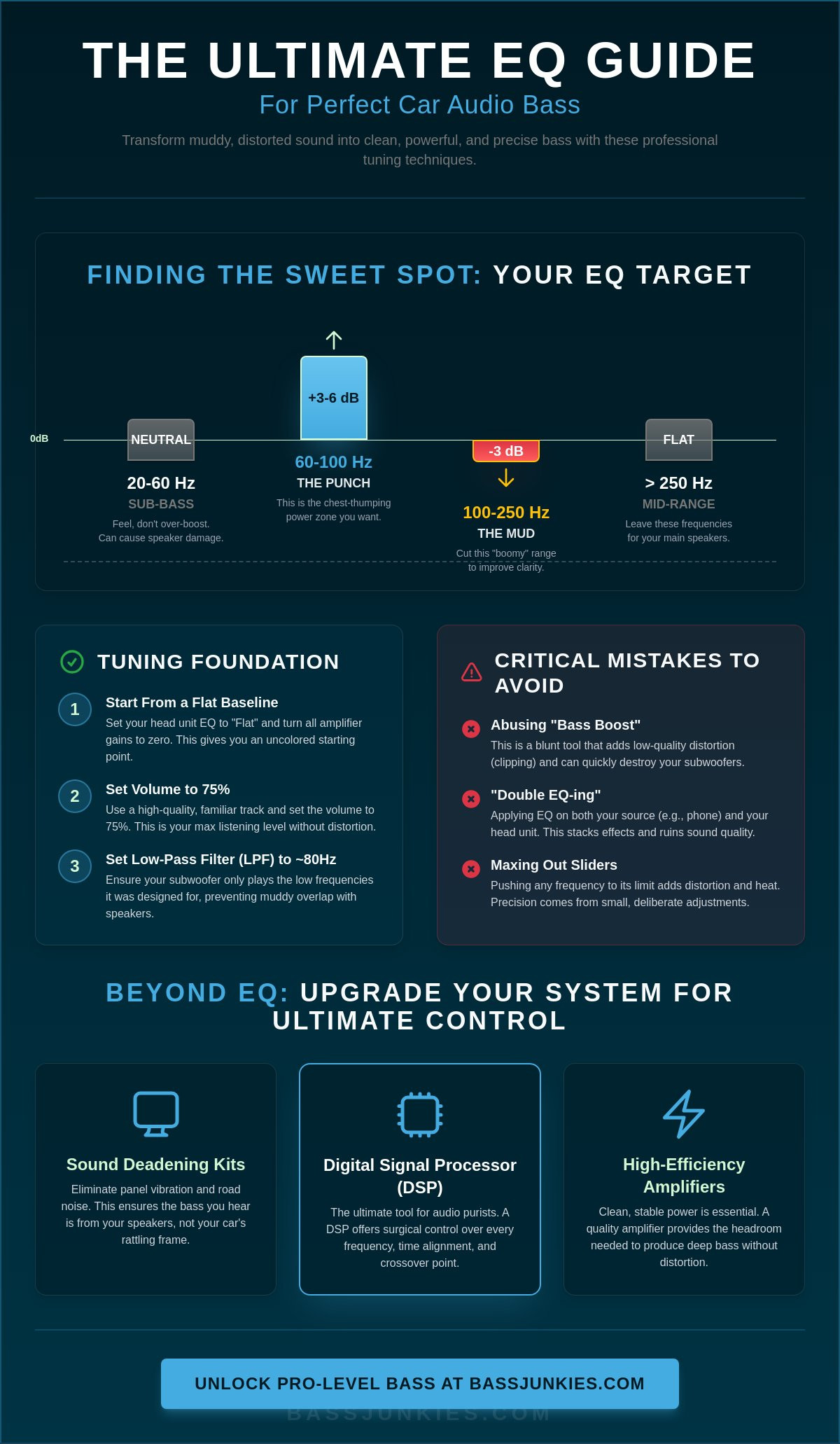
The loudest bass doesn't come from cranking every slider to the max; it comes from precision cutting. The best EQ settings for car audio bass focus on a moderate 3dB to 6dB boost in the 60Hz to 100Hz range while cutting frequencies around 250Hz to eliminate boomy interference. You must set your low-pass filter (LPF) to roughly 80Hz to ensure your car subwoofers handle only the deepest frequencies between 20Hz and 80Hz.
You've likely dealt with vibrating panels or muddy sound that ruins your favorite tracks when you turn up the volume. It's frustrating to invest in high-end gear only to have clipping and distortion kill the vibe. This guide provides the exact frequency adjustments needed to achieve professional-sounding, thumping bass without risking speaker damage. You'll learn how to tune your car amplifiers, balance your mid-bass, and use Dynamat Xtreme sound deadening kits to isolate every beat.
Key Takeaways
- Target the 60Hz to 100Hz frequency range to dial in the best EQ settings for car audio bass and achieve a punchy, professional sound.
- Avoid using "Bass Boost" features or "Double EQ-ing" on both your phone and head unit, as these common mistakes lead to signal clipping.
- Use subtractive EQ by cutting frequencies around 250Hz to remove muddiness and allow your subwoofers to hit harder without distortion.
- Start your tuning process from a flat baseline with all gains at zero while playing a high-quality track at 75% volume.
- Upgrade to a dedicated Digital Signal Processor (DSP) or install sound deadening kits to maximize the efficiency of your frequency adjustments.
Finding the Sweet Spot: The Best EQ Settings for Massive Bass
The best EQ settings for car audio bass require a targeted boost between 3dB and 6dB in the 60Hz to 100Hz range. This specific frequency window delivers the physical "punch" that enthusiasts crave without overwhelming the rest of the mix. You must avoid the common mistake of maxing out the "Bass Boost" feature on your head unit. This setting often introduces signal clipping, which causes audible distortion and can permanently damage your voice coils.
A flat EQ is your essential starting point. It allows you to hear the raw output of your car subwoofers and identifies where the cabin acoustics are causing peaks or dips. High-performance audio isn't about making everything louder; it's about balance. Using audio equalization properly means you are tailoring the sound to your specific vehicle interior rather than relying on generic presets.
The Low Pass Filter (LPF) plays a critical role in isolating these frequencies. Set your LPF to approximately 80Hz on your head unit or car amplifiers. This ensures your subwoofers only handle the low-end duties they were designed for, leaving the higher frequencies to your main speakers. This isolation prevents the "muddy" sound that occurs when multiple speakers try to play the same low frequencies simultaneously.
The 60Hz-80Hz Power Zone
The 60Hz frequency is the "thump" you feel in your chest. It provides the rhythmic drive for hip-hop, rock, and electronic music. When adjusting this range, move in small increments of 1dB or 2dB to avoid overdriving the automotive amp. The sub-bass range is defined as the 20Hz to 60Hz spectrum. While these frequencies are felt more than heard, over-boosting them can quickly lead to mechanical failure in your subs.
Mid-Bass: The 100Hz-250Hz Range
Too much energy in the 100Hz to 250Hz range makes your car audio sound "boxy" or "cheap." This range often creates a resonance that interferes with vocal clarity. You should aim to blend mid-bass with your car speakers for a seamless soundstage. Finding the best EQ settings for car audio bass often involves cutting this range by 3dB. This subtractive technique removes the "boominess" and allows the true low-end sub-bass to shine through with much more precision.
Step-by-Step Guide: How to Tune Your EQ for Maximum Impact
To lock in the best EQ settings for car audio bass, you must follow a systematic approach that protects your gear while maximizing output. Start by setting your head unit EQ to flat and turning your amplifier gains to zero. Play a high-quality, familiar track with a consistent bassline at exactly 75% volume.
This volume level provides enough headroom to hear the full potential of your system without triggering early distortion. Set your Low Pass Filter (LPF) to approximately 80Hz to ensure only the deep frequencies reach your sub. This creates a clear boundary between your sub-bass and mid-range components.
Move your EQ sliders slowly, starting from the lowest sub-bass frequencies and working your way up. If you hear a popping sound or notice the bass becoming thin, you've pushed the limits of your hardware. Back off the settings immediately to prevent permanent damage.
Precision tuning avoids common EQ tuning mistakes like over-boosting, which creates excessive heat and kills subwoofers. For those looking to push more power safely, exploring high-efficiency car amplifiers provides the technical control you need.
Phase 1: Setting the Foundation
Disconnect your door speakers before you begin tuning your subwoofers. This allows you to focus purely on the low-end response without mid-range interference. Set the crossover point on your amplifier to match your head unit setting, usually around 80Hz. Use a 0dB test tone for a maximum power setup or a -5dB tone if you want a more musical, balanced response.
Phase 2: Sculpting the Sound
A parametric equalizer gives you the ultimate control over your soundstage. Unlike a graphic EQ, it allows you to target narrow frequency peaks caused by your car's interior shape. Adjust the "Q factor" to determine how wide or narrow the adjustment curve is.
A high Q factor targets a specific boomy frequency without affecting the punchy 80Hz range. If you use a ported enclosure, always engage a Subsonic Filter set roughly 5Hz below your box's tuning frequency. This prevents dangerous over-excursion during heavy playback sessions.
Common EQ Mistakes That Kill Your Car Audio Bass
The biggest mistake in search of the best EQ settings for car audio bass is over-reliance on boosting. Most enthusiasts think adding decibels to every low-end slider creates more impact, but this actually reduces headroom and introduces noise. You should practice subtractive EQ instead. By cutting frequencies that cause resonance or muddiness, you allow your car sub woofers to breathe and deliver a cleaner, more powerful punch.
Double EQ-ing is another silent killer of sound quality. This happens when you apply a "Bass Boost" preset on your smartphone and then another on your head unit. This dual processing creates massive signal distortion before the audio even reaches your car amplifiers. Keep your source device flat and do all your heavy lifting on the head unit or a dedicated DSP for a crystal-clear signal path.
You must also account for your enclosure type when tuning. Sealed boxes provide a natural 12dB per octave roll-off, meaning they can handle a slight EQ boost at 30Hz to 40Hz to flatten the response. Ported enclosures are different. They become incredibly efficient at their tuning frequency but lose all control below it. If you boost frequencies below a ported box's tuning point, you risk mechanical failure from over-excursion.
The Clipping Crisis
Clipping occurs when your amplifier is asked to deliver more voltage than its power supply can provide. This flattens the peaks of the audio waveform, turning a smooth sine wave into a jagged square wave. This sends constant DC current to your speakers, generating voice coil heat that can exceed 200 degrees Celsius. If you smell a distinct, acrid "burning" scent in your cabin, your settings are too aggressive and your sub is melting.
The "Muddy Bass" Trap
Boosting the 125Hz to 250Hz range is the fastest way to ruin your low-end. This frequency "hump" creates a boxy, cheap sound that masks the deep sub-bass. You should use High Pass Filters (HPF) on your door speakers, set to roughly 80Hz or 100Hz. This removes the low-end burden from your smaller car speakers, leaving a clean "sonic hole" for your subwoofer to fill. If your interior trim panels start to rattle, don't just turn it down; identify the frequency causing the vibration and apply a narrow cut to that specific band.
Hardware Synergy: Why EQ Alone Isn’t Enough
EQ is only as good as the hardware it controls. Even the best EQ settings for car audio bass cannot fix a poor enclosure or a weak head unit. You need a high-quality car stereo with at least a 13-band graphic EQ to gain the granular control required for massive thump. Factory 3-band controls lack the resolution to isolate specific frequencies, often resulting in muddy sound despite your best efforts.
Low-end performance depends heavily on power stability. When your sub hits a deep note, it draws massive current from your electrical system. If your voltage drops, your frequency response suffers immediately. Adding a high-output alternator or a capacitor ensures your car amplifiers have the power to maintain a precise, powerful response across the entire sub-bass spectrum without clipping.
Sealed vs. Ported Box Tuning
Your enclosure type dictates your EQ strategy. Sealed boxes have a natural 12dB per octave roll-off, meaning they often need a slight boost in the 20Hz to 40Hz range for deep extension. This helps flatten the response curve and provides that ultra-low rumble. Ported boxes are the opposite. They require a sharp cut-off below the port tuning frequency using a subsonic filter to prevent the woofer from reaching its mechanical limits and destroying itself.
Matching your EQ curve to the physical limits of your box is non-negotiable. Pushing a 20Hz boost on a box tuned to 40Hz will result in high distortion and potential hardware failure. Always check your enclosure specifications before making aggressive adjustments to your head unit or DSP.
The Role of Sound Deadening
Effective sound deadening is the secret to making your bass feel 3dB louder without touching a single slider. By reducing the "noise floor" and stopping energy loss through thin metal panels, you ensure every watt of power translates into sound pressure. Dynamat Xtreme kits stop the vibrations that create destructive interference, allowing your subwoofers to sound tighter and more controlled.
Stopping rattles is just the beginning. Sound deadening changes the acoustic environment of your car, making your EQ adjustments much more effective. For more tips on building the perfect low-end setup, check out The Ultimate Subwoofer Buying Guide. If you're ready to transform your ride, explore our massive range of car subwoofers and start building a system that hits exactly how you want it.
Pro-Level Bass: Upgrading Your System for Ultimate Control
Achieving the best EQ settings for car audio bass often requires moving beyond the basic menus of a factory head unit. While a 13-band EQ is a massive step up, a dedicated Digital Signal Processor (DSP) is the ultimate tool for audio perfectionists. A DSP allows you to manipulate the signal with surgical precision, providing 31-band graphic control or fully parametric adjustments that standard head units cannot match.
Upgrading to high-performance Pioneer or Alpine car stereos unlocks advanced tuning features like high-voltage pre-outs and built-in crossovers. These units provide a cleaner signal to your car amplifiers, ensuring your bass remains crystal-clear even at extreme volumes. A remote bass knob is another essential pro-level addition, allowing you to make real-time adjustments for different music genres without diving into deep software menus.
Professional-grade tuning is wasted if your car's panels are vibrating and creating destructive interference. High-end EQ adjustments are significantly more effective when paired with sound deadening, which lowers the noise floor of your vehicle. This acoustic treatment allows you to hear the subtle changes made during the tuning process, ensuring your pro-level settings deliver the maximum possible impact.
Digital Signal Processors (DSP)
Time alignment is the secret weapon of a DSP. It delays the signal to the speakers closest to you, ensuring the sound from your car sub woofers and door speakers hits your ears at the exact same millisecond. This creates a focused, thumping impact that feels like it is coming from the dashboard rather than the boot. Parametric EQ control further refines this by letting you adjust the center frequency and "Q factor" of every adjustment point.
Expert Advice and Installation
DIY tuning has its limits because your ears can be deceived by cabin gain and standing waves. Professional installers use a Real Time Analyzer (RTA) to visualize the frequency response of your car's interior. This data-driven approach identifies hidden dips in the 60Hz to 80Hz range that manual tuning might miss. It ensures your hardware is performing at its absolute peak while maintaining safe operating levels.
At Bassjunkies, we're the UK’s No. 1 specialist for a reason. We provide the expert advice and massive stock levels you need to build the ultimate sound system. Whether you need a simple upgrade or a full DSP-controlled competition setup, our team helps you find the perfect balance of power and precision. Visit our shop today to see our latest offers and start your journey toward massive, thumping bass.
Dial in Your Sound for Maximum Impact
You now have the technical blueprint to stop the rattles and start the thumping. Achieving the best EQ settings for car audio bass means moving from generic presets to surgical, subtractive adjustments. By cutting muddy frequencies at 250Hz and protecting your subwoofers with an 80Hz low-pass filter, you ensure every watt of power delivers crystal-clear impact. This systematic approach prevents clipping and protects your voice coils from the heat that kills inferior setups.
High-performance tuning requires high-performance hardware. Since 1995, we've served as the UK’s No. 1 car audio specialist, providing the expert technical advice that only true junkies can offer. You'll find massive savings on elite brands like Pioneer, Alpine, and JL Audio to take your system to the pro level. Shop the UK’s largest range of high-performance subwoofers and amplifiers at Bassjunkies and get the ultimate control your music deserves. Don't settle for factory sound when you can have a system that hits exactly how it should. It's time to turn it up and feel the difference.
Frequently Asked Questions
What Hz is best for car bass?
The best frequency for punchy bass impact is between 60Hz and 100Hz. If you want the deep rumble that vibrates your seat, you must target the 20Hz to 60Hz sub-bass spectrum. Dialing in the best EQ settings for car audio bass requires balancing these two ranges to ensure your subwoofers hit hard without becoming boomy.
Should I turn my bass boost all the way up?
You should never turn your bass boost all the way up because it almost always causes signal clipping. Most head unit bass boosts are centered at 45Hz and add a massive 12dB to 18dB of gain. This creates excessive heat in the voice coil and can destroy your equipment even at moderate volume levels.
Is a 13-band EQ better than a 3-band EQ for bass?
A 13-band EQ is significantly better because it provides the precision needed to isolate specific frequencies. A 3-band EQ only offers broad "Bass" adjustments that affect everything from 20Hz to 500Hz simultaneously. With 13 bands, you can boost the 80Hz punch while cutting the muddy 250Hz range for a much cleaner soundstage.
Why does my bass sound muddy even after adjusting the EQ?
Muddy bass is typically caused by a frequency "hump" in the 125Hz to 250Hz range or vibrating interior panels. Even with the best EQ settings for car audio bass, your system will sound sloppy if thin metal panels are creating resonance. Cutting the mid-bass by 3dB and installing sound deadening will tighten the response immediately.
What is the best EQ setting for rap and hip-hop?
The best setting for rap and hip-hop is a 3dB to 5dB boost at 40Hz to 50Hz paired with a cut at 200Hz. This emphasizes the deep 808 kicks and synthetic basslines while keeping the lyrics crisp. Don't over-boost the low end, as most modern hip-hop is already mastered with high levels of bass energy.
Can I blow my subwoofer by changing EQ settings?
Yes, you can blow a subwoofer by applying extreme EQ boosts that force your amplifier into clipping. Clipping sends a distorted square wave signal that prevents the voice coil from cooling itself through normal movement. This leads to thermal failure, meaning you can melt your sub even if the audio doesn't sound extremely loud.
What is a Low Pass Filter (LPF) and where should I set it?
A Low Pass Filter is a crossover that blocks high frequencies from reaching your subwoofers. You should set your LPF to approximately 80Hz for the most balanced sound. This prevents your subs from trying to play vocals or mid-range notes, which keeps the bass sounding deep, focused, and powerful.
How does sound deadening affect my EQ settings?
Sound deadening lowers the noise floor of your cabin, which can make your bass feel 3dB louder without moving an EQ slider. By stopping panels from vibrating, you eliminate destructive interference that cancels out low-end frequencies. This allows you to use more subtle EQ adjustments, putting less strain on your car amplifiers while achieving better results.