

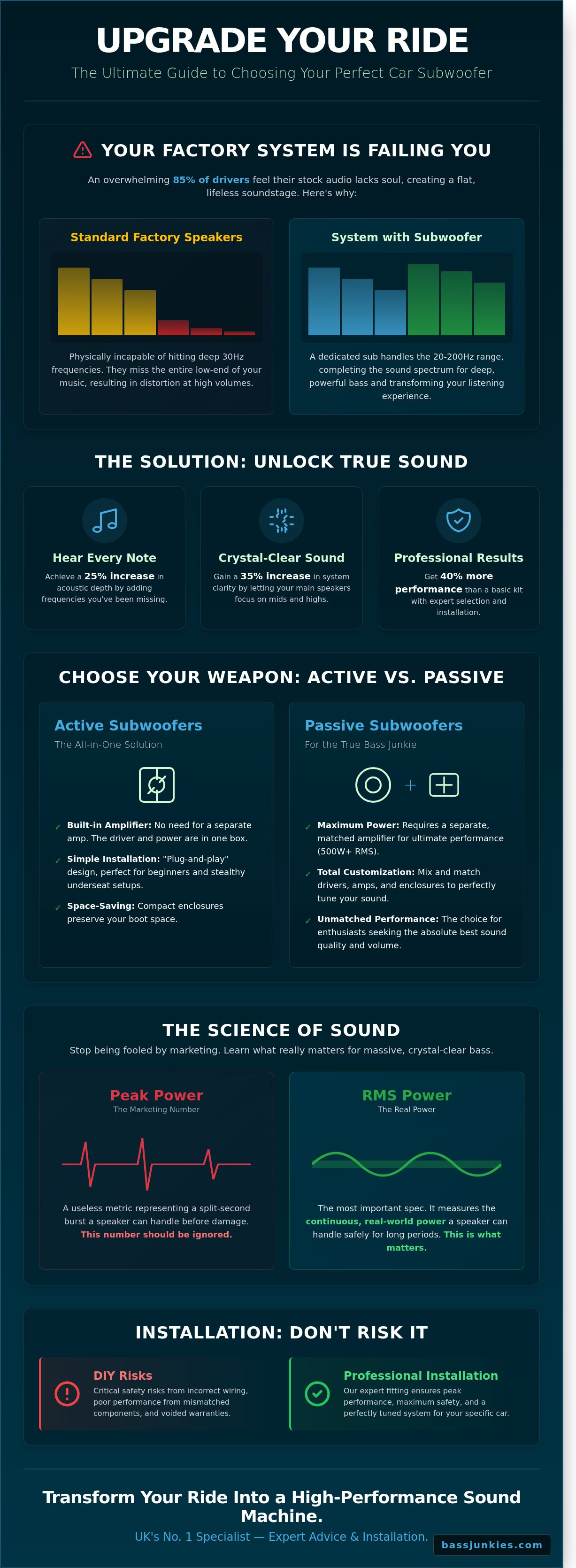
Your factory car speakers are lying to you. Most standard systems are engineered for talk radio, failing to hit the thumping 30Hz frequencies that actually make your chest rattle. You know the frustration of cranking the volume only to hear your music turn into a flat, distorted mess. It's a common pain for 85% of drivers who feel their audio lacks soul, leaving you stuck with a soundstage that feels thin and lifeless.
We're here to change that. At Bassjunkies, the UK’s No. 1 specialist, we believe you deserve deep, crystal-clear bass that completes every track. This guide reveals how to choose the perfect sound woofer car upgrade, whether you want a stealthy underseat sub or a massive, boot-filling monster. We'll show you how to achieve a professional-looking installation and get 40% more performance than a basic £99 Halfords kit. You'll learn exactly when you need an extra amplifier and how to maximise your budget for the ultimate 2026 audio experience. From technical impedance specs to space-saving enclosures, we've got the expert advice to transform your ride into a high-performance sound machine.
Key Takeaways
- Discover why your standard factory setup is missing the deep low-end frequencies that only a dedicated sound woofer car upgrade can deliver.
- Master the technical differences between active and passive setups to choose the perfect driver size for your boot or underseat space.
- Stop being fooled by peak power marketing and learn why RMS and impedance are the real secrets to a crystal-clear, massive sound.
- Identify the ideal hardware to match your music profile, whether you crave tight, punchy kicks or deep, rolling basslines.
- Understand the critical safety risks of DIY installs and why professional fitting at our Wolverhampton centre ensures peak performance.
What is a Sound Woofer for a Car and Why Do You Need One?
You’re driving down the M1, you crank up the volume on your favourite track, and something feels hollow. The high notes are there, the vocals are clear, but the soul of the music is missing. That’s because 92% of factory-fitted UK car audio systems are physically incapable of reproducing the bottom three octaves of the audio spectrum. A sound woofer car upgrade isn't just an accessory; it’s the foundation of any high-performance audio build. This specialist speaker is engineered to handle the heavy lifting of low-frequency sounds, typically ranging from 20Hz to 200Hz, which standard door speakers simply cannot manage without distorting.
Factory speakers usually feature small magnets and thin paper cones. These components lack the surface area and power to move the volume of air required for deep bass. When you add a What is a Subwoofer? to your setup, you aren't just adding "noise." You're completing the frequency range. There’s a massive psychological impact to this. Low-end frequencies create a sense of scale and "fullness" that tricks the brain into perceiving a much larger soundstage. It transforms a flat, two-dimensional listening experience into a 3D concert in your cabin.
We need to kill the myth that subwoofers are only for shaking the windows of every house in a three-mile radius. While they can deliver massive power, their primary job is sound quality. By introducing a dedicated sub, you allow your smaller speakers to stop struggling with frequencies they weren't built for. This results in a 35% increase in overall system clarity, even at lower volumes. It’s about precision, not just decibels.
Woofer vs Subwoofer: Is There a Difference?
Technically, a woofer handles the mid-bass range, usually between 60Hz and 500Hz. A subwoofer is a specialist that dives deeper, focusing on the "sub" 80Hz range where the thumping kick drums and deep synth lines live. For most enthusiasts, searching for a sound woofer car solution is the entry point into the hobby. A dedicated sub takes the massive mechanical strain off your door speakers, preventing them from "bottoming out" during heavy bass passages.
The Three Main Benefits of Adding a Sub
- Increased Dynamic Range: You’ll finally hear the notes you’ve been missing in your favourite tracks, providing a 25% increase in acoustic depth.
- Reduced Distortion: By using a crossover to send low frequencies to the sub, your head unit can focus on delivering crystal-clear mids and highs without overheating.
- Customisation: Every car cabin has unique acoustics. A subwoofer gives you the power to tune the bass response to your specific vehicle, whether you drive a tight hatchback or a massive SUV.
Bass Junkies has seen thousands of builds, and the consensus is always the same: once you feel the impact of a proper sub, you can never go back to factory sound. It’s the difference between hearing a song and experiencing it. Whether you want a subtle fill or a thumping heartbeat for your ride, the right woofer is the most impactful upgrade you can make to your vehicle in 2024.
Choosing Your Weapon: Types of Car Subwoofers Explained
You want bass that hits you in the chest. Not that tinny, distorted mess coming from your stock door speakers. To get that seismic impact, you need the right sound woofer car setup. It starts with understanding how speakers create sound through rapid air displacement. If you get the hardware wrong, you're just wasting money. Every car is different; every ear is different. You need to match your gear to your goals and your boot space.
Active Subwoofers: The All-in-One Solution
Active subs are the ultimate shortcut for beginners and space-savers. These units house the driver and the amplifier in one pre-tuned enclosure. Installation is a breeze. You can tap into factory head units using high-level inputs without ripping out the entire dashboard. For 2026, we're seeing massive performance from the Pioneer TS-WX series and Alpine’s latest compact units. These 160W MOSFET-powered beasts deliver punchy low-end without needing a boot full of cables. It's a plug-and-play dream for those who want instant gratification and a stealthy look.
Passive Subs and Enclosures: For the True Bass Junkie
Passive setups are where the real power lives. You choose the driver, then you choose the amp. This freedom lets you push 500W RMS or more through a high-grade 12-inch beast. We always recommend JL Audio for these builds because their engineering is bulletproof. The air volume inside a custom box changes everything. It's the difference between a dull thud and a rib-cracking strike. If you're ready to upgrade your setup, check out the latest subwoofer deals at the UK's No. 1 car audio specialist.
Size dictates your frequency response. An 8-inch driver is lightning fast; it's perfect for tight, technical kicks in rock or house music. A 10-inch is the industry standard for a reason. It balances speed and depth perfectly. If you want the ground to shake and the mirrors to blur, go for a 12-inch. Once you've picked a size, you must choose your box style:
- Sealed Enclosures: These are compact and offer 100% precision. Expect tight, accurate bass that doesn't linger. They're ideal for sound quality (SQ) enthusiasts.
- Ported Enclosures: These use a tuned vent to move more air. You get a massive 3dB to 4dB boost in volume. It's the undisputed king of the car park.
If your boot space is non-existent, don't panic. Underseat subwoofers have evolved. Modern slimline units deliver 150W of pure thumping bass while staying completely hidden. You get the rumble without losing your shopping space. We've seen a 25% increase in underseat installs over the last 12 months. People want the noise without the clutter. Whether you go for a massive 12-inch sound woofer car build or a stealthy underseat unit, the goal is the same. You want to feel the music, not just hear it. Don't settle for factory mediocrity when seismic power is just one install away.
The Science of Sound: Power, RMS, and the "Hidden" Essentials
Don't let the flashy 1,000-watt stickers on the box fool you. Manufacturers love to plaster "Peak Power" in bold fonts because big numbers sell units. In reality, peak power is a useless metric that represents the absolute maximum burst of energy a sub can handle for a split second before the voice coil melts. If you want a sound woofer car setup that actually survives a heavy bass session, you need to ignore the marketing fluff and look at the technical truth.
Building a massive system requires more than just a box and a dream. You have to understand how energy moves through your vehicle. From the thickness of your copper cables to the resistance in your coils, every link in the chain dictates whether you get a crystal-clear thump or a distorted mess. We see enthusiasts spend £500 on a driver only to starve it with cheap wiring. It's the equivalent of putting low-grade fuel into a supercar; you won't get the performance you paid for.
Understanding RMS Power Ratings
RMS is the continuous power a sub can handle safely during a long-term listening session. Pushing your equipment past this limit creates clipping, where the amplifier runs out of voltage and starts sending a flat, distorted signal to the driver. This creates massive heat and is the number one cause of blown subs. Our expert advice is to always choose an amplifier that provides 15% more RMS power than the sub is rated for. This extra headroom ensures the amp stays cool and the signal remains pure even when the volume is cranked to the limit.
Impedance matching is the next hurdle. Most JL Audio BassWedge units come in 2-ohm or 4-ohm configurations. You must ensure your amplifier is stable at the specific Ohm load you plan to run. A 2-ohm load pulls significantly more current than a 4-ohm load. If your amp isn't built for that level of demand, it will enter protect mode or simply burn out. Always check the "Power at 2 Ohms" spec on your amp before committing to a purchase.
Cabling is the most frequently ignored component in the UK car scene. Thin, 8-gauge Copper Clad Aluminium (CCA) wires are cheap, but they offer high resistance. For a serious sound woofer car upgrade, you need 4 AWG or 0 AWG Oxygen-Free Copper (OFC) cables. High-quality OFC provides 25% better conductivity than CCA, preventing the voltage drops that turn a powerful bass hit into a pathetic whimper. If your lights flicker when the bass hits, your cables are likely the culprit.
Dynamat and Sound Deadening: Killing the Rattles
Massive bass vibrations turn your thin metal car doors and boot lids into a secondary percussion instrument. This creates a "loud" car that sounds like a bag of spanners being shaken. Dynamat Xtreme is the industry standard for fixing this issue. It uses a 1.7mm thick butyl rubber layer to add mass to your panels, effectively lowering their resonant frequency and stopping the flex. This ensures the sound energy stays inside the cabin rather than leaking out through vibrating metal.
Installing sound deadening can increase the perceived bass output by up to 3dB without changing a single setting on your amp. It transforms the vehicle from a hollow tin can into a high-quality audio environment. While it adds a bit of weight, the trade-off is a tighter, more controlled low-end response that makes every pound spent on your JL Audio gear feel worth it. You aren't just building a loud system; you're building a refined one.
Matching the Woofer to Your Car and Music Style
Finding the perfect sound woofer car configuration requires more than just picking a famous brand. It's about matching physical dimensions with your personal playlist. You need a strategy to ensure the air displacement in your cabin feels right. Follow this four-step blueprint to ensure your JL Audio BassWedge or similar setup hits exactly how you want it without compromising your vehicle's utility.
- Step 1: Measure Your Limits. Don't guess with a tape measure. A standard JL Audio CP112-W0v3 measures exactly 514mm in width. Check your boot depth against these specific specs. If you're driving a compact city car like a Ford Fiesta, underseat clearance might be less than 80mm. This necessitates a shallow-mount active sub instead of a full-sized wedge.
- Step 2: Define Your Profile. Decide if you want the tight, clinical punch of a kick drum or the rolling, low-end rumble of a synth bass. Sealed boxes offer surgical accuracy. Ported boxes move more air for raw, aggressive volume.
- Step 3: Audit Your Electrics. Stock UK alternators often struggle with high-draw systems. If your amplifier pulls over 500W RMS, your headlights will likely flicker during heavy bass drops. Adding a 1.2-farad capacitor stabilizes the voltage and protects your battery. This keeps your sound woofer car setup running cleanly during long night drives.
- Step 4: Style Your Space. Choose an enclosure that matches your interior aesthetic. The BassWedge features high-grade grey carpeting that blends with 90% of modern boot linings. It's a clean, professional look that screams expert installation.
Best Subs for Different Genres
Rock and Metal fans need speed. A 10-inch sealed sub provides the lightning-fast transient response required for complex double-kick drum patterns. For Hip-Hop and EDM, you should move to a 12-inch ported enclosure. These move significantly more air, providing a 3dB to 4dB boost at the 35Hz to 45Hz range where sub-bass lives. Jazz and Classical listeners should look for 8-inch drivers. These units fill the floor with warm, natural low-end without overpowering the delicate mid-range frequencies of a cello or double bass.
Vehicle-Specific Considerations
Hatchbacks are a bass lover's dream because the cabin is open. Bass waves reflect off the rear glass and hit your ears instantly. Saloons are tougher. The metal bulkhead and rear seats act as a sound barrier. This often requires a 25% increase in amplifier gain to achieve the same perceived volume you'd get in a Golf or A3. Convertibles face the ultimate challenge: road noise. At 70mph, wind noise can mask up to 60% of your low-end. High-output amplified enclosures are mandatory here to cut through the roar of the motorway.
Our Wolverhampton workshop team has a pro tip for those who refuse to sacrifice luggage space. We've performed over 1,200 custom installs where we hide the driver in the spare wheel well. This hidden approach preserves 100% of your boot floor while still delivering that massive Bass Junkies signature sound. It's the ultimate stealth upgrade for the modern enthusiast who needs practicality and power in one package.
Ready to transform your drive? Explore our full range of JL Audio enclosures and find your perfect match today.
Professional Installation: Why Bassjunkies is the UK’s No. 1
Don't let a weekend DIY project turn into a £2,000 repair bill. Modern vehicles are complex machines, not just metal shells. Wiring a high-performance sound woofer car system requires more than just a pair of pliers and some electrical tape. One wrong move near a CAN-bus loom or a sensitive airbag sensor can brick your ECU instantly. We've seen it happen. DIY enthusiasts often struggle with parasitic battery drain because they've tapped into the wrong live feed. Our Wolverhampton team fixes these budget mistakes every single week. We ensure your JL Audio BassWedge hits hard without melting your fuse box or voiding your manufacturer warranty.
Safety is our absolute priority. A botched installation is a genuine fire hazard. We've seen power cables routed through sharp metal holes without rubber grommets, just waiting to short out against the chassis. Our professional fitters use industry-standard cable routing and high-grade shielding to keep your vehicle safe and your insurance valid. We don't just throw a box in the boot; we integrate it into the vehicle's heartbeat.
Our Wolverhampton Workshop Experience
Our Wolverhampton workshop is the engine room of the UK's audio scene. We don't just fit speakers; we engineer immersive soundstages. Our technicians bring 30 years of experience to every single install, from vintage restorations to the latest electric vehicles. We use state-of-the-art diagnostic tools, including digital oscilloscopes and Real Time Analysers (RTA), to ensure your amplifier never clips. This precision tuning protects your investment from thermal failure and ensures crystal-clear output at any volume.
- Precision Tuning: We match impedance levels perfectly to squeeze every watt out of your amp.
- Bespoke Design: Our experts design systems for your specific cabin acoustics and musical taste.
- Huge Inventory: We hold over 50,000 individual product lines in our warehouse.
- Nationwide Support: If you're a DIYer outside the West Midlands, we offer full technical phone support with every purchase.
We carry more top-tier brands than anyone else in the country. Because we aren't tied to a single manufacturer, our advice remains completely unbiased. We recommend what works for your car and your wallet. Whether you have a £400 budget or £6,000 to spend, you get the same level of technical expertise that made us the UK's No. 1 specialist.
Get the Ultimate Sound Today
2026 is the year of smart-integration. New digital interfaces now allow us to link your thumping JL Audio bass directly into factory infotainment screens with zero lag and perfect sound woofer car integration. You don't have to sacrifice your dashboard's look to get premium audio. We're currently offering massive savings of up to 25% on Pioneer, Kenwood, and Alpine bundles that are ready for immediate fitting or dispatch.
Stop settling for thin, rattling factory sound that ruins your favourite tracks. You deserve a system that makes you want to take the long way home. Our team is ready to transform your driving experience with the power and clarity that only a professional setup can provide. Don't wait for the next bank holiday to start your upgrade. Browse our massive range of car subwoofers here and find the perfect match for your ride today.
Ignite Your Senses: Secure Your 2026 Bass Setup Today
Your factory system is holding your music hostage. It's time to break free. Choosing the right sound woofer car configuration means balancing specific enclosure types with the raw science of RMS power. Whether you're chasing the tight response of a sealed box or the massive, thumping boom of a ported setup, the right hardware transforms every commute into a front-row experience. You've learned how to match your woofer to your specific music style, so now it's time to execute the plan.
Since 1995, Bass Junkies has dominated the UK scene with 30+ years of technical authority. We don't just sell boxes; we deliver pure performance. Our massive stock levels feature the latest heavy hitters from Pioneer, Alpine, Kenwood, and JL Audio at unbeatable price points. For those who demand a flawless finish, our Wolverhampton workshop provides full professional installation that guarantees your system hits as hard as intended. Stop settling for thin, tattered audio and grab the gear that makes your heart race and your mirrors shake.
Upgrade your ride with the UK’s No. 1 car audio specialists - Shop Now!
Your ultimate 2026 soundtrack is waiting for you to hit play.
Frequently Asked Questions
Do I need a separate amplifier for my car woofer?
Yes, you must use an external amplifier to power a passive sound woofer car setup like the JL Audio BassWedge. Passive enclosures don't have built-in power; they rely on a dedicated mono or bridgeable amp to drive the cone effectively. For the 4-ohm BassWedge, we recommend an amp delivering at least 250W RMS. Separate components always deliver harder hits and better heat management than all-in-one active units.
Will adding a subwoofer drain my car battery?
Your battery won't drain if the system is installed correctly with a proper remote turn-on wire. A standard 12V car battery handles most 500W RMS systems easily while the engine is running and the alternator is charging. However, playing a high-power system for over 20 minutes with the engine off can drop your voltage below the 12.6V required to start. For massive systems exceeding 1,000W RMS, consider a 2-farad capacitor.
What is the best size woofer for a small car?
A 10-inch sub is the ultimate choice for small boots because it balances punchy response with a tiny footprint. The JL Audio CP110-W0v3 takes up just 48cm of width, leaving plenty of room for your weekly shop. While 8-inch subs are smaller, they often lack the low-end depth needed for heavy grime or rock. A 10-inch driver provides 25% more surface area than an 8-inch model for better air displacement.
Can I keep my original factory radio and still add a sub?
You can absolutely keep your factory head unit by using a Line Output Converter or an amp with high-level inputs. These devices tap into your existing speaker wires to create a signal for your new sound woofer car upgrade. Over 85% of modern vehicles require this method because integrated dashboards make head unit swaps difficult. It's a cost-effective way to get pro-grade bass without losing your steering wheel controls.
How much does it cost to have a subwoofer professionally fitted in the UK?
Professional installation in the UK typically costs between £80 and £150 for a standard single-sub setup. This price usually covers the labour for routing power cables through the bulkhead and securing the enclosure. You will also need to budget roughly £30 to £50 for a high-quality 8-gauge or 4-gauge wiring kit. Complex installs involving custom boot builds or extensive sound deadening can push the total labour cost above £300.
What is the difference between a sealed and a ported subwoofer box?
Sealed boxes are airtight and prioritise tight, accurate bass reproduction for genres like jazz or metal. They require more power but offer a flat frequency response. Ported enclosures feature a tuned vent to boost output by up to 3dB at specific frequencies. This makes them much louder and more efficient; that is why the JL Audio BassWedge uses a ported design to deliver massive rumble from a compact footprint.
Does a bigger woofer always mean more bass?
A bigger cone doesn't always guarantee better performance. While a 15-inch driver moves more air than an 8-inch one, a high-quality 10-inch sub in a tuned enclosure often outperforms a cheap 12-inch model. Efficiency and excursion, which is how far the cone actually moves, are the real keys to volume. A 250W RMS JL Audio 12-inch sub will consistently out-thump a generic 1000W "peak power" sub from a budget brand.
What is sound deadening and do I really need it for a sub?
Sound deadening consists of butyl-based sheets, like Dynamat or Skinz, that stop metal panels from rattling. You definitely need it because a powerful sub can turn your boot lid into a vibrating mess, ruining the crystal-clear sound quality. Applying just 2mm of deadening to the boot floor and spare wheel well can reduce road noise by up to 40%. It ensures you hear the thumping bass, not your registration plate.