
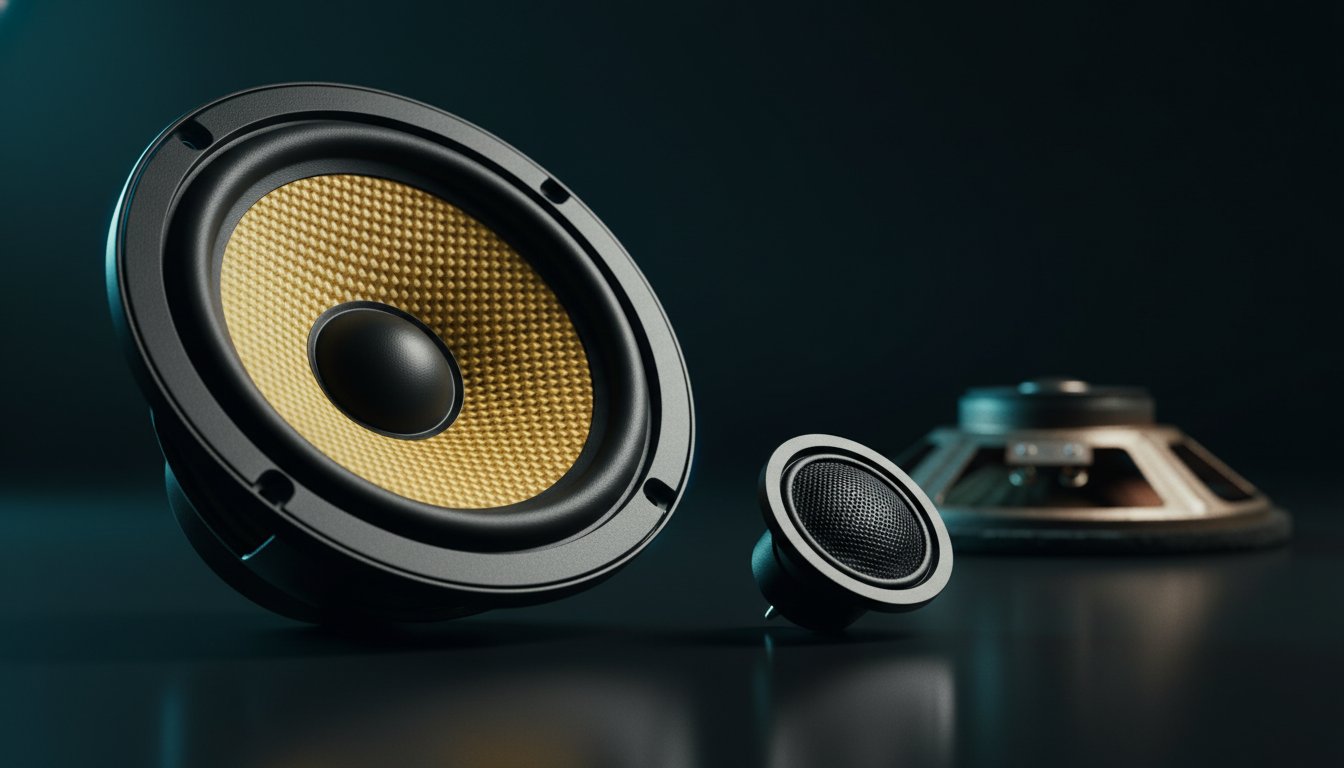
Most factory car speakers are built with 15-watt paper cones that physically cannot handle high-volume playback without distorting. This car speaker upgrade guide provides the technical roadmap to replace those weak components with high-sensitivity drivers that deliver crystal-clear highs and thumping bass. You'll learn to identify the correct 165mm or 6x9-inch drivers that fit your specific door cards without permanent modification. We focus on high-octane performance that maintains 100% compatibility with your vehicle's original wiring looms and mounting depths.
You've likely felt the frustration of sound quality crumbling as soon as the volume dial goes up. We promise to show you how to choose between coaxial and component setups to ensure your audio remains punchy and rattle-free even at peak output. This guide previews the essential tools, mounting baffles, and wiring techniques required for a flawless 2026 audio overhaul. We'll walk through the technical specs of impedance matching and the latest installation kits to keep your steering wheel controls fully functional.
Key Takeaways
- Swap weak factory paper-cone drivers for high-performance materials like silk or Kevlar to eliminate distortion and boost clarity.
- Use this car speaker upgrade guide to decide between simple coaxial "all-in-one" installs or precision component systems for a superior soundstage.
- Learn how to pair your new speakers with dedicated amplifiers and sound deadening to ensure massive headroom and a rattle-free cabin.
- Identify standard UK speaker sizes and check mounting depths to guarantee your new magnets do not obstruct window glass operation.
- Understand the technical benefits of professional installation, from custom baffle fabrication to ensuring your system is perfectly in-phase.
What is the best way to upgrade car speakers for better sound?
The most effective way to upgrade car speakers for better sound is to replace factory-installed paper-cone units with high-quality aftermarket speakers featuring superior materials like silk, polypropylene, or Kevlar. Standard UK vehicle manufacturers typically use cheap, flimsy materials that cannot handle high volumes without distorting. Swapping these for robust aftermarket drivers provides an immediate boost in clarity and frequency response. For the best results, you must follow a "System Approach" by combining new drivers with sound-deadening materials and a clean power source. This car speaker upgrade guide ensures you move away from muddy audio toward a crystal-clear, high-performance listening experience.
Factory speakers fail because they are built to a budget. Most original equipment manufacturers (OEM) use tiny magnets and thin paper diaphragms that lack the structural integrity to control cone movement accurately. This leads to significant distortion at even moderate volume levels. When you switch to aftermarket sets, you benefit from massive magnets and rigid cones that provide precise control. You can expect a massive increase in volume and a much wider frequency range that brings your music to life.
The difference between factory and aftermarket speakers
The "paper cone" problem is the primary reason for poor audio in most standard UK vehicles. Paper absorbs moisture and degrades over time, leading to a loss of tension and poor sound reproduction. Aftermarket speakers use synthetic materials like Kevlar or carbon fibre to ensure the cone remains stiff under pressure. These materials allow the speaker to move faster and stop more accurately, which is essential for "thumping" bass and crisp highs.
High-quality magnets in aftermarket sets improve cone control significantly compared to the 10-gram magnets often found in stock units. A larger, more powerful magnet allows the voice coil to react instantly to changes in the audio signal. It is a common mistake to think that "louder" means "better" during a car audio overhaul. True quality comes from increased fidelity and the ability to maintain a clean signal at high decibels. To find the right hardware for your vehicle, you can view car speakers from the UK’s leading brands.
Modern car audio systems are complex, but the physical quality of the driver remains the most critical factor. Aftermarket speakers are designed to last for the life of the vehicle, whereas factory units often show signs of wear after just three years of heavy use.
Key technical specs you must know
- RMS Power vs Peak Power: Only shop by RMS ratings. While "Peak Power" looks impressive on the box, it only measures short bursts of energy. RMS (Root Mean Square) measures continuous power handling, which is the only figure that matters for long-term reliability.
- Sensitivity: If you are not adding an external amp, look for speakers with a high sensitivity rating, typically 90dB or higher. This allows the speakers to produce more sound with the limited power provided by a standard factory head unit.
- Impedance: Ensure your new speakers match your head unit’s 4-ohm standard. Using 2-ohm speakers on a 4-ohm system can cause the internal amplifier to overheat and fail.
Understanding these specifications is vital for any car speaker upgrade guide. Matching the power output of your stereo to the RMS rating of your speakers prevents "clipping," which is the leading cause of blown drivers. If you want the ultimate performance, consider adding a 4-channel amplifier to provide the raw power these high-end speakers crave.
Should you choose coaxial or component car speakers?
Your choice between coaxial and component speakers depends on your budget, installation skills, and how much you value audio precision. Coaxial speakers offer a simple "all-in-one" solution by mounting the tweeter directly over the woofer cone, making them the perfect drop-in replacement for factory units. Component sets provide superior sound quality by separating the tweeter from the woofer, which allows for better imaging and a more realistic soundstage. While coaxial units are easier to install, component systems are the preferred choice for high-performance builds. This car speaker upgrade guide helps you identify which path fits your vehicle and your listening habits.
Coaxial speakers: The budget-friendly upgrade
Coaxial speakers, often called full-range speakers, contain all the necessary drivers within a single basket. The tweeter sits on a pole or bracket directly over the woofer. This clever design saves massive amounts of space and simplifies the wiring process. It's the most efficient way to replace tired, factory-fitted paper cones with something that delivers punchy, crystal-clear sound.
These units are the go-to choice for rear doors or vehicles with limited mounting depth where you cannot fit separate drivers. You get a significant boost in clarity without having to cut new holes in your door cards or dash. If you need a reliable, high-performance swap that doesn't break the bank, you can view our range of coaxial car speakers to find a direct fit. This is the fastest route for anyone using a car speaker upgrade guide to improve their daily drive quickly.
Component speakers: The enthusiast’s choice
Component speakers are designed for listeners who refuse to compromise on audio fidelity. These sets include separate woofers, tweeters, and external crossovers. The crossover is a critical piece of hardware that filters the audio signal. It ensures high frequencies go to the tweeter while mid-bass frequencies stay with the woofer, preventing distortion and protecting your drivers.
When understanding car audio systems, you quickly learn that tweeter placement is everything. Component sets allow you to mount tweeters at ear level on the dash or A-pillars. This creates a wide, immersive soundstage that makes the music feel like it is coming from the bonnet rather than your feet. It provides a level of detail and separation that coaxial speakers simply cannot match.
These systems are the foundation of any high-performance car audio system. They handle more power and offer cleaner separation, making them ideal for use with external amplifiers. While they require more effort to install, the result is a thumping, crystal-clear performance. If you are serious about your sound, it is time to upgrade your car speakers to a premium component set and experience your music as the artist intended.
Why do new car speakers need amplifiers and sound deadening?
New car speakers require dedicated power and acoustic treatment because factory systems cannot provide the wattage or stability needed for high-fidelity audio. Most factory head units only produce 10 to 15 watts RMS per channel. High-performance aftermarket speakers often require 50 to 100 watts RMS to function correctly. Without an external power source, these speakers will suffer from signal clipping and audible distortion at higher volumes. Sound deadening is equally vital as it stops thin metal door panels from vibrating, which prevents the cancellation of mid-bass frequencies and lowers the cabin noise floor by up to 6dB. The biggest misconception in any car speaker upgrade guide is that premium drivers alone will fix a thin, rattling sound. If you install high-end Focal or Alpine components into a bare metal door, the speakers will struggle against the resonance of the vehicle itself. You need clean power to provide "headroom" for dynamic peaks in your music. This ensures that a sudden drum hit or bass drop remains crystal-clear rather than sounding compressed or flat.Adding a 4-channel amplifier for maximum punch
Standard factory head units are designed for efficiency and low cost, not high-octane performance. They quickly run out of steam when pushed, leading to clipped signals that can actually overheat and destroy your new voice coils. Integrating a dedicated car amplifier provides the massive, sustained energy required to move larger speaker magnets with precision. You can choose between compact "hidden" Class D amps that tuck behind the dashboard or full-sized performance units for the boot. Compact amps are perfect for modern vehicles with limited space, offering a significant boost over stock power. Full-sized units typically provide better heat dissipation and more MOSFET power for those who want the ultimate thumping experience.The Dynamat effect: Stopping the rattles
Applying sound deadening kits transforms a flimsy door skin into a rigid, sealed speaker enclosure. When a speaker cone moves forward, it also sends a sound wave backward into the door cavity. Without deadening, this causes the metal to flex and vibrate, creating "out-of-phase" sounds that muddy your audio. * Lowering the noise floor: Reducing road and tyre roar means you hear more detail at lower volumes. * Improved Mid-bass: A stiffened door panel allows the speaker to kick harder without the metal buzzing. * Thermal Insulation: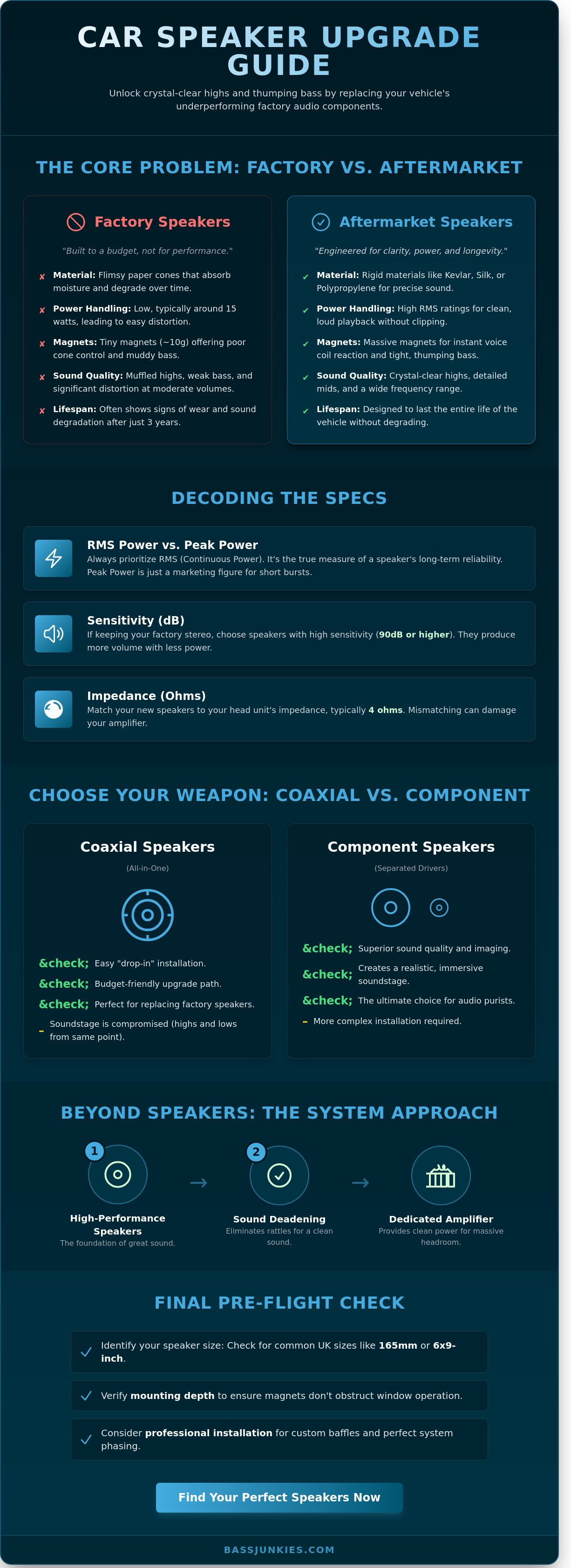
How do you check car speaker compatibility and fitment?
To check car speaker compatibility, you must match the factory diameter and ensure the mounting depth clears the window glass. Most UK vehicles use 10cm, 13cm, 17cm, or 6x9 inch speakers. This car speaker upgrade guide recommends using vehicle-specific speaker adaptors and wiring harnesses to facilitate a "no-cut" installation. This approach preserves factory features like parking sensors and steering wheel controls while providing a stable platform for your new drivers.
UK car manufacturers typically stick to four main sizes. 10cm and 13cm units often sit in dashboards or rear parcels. 17cm drivers are the standard for front doors, while 6x9 inch speakers provide the heavy lifting in rear shelves. Using this car speaker upgrade guide, you can identify which size fits your specific make and model without guesswork.
Depth is the silent killer of many DIY installs. If your new speaker has a massive magnet, it might stop your window from rolling down. Always measure the distance between the mounting surface and the glass in its lowest position. If clearance is tight, slim-line speakers or thicker mounting baffles are the solution.
Wiring is equally critical for a professional finish. Factory plugs are proprietary and won't fit aftermarket terminals. Using dedicated harnesses offers several benefits:
- Use T-harnesses to avoid voiding your vehicle warranty.
- Ensure polarity is correct to prevent phase cancellation.
- Maintain factory warnings like seatbelt and parking sensor tones.
- Allow for a total return to factory settings if you sell the car.
Measuring your mounting depth
Standard sizes fluctuate between manufacturers. A 17cm Pioneer speaker might have a different mounting hole alignment than a Kenwood equivalent. You should use MDF or high-quality plastic baffles to create a solid, vibration-free seal. These spacers also provide that crucial extra few millimetres of clearance for deeper magnets. You can browse essential installation accessories to find the right spacers for your vehicle.
Connects2: Keeping your steering wheel controls
Modern cars rely on complex digital networks to manage audio. If you chop into the factory loom, you risk losing parking sensor chimes or steering wheel button functionality. Connects2 interfaces act as a bridge between your car’s digital brain and your aftermarket gear. These plug-and-play kits mean you don't have to guess which wire does what. They ensure your new car stereo integrates perfectly with the existing OEM wiring.
Is professional car speaker installation worth the cost?
Professional car speaker installation is worth the investment for any driver demanding high-fidelity sound and vehicle safety. Expert installers eliminate the risk of snapped door card clips and internal short circuits that occur when wires rub against sharp metal edges. They use professional-grade tools to ensure every connection is secure and weatherproof. This technical precision prevents the common DIY pitfall of "out-of-phase" wiring, where speakers cancel each other's output and destroy your bass response. Following a car speaker upgrade guide is a great start, but a pro brings the fabrication skills needed for custom baffles that maximise driver excursion. They ensure your equipment operates within its thermal limits, preventing blown voice coils on day one.
A professional finish guarantees that your car's interior remains rattle-free and your manufacturer warranty stays intact. DIY enthusiasts often overlook the physical stress placed on factory wiring. Pros know when to bypass thin factory looms in favour of high-current cables that can actually handle the power of an aftermarket amplifier. They also possess the specialised trim removal tools required to access speakers without scarring your dashboard or door plastics. If you want the loudest, cleanest results without the headache of fixing broken trim, professional fitting is the only way to go.
Tuning your system for the perfect beat
Professional installers use RTA (Real Time Analyser) equipment to map your cabin's unique acoustics. They adjust gain settings and crossover points to prevent distortion at high volumes, ensuring your tweeters and mid-bass drivers blend seamlessly. This process corrects the acoustic peaks and dips caused by your car's glass and plastic surfaces. A professionally fitted subwoofer is the final piece of the puzzle for a complete 3-way sound experience. It fills the low-end gap, allowing your main speakers to play louder and cleaner by removing the burden of heavy bass frequencies.
The ultimate upgrade checklist
Before you pull the trigger on new gear, you need to verify your hardware compatibility. This car speaker upgrade guide recommends a final check of your amplifier's RMS ratings against your speakers' continuous power handling. Peak power ratings are marketing fluff; RMS is the figure that actually determines performance. Check the mounting depth of your chosen drivers to ensure windows can still roll down fully after installation. You should also factor in the cost of sound deadening material to kill resonance and improve mid-bass response by at least 3dB to 5dB.
- Verify RMS power matching to avoid thermal failure.
- Check mounting depth and basket diameter for a flush fit.
- Order 2mm butyl sound deadening for all door skins.
- Use 14-gauge or 16-gauge OFC speaker cable for high-current amplifier runs.
- Ensure you have the correct wiring harnesses to avoid cutting factory plugs.
Ready for thumping sound? Explore our latest car speaker offers and get the expert gear your ride deserves. Don't settle for factory thin sound when massive audio performance is just an upgrade away.
Ready to Build Your Ultimate In-Car Concert?
Factory door speakers are built to a budget, not for performance. To get the best results, always prioritise component speakers for the front stage and support them with a dedicated power source. Adding a 4-channel amplifier and high-quality sound deadening isn't optional if you want crystal-clear mids and thumping mid-bass. These upgrades eliminate distortion and block out the drone of the UK's motorways. Use this car speaker upgrade guide to verify your vehicle's specific fitment and mounting depths before you buy.
Bassjunkies has been the authority in high-octane audio since 1995. We provide huge savings on top-tier brands like Alpine and Focal, ensuring you get premium gear without the premium price tag. Whether you need technical advice on impedance matching or want to book professional UK-wide installation, our team is ready to help. Don't let a weak factory system ruin your drive. Grab the gear that makes every journey an event.
Upgrade your ride with the UK’s No. 1 car audio specialist
Frequently Asked Questions
Do I need an amplifier if I upgrade my car speakers?
You don't always need an external amplifier, but it's the best way to unlock the full potential of high-end aftermarket speakers. Most factory head units only push 15 to 22 watts RMS per channel, which leaves premium speakers underpowered and prone to distortion. Adding a 4-channel amplifier ensures your new kit gets the 50 to 100 watts RMS it needs for thumping, crystal-clear sound at high volumes.
What size speakers do I need for my car?
Speaker sizes vary by vehicle, but the most common UK fitments are 13cm, 16.5cm, and 6x9 inch units. You can find your specific requirements by checking your car's manual or using an online fitment guide based on your registration number. This car speaker upgrade guide recommends measuring your existing factory units before purchasing. While 16.5cm is a standard door size for 75 percent of modern hatchbacks, some vehicles require specific mounting adapters.
Is it better to have 2-way or 3-way car speakers?
It's better to choose 2-way speakers for standard door upgrades because they offer a balanced sound signature that's easier to drive. A 2-way coaxial speaker uses a woofer and a tweeter to handle the frequency range, while a 3-way adds a mid-range driver for extra detail. Unless you're building a high-fidelity system with a dedicated DSP, a 2-way component set usually provides the cleanest imaging for most UK drivers.
Will upgrading my speakers void my car warranty?
Upgrading your car speakers won't void your entire vehicle warranty, as the Consumer Rights Act 2015 protects your right to use aftermarket parts. The manufacturer can only reject a claim if they prove the new audio equipment directly caused a specific electrical fault. To stay safe, use vehicle-specific wiring harnesses to avoid cutting factory looms. This keeps the installation 100 percent reversible and protects your manufacturer's guarantee.
Can I replace just the front speakers and leave the rears factory?
You can absolutely replace just the front speakers, and it's actually the most cost-effective way to improve your soundstage. Since the driver and passenger sit at the front, 80 percent of the perceived audio quality comes from the front doors. Swapping factory paper cones for high-performance components up front creates an immediate impact. You can always upgrade the rear fill later if you want a fully immersive, 360-degree audio experience.
How much should I spend on a car speaker upgrade?
A solid entry-level speaker upgrade in the UK typically starts around £50 to £80 for a pair of high-quality coaxial units. If you're chasing ultimate performance, expect to invest between £150 and £300 for premium component sets that include external crossovers. Don't forget to budget roughly £20 for sound deadening material. Adding vibration dampening to your doors can improve mid-bass response by up to 3dB without changing any other components.