

The "premium" factory audio system you paid extra for is actually the weakest link in your vehicle's performance. Upgrading your car audio and multimedia setup for 2026 requires moving from low-output factory chips to high-performance MOSFET power and 4-volt pre-outs. Most stock head units deliver a mere 7 to 10 watts RMS per channel, which leads to instant distortion. Aftermarket units provide a minimum of 22 watts RMS, ensuring crystal-clear audio even when the volume is cranked.
You've likely felt the frustration of muddy sound and the total lack of modern smartphone integration in a standard rig. You deserve a system that offers seamless CarPlay and Android Auto alongside thumping, high-fidelity output. This guide promises to demystify technical terms like impedance and RMS so you can build the ultimate high-performance setup without the guesswork.
We're comparing the latest 2-DIN multimedia units against factory hardware to highlight the best upgrade paths for your vehicle. From DAB+ integration to choosing the right 4-channel amplifier, you'll learn exactly what parts are needed for a professional-grade installation.
Key Takeaways
- Boost your system's output by 3x-5x by swapping flimsy factory paper cones for high-performance composite aftermarket materials.
- Navigate the technical differences between car audio and multimedia setups to decide if an all-in-one coaxial or a precision component set fits your build.
- Compare "plug-and-play" active subwoofers against customisable passive enclosures to find the ultimate balance between boot space and thumping low-end.
- Upgrade your dashboard with the latest multimedia centres, using floating screen tech to bring massive 2-DIN functionality to restricted 1-DIN slots.
- Avoid the risks of "grey market" imports by securing genuine UK stock and expert technical support from the UK’s No. 1 car audio specialist.
What is the difference between factory car audio and aftermarket systems?
Aftermarket car audio and multimedia systems provide 3x to 5x more power and significantly higher fidelity than standard factory setups. Most factory speakers rely on cheap paper-cone materials that degrade and distort under pressure. In contrast, aftermarket speakers utilise robust composite materials like carbon fibre or polypropylene to handle massive transients. Factory head units are also throttled by poor internal heat management and low-voltage outputs, usually limited to 2V. Upgrading to a pro-grade unit introduces MOSFET power for crystal-clear audio even at high volumes. This is the fastest way to turn a dull commute into a thumping, high-performance experience.
The build quality gap is staggering. Factory drivers often feature tiny magnets and flimsy plastic baskets that resonate and rattle. High-end performance speakers use oversized magnets and cast aluminium frames to maintain absolute cone control. When comparing factory car audio and aftermarket systems, you are looking at the difference between a basic utility and a precision instrument. For a full breakdown of how to plan your upgrade, read our Car Audio Buying Guide 2026.
Factory head units lack the cooling capacity for sustained high-volume playback. This heat buildup causes "clipping," which can destroy your speakers over time. Aftermarket units feature 4V or 5V pre-outs, providing a much cleaner signal to your external amplifiers. This higher voltage reduces the noise floor, ensuring your music sounds punchy rather than thin and strained.
Comparing sound quality and frequency response
Factory systems typically offer a flat or muddy response that fails to capture the full energy of a track. Pro gear delivers a massive dynamic range across the full 20Hz to 20kHz spectrum. You get thumping lows and shimmering highs that factory paper tweeters simply cannot reach. Built-in digital time alignment and multi-band equalisers let you customise the sound signature to your exact cabin acoustics. This level of control ensures the sweet spot is right in the driver's seat.
Connectivity and multimedia integration
Standard factory Bluetooth is often laggy and lacks the bandwidth for high-fidelity streaming. Aftermarket multimedia stereo screens provide high-speed Apple CarPlay and Android Auto for instant access to navigation and lossless audio. You also gain DAB+ digital radio, delivering crystal-clear reception and more stations than standard FM. Modern interfaces ensure you don't lose functionality, as dedicated fitting accessories allow you to retain steering wheel controls and original vehicle settings perfectly.
Comparing car speakers: Coaxial vs component speaker systems
Coaxial speakers integrate the tweeter and woofer into a single unit, whereas component systems separate these drivers to allow for custom placement and superior frequency management. Component speakers are the gold standard for high-end car audio and multimedia builds because they allow the tweeter to be mounted at ear level. This separation creates a defined soundstage where the music feels like it is coming from the dashboard rather than your ankles. Coaxial speakers remain the most popular choice for simple factory replacements due to their "drop-in" design and lower price points.
The technical heart of a component system is the external crossover. This dedicated circuit board acts as a traffic warden for your audio signal. It precisely filters frequencies, sending deep bass to the woofer and sharp highs to the tweeter. By preventing the drivers from trying to play frequencies they aren't designed for, component systems deliver significantly higher clarity and lower distortion at high volumes. Coaxial units typically use a basic capacitor as a crossover, which is less efficient at protecting the drivers from overlapping frequencies.
Achieving a balanced soundstage is a core requirement for Professional car audio competition standards. When tweeters are buried at the bottom of a door card, high-frequency sounds are absorbed by the vehicle's carpet and upholstery. Component systems solve this by moving the tweeter to the A-pillars or dashboard. This physical height adjustment ensures that the most detailed parts of your music reach your ears directly, providing a massive improvement in imaging and depth.
When to choose coaxial speakers
Coaxial speakers are the ultimate solution for rear-fill or budget-conscious upgrades. They fit directly into factory mounting holes without the need for custom pods or drilling. This makes them the best choice for leased cars or drivers who want a massive sound boost without permanent modifications. If you are looking for a high-performance "plug and play" solution, browse our latest speaker collection for coaxial options that deliver crystal-clear audio on a budget.
The performance advantage of component systems
Serious audiophiles always prioritise component speakers for the front cabin to eliminate interference. Separating the woofer from the tweeter prevents the vibrating woofer cone from physically affecting the high-frequency output of the tweeter. This mechanical isolation results in a thumping mid-bass and sparkling highs that remain distinct even during complex tracks. For the best imaging, mount your tweeters on-axis, angled slightly towards the centre of the cabin to create a focused sweet spot for the driver. If you want to take your system to the next level, consider adding a 4-channel amplifier to provide the raw power these high-fidelity drivers crave.
Ready to transform your drive? Explore our range of high-performance speakers to find the perfect fit for your vehicle.
Active subwoofers vs passive enclosures: Which bass setup is better?
Choosing between an active subwoofer and a passive enclosure depends on your available space and your hunger for raw volume. Active subwoofers are the superior choice for drivers who want a compact, all-in-one solution that's easy to install. Passive subwoofers are better for enthusiasts who demand maximum power and the ability to customise every component of their system. If you want a simple "plug-and-play" upgrade, go active; if you want to win sound competitions, go passive. Active subwoofers feature a built-in amplifier specifically tuned to the driver and the box. This eliminates the need for a separate amp rack and simplifies your car audio and multimedia wiring. Because the manufacturer matches the power output to the speaker's limits, you get reliable performance without the risk of blowing the voice coil through improper gain settings. You can explore our full subwoofer collection to see the latest amplified models. Space is a premium in modern UK hatchbacks like the Ford Fiesta or Volkswagen Golf. Under-seat active subwoofers are a massive win for these vehicles because they provide a thumping low-end fill without taking up a single litre of boot space. These ultra-slim units deliver surprising punch for their size, though they won't rattle the windows of the car next to you. Passive subwoofers offer the ultimate power potential because they rely on external monoblock amplifiers. A dedicated Class D amp can deliver 1000W RMS or more to a passive driver, which is far beyond the capabilities of most active units. This setup allows you to choose between a sealed enclosure for tight, accurate bass or a ported box for maximum SPL and "boomy" output.Pros and cons of active (amplified) subwoofers
- Pro: The built-in amp simplifies wiring and saves significant boot space in smaller vehicles.
- Con: These units have limited peak power compared to large external amplifier setups.
- Best for: Drivers wanting "thumping" bass without a complex or invasive installation process.
Why enthusiasts prefer passive subwoofers
Enthusiasts choose passive setups for the ability to match specific subwoofers with high-current amplifiers to reach maximum sound pressure levels. This modular approach provides the flexibility to change enclosures or upgrade individual components as your system grows. It's a more technical route that requires heavy-gauge power cables and careful impedance matching to ensure the amplifier remains stable at 1-ohm or 2-ohm loads. While the installation is more involved, the result is a high-performance car audio and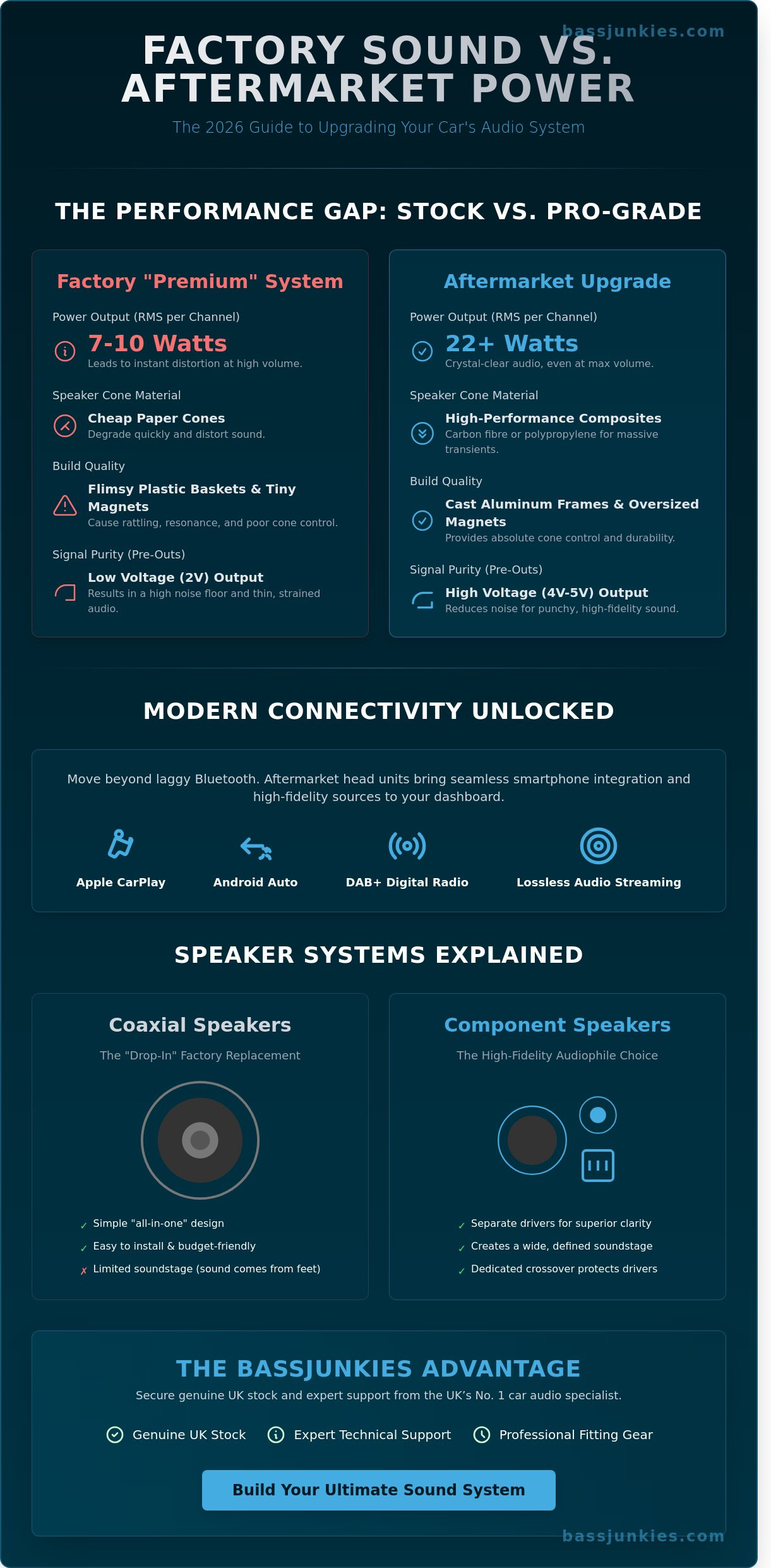
Head unit upgrades: Single-DIN vs double-DIN multimedia centres
Choosing between single-DIN and double-DIN head units depends on your dashboard aperture and multimedia requirements. A standard single-DIN unit measures 50mm by 180mm, whereas a double-DIN unit doubles the height to 100mm. Most modern vehicles utilise the 2-DIN format to accommodate large touchscreens and integrated safety features. If your car only has a small slot, floating screen technology now allows you to mount a massive display that sits proud of the dash. This innovation brings 2026-spec features to older vehicles without requiring custom fabrication. You can find the right fitment for your vehicle in our car stereos collection. Double-DIN units provide the surface area needed for complex navigation and high-definition video. Single-DIN units remain the go-to for enthusiasts focusing on pure audio performance in restricted spaces. Both formats now support advanced car audio and smartphone integration, including Apple CarPlay and Android Auto. Selecting the right size is the first step toward a total system overhaul.The versatility of double-DIN screens
Double-DIN units are the ultimate choice for a "factory-plus" look. High-end models feature 6.8-inch to 10-inch glass capacitive touchscreens that respond instantly to your touch. These units often include HDMI inputs for high-definition video playback and support for up to four camera inputs. Multi-camera support is a massive safety upgrade for 2026. These systems allow for 360-degree views and crystal-clear reversing images that eliminate blind spots entirely. It's the standard for anyone serious about their car audio and visual experience. The larger chassis also provides more room for internal components, often resulting in better heat dissipation during heavy use.Single-DIN units for classic and compact cars
Single-DIN units remain vital for classic cars and compact dashboards where space is at a premium. Modern "mechless" designs have ditched the CD player, allowing for a much shallower chassis. This makes installation easier in tight spots where wiring looms are crowded. Many hardcore audiophiles still choose high-spec 1-DIN units for their dedicated focus on sound quality. These units often feature 24-bit DACs, 13-band graphic equalisers, and superior MOSFET power delivery. They provide thumping performance and precise digital time alignment without the distraction of a large screen. This makes them perfect for drivers who prioritise high-fidelity audio over multimedia fluff.Professional car audio and specialist hardware: The Bassjunkies advantage
The ultimate car audio and multimedia upgrade for 2026 requires a balance between high-output hardware and seamless vehicle integration. Comparing top-tier brands like Pioneer and Alpine reveals that genuine UK stock is the only way to ensure full DAB+ compatibility and warranty protection. Buying from a specialist like Bass Junkies provides the technical support needed to match amplifiers to speakers correctly. This guide confirms that using authorised dealers and vehicle-specific fitting kits is the safest route to a high-performance system. Expert advice ensures your 2026 build delivers crystal-clear sound without the risks associated with grey market imports.
Grey market imports often arrive without UK-specific tuners or local warranty coverage. Saving a few pounds on a non-UK unit isn't worth the risk of a faulty device with no repair path. As the UK’s No. 1 specialist, Bass Junkies only stocks verified hardware designed for the British market. You get the peace of mind that every head unit or amplifier is 100% authentic and fully supported by the manufacturer. This protection is vital when investing in high-end 2026 technology.
Top brands and technical support
Pioneer, Alpine, and Kenwood lead the industry in 2026 because of their superior MOSFET power and refined smartphone integration. Matching a 4-channel amplifier to your door speakers requires precise impedance calculation to avoid thermal shutdown. Our experts provide the technical heavy lifting so you don't blow a voice coil on your first drive. You can build a massive system without the premium price tag by checking our latest offers for seasonal hardware bundles.
Completing your build with the right accessories
High-quality OFC (Oxygen-Free Copper) speaker cables and butyl-based sound deadening are non-negotiable for thumping bass and crystal-clear output. A Connects2 interface is essential for retaining your steering wheel controls and factory parking sensor tones. Without these specialist accessories, even the most expensive 2-DIN head unit will feel like an unfinished aftermarket add-on. Use this final checklist for a successful car audio and multimedia upgrade:
- Verify vehicle-specific fascia panel fitment for a factory-look finish.
- Select a high-gain DAB+ antenna for uninterrupted digital radio reception.
- Install sound deadening to door skins to eliminate unwanted vibrations.
- Use a dedicated vehicle-specific wiring harness for plug-and-play connectivity.
Don't settle for standard sound when professional performance is one click away. Browse our full range of car audio and visual tech to start your 2026 build today.
Build Your Ultimate 2026 Sound System Today
Ditching factory sound for high-performance aftermarket hardware is the only way to achieve the crystal-clear clarity and thumping bass your vehicle deserves. Whether you're installing component speakers for precise imaging or adding an active subwoofer for immediate low-end impact, the right hardware transforms every drive. It's about more than just volume; it's about the technical precision of MOSFET power and seamless smartphone integration.
Bass Junkies has been the UK’s No. 1 specialist since 1995, delivering expert technical knowledge and massive stock levels to enthusiasts nationwide. We offer huge savings on premium brands including Alpine, Pioneer, and Kenwood, ensuring you get professional gear without the professional price tag. You don't need to settle for stock limitations when our team is ready to help you navigate 2-DIN fitments and complex wiring requirements.
Shop the UK’s Largest Range of car audio and Multimedia
Your perfect setup is waiting, so let's get your car sounding exactly how it should.
Frequently Asked Questions
Is it worth upgrading my factory car audio system?
Yes, because factory systems are built to a budget, often using flimsy paper cones and tiny magnets that distort at high volumes. Upgrading your car audio and multimedia setup delivers crystal-clear highs and thumping bass that stock gear simply cannot produce. You'll gain massive power handling and modern features like high-voltage pre-outs, giving you the ultimate control over your soundstage.
Can I install an aftermarket stereo and keep my steering wheel controls?
You can retain full steering wheel functionality by using a vehicle-specific CAN-bus or analogue wiring interface. These adapters bridge the gap between your car's factory loom and the new head unit's input. It's a plug-and-play solution for most UK vehicles manufactured after 2005. This ensures you keep your eyes on the road while skipping tracks or adjusting volume levels.
What is the difference between a 2-channel and a 4-channel amplifier?
A 2-channel amplifier powers a single pair of speakers or a bridged subwoofer, while a 4-channel amp drives your entire cabin's front and rear speakers. If you want a complete car audio and multimedia overhaul, a 4-channel unit is the standard choice. It provides independent control over the soundstage, allowing you to fine-tune the gain and crossover settings for each pair of speakers.
Do I need to upgrade my car battery for a high-power audio system?
You only need a battery upgrade or a second cell if your total system draw exceeds the alternator's output, typically around 1,000 watts RMS. For massive builds, installing an AGM battery provides faster discharge rates to handle heavy bass peaks. If your lights flicker when the beat drops, it's time to look at the "Big Three" wiring upgrade or a high-output alternator.
What is DAB+ and do I need a special antenna for it?
DAB+ is the current digital radio standard in the UK, offering more stations and better sound quality than traditional FM. You'll need a DAB-compatible head unit and a dedicated digital antenna to receive the signal. Most kits include a discreet glass-mount internal aerial, but an external roof-mount shark fin usually provides the strongest reception in weak signal areas across the country.
Will an aftermarket head unit improve the sound of my factory speakers?
An aftermarket head unit provides a cleaner signal and more power than a standard factory radio. Most branded units feature high-quality MOSFET amplifiers and 13-band graphic equalisers to fix the flat response of stock speakers. Even without changing the drivers, you'll notice improved clarity and better control over your car audio and multimedia performance. It's the quickest way to boost audio fidelity.
What are the benefits of Apple CarPlay and Android Auto in a car?
These platforms mirror your smartphone's interface on the stereo screen for safer access to navigation, music, and messaging. You get real-time traffic updates via Google Maps or Waze and voice control through Siri or Google Assistant. It's the ultimate way to modernise an older vehicle, giving you a lag-free experience that beats almost any factory infotainment system on the market today.
How do I know if a double-DIN stereo will fit in my car?
A double-DIN stereo fits if your dashboard has a 180mm by 100mm aperture, which is roughly the height of two standard CD players. You'll likely need a vehicle-specific fascia kit to fill the gaps and provide a factory-look finish. Check your car's year and model against a compatibility database to ensure the internal depth also accommodates the new unit's chassis and wiring looms.