

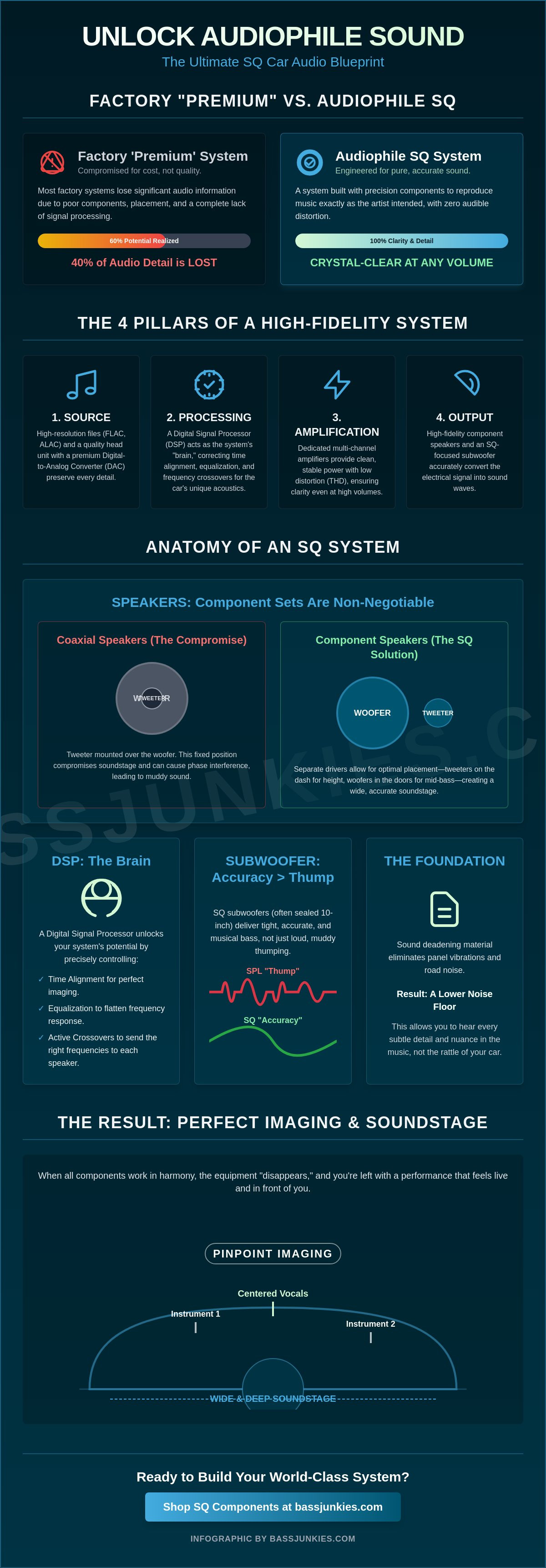
Most factory "premium" audio systems lose 40% of their potential detail because of poor speaker placement and a total lack of signal processing. To achieve the best car audio setup for sound quality, you must integrate a Digital Signal Processor (DSP) with a high-performance 3-way component front stage. You need a dedicated multi-channel amplifier to run your drivers actively, which provides total control over every frequency range. This configuration, when paired with a sealed 10-inch subwoofer, eliminates muddy bass and ensures your audio remains crystal-clear at massive volumes.
You've likely felt the frustration of harsh high frequencies or a soundstage that feels trapped beneath your feet. It's a common headache for junkies who want more than just "loud" noise. This guide promises to reveal the exact hardware configurations and tuning secrets required to achieve a true audiophile-grade experience in any vehicle. We'll walk through the hardware selection, sound deadening essentials, and DSP calibration steps needed to build a world-class SQ system.
Key Takeaways
- Build the best car audio setup for sound quality by prioritising component speakers over coaxials to achieve pinpoint high-frequency positioning.
- Unlock the "brain" of your system with a Digital Signal Processor (DSP) to correct acoustic timing and eliminate factory audio limitations.
- Eliminate cabin rattles and road noise with professional sound deadening to lower the noise floor and hear every subtle detail.
- Move beyond "thumping" by selecting an SQ-focused subwoofer designed to provide accurate, lifelike bass response across the bottom octaves.
- Learn why dedicated amplification and high-quality wiring are non-negotiable for delivering the clean power required for audiophile-grade performance.
What defines the best car audio setup for sound quality?
The best car audio setup for sound quality (SQ) is a system engineered for the accurate, lifelike reproduction of music rather than raw volume. While SPL builds focus on Sound Pressure Level and maximum loudness, an SQ build targets a flat frequency response and zero audible distortion. This standard requires a high-resolution source, digital signal processing, clean amplification, and high-fidelity speakers. Most factory systems fail because they utilize low-cost paper-cone drivers and integrated circuits that lack the power to handle musical peaks. A true SQ build creates a transparent listening experience where the equipment disappears and only the music remains.
Achieving this level of performance relies on four critical pillars. The source provides the data, the processing shapes the signal, the amplification provides the muscle, and the output drivers move the air. Understanding the history and components of Vehicle audio systems helps clarify why each stage is vital for high-fidelity results. If any single pillar is weak, the entire system's resolution suffers. We focus on eliminating these bottlenecks to ensure every note is delivered with surgical precision.
- Source: High-bitrate files like FLAC or ALAC that preserve every detail.
- Processing: Using a DSP to correct time alignment and cabin-specific EQ.
- Amplification: External amps with high headroom and low Total Harmonic Distortion (THD).
- Output: Component speakers with high-quality crossovers and premium cone materials.
The role of the head unit and high-res audio
Your audio source material dictates the absolute ceiling of your system's potential. Low-bitrate MP3s are compressed files that discard the subtle details and harmonics found in high-resolution FLAC or Tidal MQA streams. High-quality car stereos feature premium Digital-to-Analogue Converters (DACs) that process audio at 24-bit or 32-bit depths for massive clarity. Signal-to-Noise Ratio is the ratio of the desired audio signal to the level of background electronic noise; a higher ratio ensures your music is crystal-clear without an audible hiss. This technical foundation is what separates a basic upgrade from a world-class SQ build.
Imaging and soundstage explained
Imaging is the technical ability of a system to "place" specific instruments and vocals in a physical space across your dashboard. When a system is tuned correctly, you can point to exactly where the lead guitarist is standing or where the snare drum is positioned. Soundstage refers to the perceived width, depth, and height of the music within the car's cabin. The goal of every high-end SQ build is a perfect "centre stage" where the artist sounds like they're performing directly in front of you. Proper speaker placement and time alignment are essential to overcome the acoustic challenges of a vehicle's interior.
Component speakers: The heart of high-fidelity audio
The best car audio setup for sound quality requires a dedicated component speaker system to achieve true high-fidelity performance. Unlike standard coaxial speakers that stack the tweeter directly over the woofer, component kits separate these drivers to eliminate phase interference and allow for custom positioning. This separation is vital for creating a realistic soundstage where vocals appear to come from the dashboard rather than your feet. High-end builds rely on external passive or active crossovers to manage frequencies; these units ensure the tweeter never sees low-end bass that could cause damage or distortion. By isolating these signals, you get a cleaner, more accurate reproduction of your music.
Technical precision in a 2026 SQ build starts with the physical composition of the drivers. Premium components often utilize materials like silk for smooth high frequencies, or Kevlar and treated paper for mid-bass cones to maintain a natural timbre. According to the Audio Engineering Society, managing these transducer variables is critical for minimizing resonance and achieving a flat frequency response. When you choose high-quality materials, you aren't just buying a brand; you're investing in the science of sound reproduction that factory paper cones simply cannot match.
Tweeter placement for maximum clarity
Tweeter positioning dictates the height of your audio. Mounting tweeters on-axis, where they point directly at the listener, provides the brightest and most detailed high-end response. Off-axis mounting, such as firing them across the dashboard, can soften harsh frequencies for a smoother listen. For the best results, install your tweeters in the A-pillars or the upper corners of the dash to lift the soundstage to ear level. You can explore the latest high-performance options in our car speakers collection to find the right fit for your cabin layout.
Mid-bass drivers and door treatments
The 6.5-inch mid-bass driver is responsible for the meat of the sound, providing vocal warmth and that essential rhythmic punch. Even the most expensive drivers will sound thin and hollow if they're vibrating against a loose plastic door card. You must create a sealed, baffled environment within the door cavity to prevent back-wave cancellation. Rigid mounting is essential; use solid adapters to ensure all the speaker's energy is converted into sound rather than lost to panel vibration. If you want to hear the difference between a basic upgrade and a professional SQ build, focus on the integrity of your door seals. For those ready to take the next step, check out our latest offers on sound deadening and driver kits.
Digital Signal Processing (DSP) and clean amplification
The best car audio setup for sound quality relies on a Digital Signal Processing (DSP) unit and a dedicated multi-channel amplifier to eliminate cabin-induced distortion. A DSP functions as the system's brain, using time alignment to ensure sound from every speaker reaches the listener simultaneously. High-performance SQ builds use 31-band EQs to flatten frequency response and 4-channel or 5-channel amplifiers to provide clean headroom. This hardware configuration is the only way to achieve a true audiophile experience in a vehicle.
Your car interior is an acoustic nightmare. Hard glass surfaces reflect high frequencies while upholstery absorbs mid-range tones, creating a chaotic environment for sound waves. A DSP corrects these flaws by allowing granular control over every individual driver. Time alignment is the most critical feature; it delays the signal to the speakers closest to you by fractions of a millisecond. This ensures the sound from the left tweeter and the right woofer hits your ears at the exact same moment, creating a centered, rock-solid soundstage on your dashboard.
Standard head units usually offer basic bass and treble sliders that are too broad for precision tuning. An SQ-grade DSP provides a 31-band EQ for every channel. This allows you to target narrow frequency peaks caused by cabin resonance or fill in dips where the car's geometry cancels out sound. By smoothing the frequency response, you achieve a natural, balanced tone that mimics a high-end home studio environment.
Why you need a dedicated amplifier for SQ
Factory head units rarely produce more than 15 watts of clean RMS power. When you push these internal chips to higher volumes, they suffer from clipping. This occurs when the amplifier reaches its voltage limit and "squares off" the audio wave, creating harsh distortion that destroys speaker voice coils. You need a dedicated 4-channel or 5-channel amplifier to provide the headroom required for dynamic peaks in music.
Always focus on the RMS power rating and ignore the "Peak" or "Max" numbers on the box. Peak ratings are purely for marketing and do not represent the amplifier's ability to play music clearly over long periods. For the ultimate SQ build, you should browse car amplifiers to choose between Class AB units, known for their warmth and fidelity, or modern Class D options that offer massive power in a compact chassis.
Tuning your system with DSP
Modern factory stereos often use pre-set equalization and signal splitting that ruins aftermarket sound. A DSP with "summing" capabilities takes these fragmented factory signals and reconstructs them into a clean, full-range audio stream. To tune this effectively, professional installers use a calibrated microphone and Real-Time Analyser (RTA) software. This hardware "sees" what the car is doing to the sound, allowing you to make precise EQ adjustments based on data rather than guesswork.
In a high-level SQ build, an "active" setup is the gold standard. This means the DSP acts as the crossover, sending specific frequency ranges directly to each tweeter, midrange, and woofer. This removes the need for passive crossover boxes, which waste power and introduce phase shifts. By going active, you gain total control over the slope and frequency of every speaker in your system, resulting in a crystal-clear performance that factory systems cannot match.
Subwoofers for SQ: Accuracy over thumping
The best car audio setup for sound quality requires a dedicated subwoofer to reproduce the frequencies between 20Hz and 80Hz. This bottom octave provides the essential weight and realism that standard mid-bass drivers cannot achieve. In an SQ build, the subwoofer is not designed to rattle body panels; it exists to round out the frequency response and create a seamless, full-range listening experience. Accuracy is the primary goal, meaning the driver must start and stop exactly with the signal to maintain musical integrity.
Sealed enclosures are the superior choice for high-fidelity systems. While ported boxes increase output at specific frequencies, they often suffer from group delay and "boomy" characteristics. A sealed box provides a flat frequency response and exceptional cone control. This results in a superior transient response, allowing the subwoofer to handle rapid bass lines and complex percussion with precision. If you want your bass to feel tight and controlled rather than muddy and lingering, a sealed setup is the only option.
Choosing the right SQ subwoofer
Selecting a 10-inch or 12-inch subwoofer typically offers the best balance of low-end extension and cone speed. Larger drivers can move more air but often struggle with the rapid transients required for high-end sound quality. It is vital to match the driver's mechanical parameters to the correct enclosure volume to ensure optimal damping. For enthusiasts with limited boot space, a high-quality under-seat active subwoofer can provide the necessary low-end reinforcement without requiring a massive custom box.
Seamless sub-to-mid integration
Perfect integration ensures the bass sounds like it is coming from the front speakers rather than the boot. Setting a low-pass crossover point at 80Hz is a standard starting point for most SQ builds. You must also utilise phase adjustment on your amplifier or DSP to align the subwoofer's output with the mid-range drivers. This time-alignment prevents frequency cancellation and ensures the soundstage remains focused on the dashboard. When tuned correctly, the subwoofer disappears into the music, providing a solid foundation without drawing attention to its physical location.
The foundation: Sound deadening and high-quality wiring
The best car audio setup for sound quality requires a solid physical and electrical foundation to overcome the car's hostile acoustic environment. Road noise, wind, and engine vibrations create a high noise floor that masks subtle musical details and ruins the soundstage. Installing high-grade sound deadening materials can lower this noise floor by 3 to 10 decibels, revealing micro-details in your favourite tracks. Oxygen-Free Copper (OFC) cabling is essential for maintaining signal purity and preventing voltage drops that starve your components. A rock-solid grounding point is your primary defence against alternator whine and unwanted system hiss.
Applying Dynamat for acoustic control
Acoustic treatment must focus on the "big three" areas: the doors, boot, and floorpan. These large metal surfaces act like drum skins, vibrating in sympathy with your speakers and road impact. Mass-loading vibration dampeners like Dynamat stop these panels from "singing" along with the music. This ensures your mid-bass drivers produce punchy, tight notes rather than muddy vibrations. Treating the inner and outer door skins is the most effective way to clarify the 80Hz to 250Hz frequency range.
Sealing the door cavity creates a dedicated enclosure for your speakers, which increases efficiency and sharpens the soundstage. You don't need to cover 100% of every surface to see results. Focus on the centre of large, flat panels where vibrations are most intense. This targeted approach provides the best return on investment for your SQ build.
Wiring and interconnects for SQ
High-fidelity audio is only as good as the cables carrying the signal from the source to the speakers. Shielded RCA cables are vital for a noise-free path between your head unit and processors. These cables use twisted-pair construction or foil shielding to block electromagnetic interference from the vehicle's complex electronics. Using the correct gauge power wire for your amplifiers prevents current starvation during heavy bass peaks.
Maintaining factory functionality is also a priority for modern SQ builds. We recommend using Connects2 interfaces to retain steering wheel controls and vehicle settings when upgrading your head unit. This keeps your focus on the road while you enjoy crystal-clear audio.
- Use 100% OFC copper wire instead of Copper Clad Aluminium (CCA) to prevent signal degradation and oxidation.
- Ensure the ground wire is the same gauge as the power wire and bolted to a cleaned, bare metal surface.
- Separate RCA cables from power cables by at least 30 centimetres to avoid induction noise.
- Use high-quality distribution blocks to keep your power delivery organised and fused correctly.
By investing in these foundational elements, you ensure that your high-end speakers and processors can perform at their absolute peak. Without proper deadening and wiring, even the most expensive equipment will sound thin and uninspired.
Lock In Your High-Fidelity Audio Build
Achieving the best car audio setup for sound quality requires a precise balance of digital signal processing and premium hardware. You can't ignore the foundation. Sound deadening and high-quality wiring are essential to prevent resonance and signal loss. Integrating a dedicated DSP allows for surgical tuning of your soundstage. Meanwhile, component speakers from brands like Focal or Alpine deliver the clarity your ears deserve. It's about accuracy over volume, ensuring every note hits with studio-level detail.
We've been the UK's No. 1 specialist since 1995, so we know exactly what it takes to transform a factory system into a high-end masterpiece. Our team consists of true audio junkies who provide expert technical advice on everything from impedance matching to complex DSP configurations. We maintain massive stock levels of JL Audio, Alpine, and Focal gear. This ensures you get the right components without the wait. Stop settling for muddy audio and start building a system that moves you.
Build your dream SQ system with our latest offers on high-end car audio
Your journey to perfect sound starts with the right gear and expert support. Let's get your build moving today.
Frequently Asked Questions
How can I improve my car sound quality without replacing the head unit?
Adding a Digital Signal Processor (DSP) and a multi-channel amplifier is the most effective way to upgrade sound without touching the factory dashboard. These components take the "dirty" signal from your stock radio and clean it up by removing factory EQ bottlenecks. You'll get a massive boost in clarity and power by integrating a high-quality line output converter to feed your new amps.
Is a 2-way or 3-way component speaker system better for sound quality?
A 3-way component system is superior for the best car audio setup for sound quality because it includes a dedicated midrange driver. This setup handles the critical 300Hz to 3kHz vocal range much better than a standard 2-way kit. By spreading the frequencies across three drivers, you reduce distortion and lift the soundstage right onto your dashboard where it belongs.
Does sound deadening really make a difference to audio quality?
Applying sound deadening is essential as it can reduce ambient road noise by 3dB to 6dB while stopping door panels from rattling. Using butyl-based sheets on the inner and outer door skins transforms your car door into a sealed speaker enclosure. This simple step increases mid-bass impact by up to 20% and ensures you hear the music, not the vibrations of your vehicle's metalwork.
What is the best crossover frequency for SQ car audio?
Setting your subwoofer low-pass filter and door speaker high-pass filter to 80Hz is the industry standard for a balanced SQ build. Use a 24dB per octave slope to ensure a sharp, clean transition between your drivers. This prevents your smaller speakers from straining with deep bass while keeping your subwoofer's output focused on the low-end frequencies it was designed for.
Do I need a DSP if I have a high-end aftermarket head unit?
You still need a dedicated DSP because it offers 31 bands of EQ per channel compared to the 13 bands found on most high-end head units. Standalone processors allow for granular time alignment and phase correction for every single speaker in the car. This level of precision is the only way to achieve a perfect centre image in the challenging acoustic environment of a vehicle cabin.
Can I get high-end sound quality with a factory-fit speaker location?
You can achieve incredible results in factory locations by using solid MDF baffles and closed-cell foam rings to seal the speaker against the door card. These rings prevent sound waves from "leaking" into the door cavity, which can cause phase cancellation. While custom pillars are better for imaging, a well-sealed factory location provides a stealthy look with 90% of the performance.
What is the difference between SQ and SPL setups?
SQ focuses on the best car audio setup for sound quality by prioritising accuracy, tonal balance, and a realistic soundstage. SPL setups are designed for maximum volume and physical impact, often using massive enclosures to hit pressure levels over 150dB. While SQ builds use high-end materials like silk tweeters, SPL builds rely on heavy-duty subwoofers and thousands of watts of raw power.
Why does my car audio sound better when the engine is off?
Your audio sounds better when stationary because the engine and road noise aren't competing with your speakers, which lowers the noise floor by roughly 10dB. When the engine runs, alternator whine and mechanical vibrations can introduce electrical interference into your signal path. Investing in high-quality shielded RCA cables and ensuring a solid ground point can help maintain that "engine-off" clarity while you're on the move.