
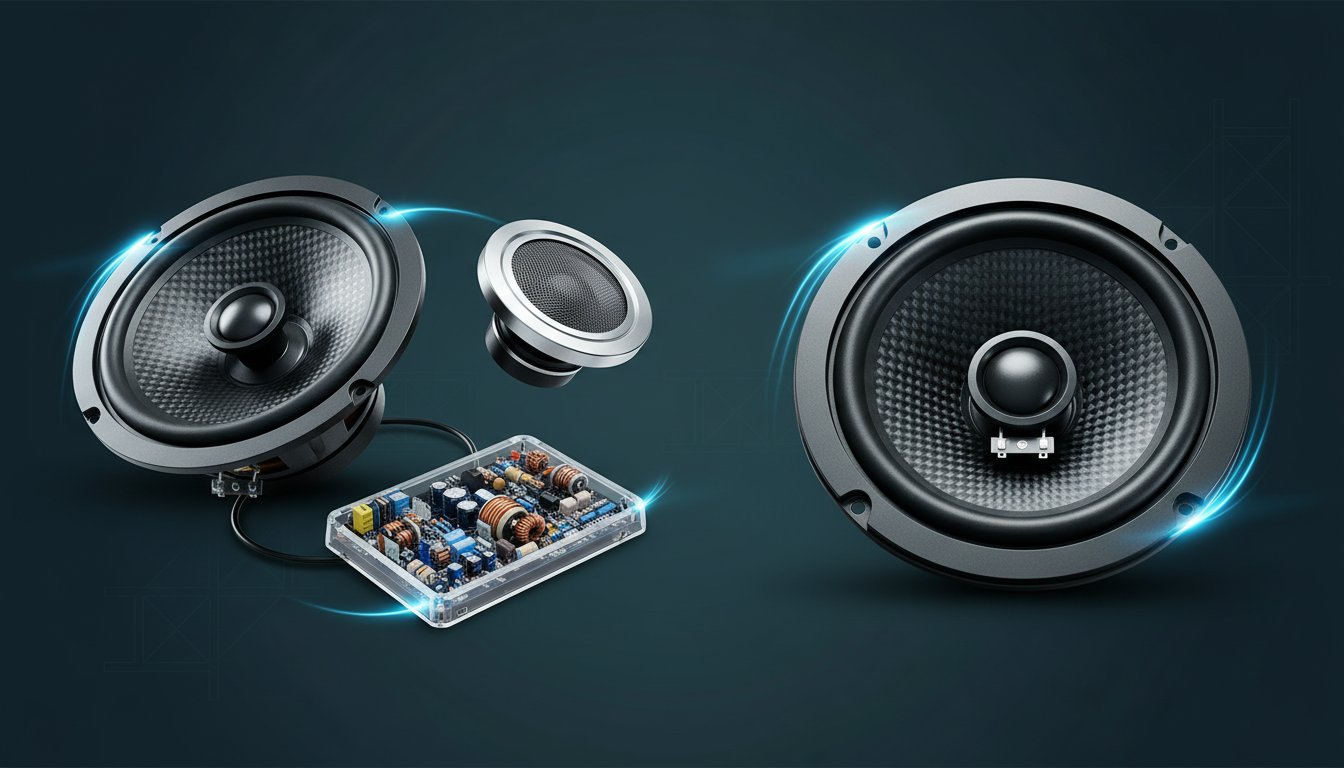
Component speakers use separate woofers, tweeters, and external crossover networks to deliver a precise soundstage, while coaxial speakers combine these drivers into a single unified chassis for a simplified installation. This component vs coaxial speakers explained comparison shows that coaxial units, like the $104.99 JL Audio C1-650x, are designed as space-saving replacements for factory locations. Conversely, component systems such as the $149.99 Pioneer TS-A653CH provide superior imaging by allowing the tweeter to be mounted at ear level to lift the soundstage.
You likely want to eliminate the muddy sound of standard factory speakers without wasting money on hardware that won't fit or perform. We promise to clarify the technical differences between these setups so you can determine which upgrade path delivers the best audio for your vehicle and budget. You'll gain a clear understanding of the hardware required to achieve crystal-clear audio and a thumping mid-bass response.
This guide explores the role of external crossovers, the benefits of sound deadening, and why high-performance components often require a dedicated 4-channel amplifier to reach their full potential. Bassjunkies provides the expert advice you need to move from a basic factory setup to a high-octane sound system that dominates the road.
Key Takeaways
- Coaxial speakers combine the woofer and tweeter into a single unit to facilitate a simplified 30-minute factory speaker replacement.
- This component vs coaxial speakers explained analysis confirms that separate drivers allow for precise imaging by lifting the soundstage to ear level.
- High-performance component systems require a dedicated 4-channel amplifier to handle power ratings that often exceed 60W RMS.
- External crossover networks use high-quality capacitors to surgically split frequencies and protect tweeters from low-end distortion.
- Sound deadening kits are an essential technical foundation to eliminate door vibrations and preserve mid-bass clarity in high-output systems.
What is the Difference Between Component and Coaxial Speakers?
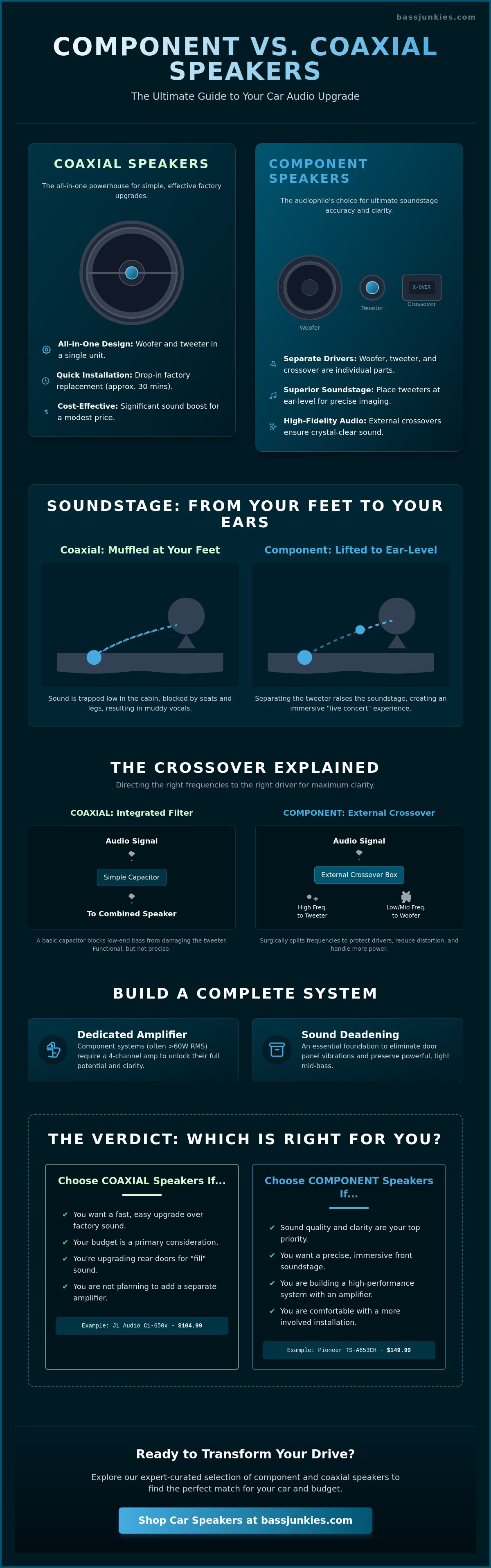
The primary difference between component and coaxial speakers lies in the physical separation of the drivers and how they manage frequencies. Coaxial speakers, often called "full-range" units, house the woofer and the tweeter on a single, unified chassis. Component speakers, or "separates," use independent drivers for low and high frequencies, managed by an external crossover network. This component vs coaxial speakers explained comparison highlights that while coaxials focus on space-saving convenience, components prioritize ultimate soundstage accuracy and vocal clarity.
Understanding how speakers work is essential for making the right choice for your build. Every speaker uses a driver to move air, but how that driver is configured determines the final output. Coaxial units are designed for quick, 30-minute upgrades. Component sets are engineered for enthusiasts who want to transform their dashboard into a live concert stage. You can browse our full range of car speakers to see these different configurations in action.
Coaxial Speakers: The All-in-One Powerhouse
Coaxial speakers are the standard for most vehicle manufacturers because they fit into tight factory locations without drama. They feature a woofer for mid-bass and a tweeter mounted directly above it on a central pole. These units use simple, built-in crossovers, usually just a single capacitor, to block low frequencies from damaging the delicate tweeter. This design keeps the footprint small and the installation process incredibly simple.
They are the perfect solution for rear door fill or budget-conscious front-stage upgrades. If you're looking for a massive "bang-for-buck" improvement over paper factory cones, coaxials deliver punchy performance without requiring custom wiring or mounting pods. They are a direct replacement for standard fitments in roughly 95% of modern vehicles, making them the go-to for a fast, effective audio boost.
Component Speakers: The Audiophile's Choice
Component speakers represent the professional standard for soundstage accuracy by physically separating the woofer from the tweeter. This setup includes two woofers, two tweeters, and two dedicated external crossover boxes. These crossovers use high-grade inductors and capacitors to ensure each driver only receives the frequencies it was designed to handle, reducing distortion and increasing power handling.
This separation allows for precise "imaging," which is the ability to position the sound at ear level rather than having it muffled at your feet. By mounting the tweeter on the A-pillar or dashboard, you lift the vocals and high-end detail into the cabin. It creates a thumping, crystal-clear experience that mimics a high-end home studio. Component speakers are the professional standard for achieving total soundstage accuracy in any vehicle cabin.
How do crossovers and imaging affect car audio sound quality?
Crossovers function as frequency filters that ensure each driver receives only the signals it can reproduce without distortion. This component vs coaxial speakers explained technical breakdown shows that while coaxials use a basic capacitor, components use external networks to prevent the woofer from "bleeding" into high-frequency territory. This surgical separation is the key to maintaining crystal-clear vocals even when the volume is pushed to the limit.
Imaging is the psychological effect of sound appearing to come from a central point on your dashboard rather than from the floor. By separating the drivers, you can physically move the high-frequency source to a location that isn't blocked by car seats or passenger legs. This creates a thumping, immersive experience that mimics a live concert environment right inside your cabin.
Why External Crossovers Beat Integrated Filters
External crossovers are built with heavy-duty inductors and capacitors that handle heat better than the tiny components found on coaxial poles. When you push your system with a high-performance amplifier, these circuits keep the signal stable and prevent the tweeter from frying. Many premium kits also feature adjustable -3dB or -6dB switches to fine-tune the brightness based on your specific cabin acoustics.
These dedicated boxes also provide a steeper "slope" for frequency roll-off. This means the transition between the woofer and tweeter is much smoother, eliminating the harsh peaks found in lower-quality systems. Bassjunkies experts always recommend secure mounting for these crossovers to prevent internal vibrations from damaging the soldering over time.
Positioning Your Tweeters for the Ultimate Soundstage
High frequencies are extremely directional, meaning they must be pointed at the listener to be heard with maximum detail. Mounting tweeters on the A-pillars or dash "lifts" the music from your floorboards to ear level, providing an immediate sensory impact. This on-axis placement ensures you hear every crisp detail of the cymbals and the natural air in the vocals.
This setup transforms a standard cabin into a professional-grade listening environment. It's the only way to get a massive, distortion-free performance that stays clear even when the bass is thumping. For the best results, ensure your tweeters are angled toward the center of the car to create a balanced "phantom" center image on your dashboard.
Comparing Component vs Coaxial: Pros, Cons, and Price
Choosing between these two paths depends on whether you want a 30-minute "drop-in" fix or a full-scale acoustic overhaul. Coaxial speakers are the undisputed budget kings for quick swaps. Options like the $84.96 Kicker CS Series or the $104.99 JL Audio C1-650x deliver a massive performance boost for a relatively low investment. This component vs coaxial speakers explained comparison proves that while coaxials save you money on professional installation, which typically ranges from $75 to $200 per pair, they can't match the surgical precision of a dedicated component set.
Component systems like the $149.99 Pioneer TS-A653CH represent the professional standard for high-fidelity builds. They offer unmatched clarity because they use superior materials like silk, Kevlar, or carbon fiber for their drivers. However, they are more complex to install. You'll need to find mounting space for the external crossover boxes and potentially modify your A-pillars or dashboard to house the separate tweeters. If you want a thumping, crystal-clear front stage that feels like a live concert, the extra effort is mandatory.
When to Choose Coaxial Speakers
Coaxial speakers are the perfect choice for leased vehicles or daily drivers where you want a "plug and play" solution. Since the tweeter is mounted directly to the woofer, you don't have to run extra wires through door grommets or cut into your interior trim. They are also the smartest choice for rear door fill. Because the rear soundstage is less critical for imaging, spending big on components for the back seats is often unnecessary. You can explore our range of car speakers to find high-performance coaxial options that fit your specific vehicle dimensions.
Why Components are Worth the Extra Investment
For any serious "Sound Quality" enthusiast, components are the only acceptable foundation for a build. They are engineered to handle the high-wattage output of aftermarket 4-channel amplifiers without breaking a sweat. While a $79.99 set of Rockford Fosgate Prime R165-S components is an entry-level start, moving up to premium sets ensures you get advanced motor structures and better heat dissipation. These materials don't just sound better; they last longer under aggressive listening conditions. If you're planning to add a powered subwoofer later, components provide the mid-bass punch and high-end sparkle needed to keep up with massive low-end pressure.
Installation Requirements: Amps, Wiring, and Sound Deadening
Installing component speakers requires a higher level of technical commitment than a simple coaxial swap. You must mount the woofer and tweeter separately, which often involves running new speaker cables through the door bellows. This component vs coaxial speakers explained guide clarifies that while coaxials are a "drop-in" fix, components are a custom integration. Achieving the ultimate soundstage depends on your ability to manage these hardware requirements correctly.
Professional installation costs for speakers usually range from $75 to $200 per pair. If you're doing a DIY component install, you'll need to find a dry, secure location for the external crossover boxes. Loose crossovers will rattle against the door skin and eventually fail. Securing these units with industrial-strength adhesive or mechanical fasteners is a non-negotiable step for a clean, professional build.
Do You Need an External Amplifier?
Most factory head units output a weak 15W to 22W RMS per channel. High-performance component sets are built with heavier magnets and stiffer surrounds that need 60W RMS or more to sing. This component vs coaxial speakers explained technical requirement is why an external amp is so critical. Underpowering these speakers causes the internal amp to clip, which sends a distorted signal that can easily fry your tweeters.
Adding a dedicated automotive amp provides the essential "headroom" needed for dynamic sound. This extra power allows your speakers to handle thumping transients without straining or losing clarity. Matching the RMS output of your amp to the speaker's rating ensures a crystal-clear performance at any volume level. You'll get more punch, better detail, and a massive increase in overall sensory impact.
The Importance of Sound Deadening
High-excursion woofers turn your car doors into vibrating tin cans. This resonance creates "phase cancellation," which physically eats your mid-bass frequencies before they reach your ears. Sound deadening stops this energy loss by adding mass to the metal panels. It transforms a flimsy door into a solid, sealed acoustic enclosure that acts like a professional speaker cabinet.
Applying Dynamat Xtreme Sound Deadening Kits is the most effective way to lower your vehicle's noise floor. By reducing road noise and panel rattles, you allow the fine details of your separate tweeters to shine through. It's the difference between hearing the music and feeling the performance. Every serious Bass Junkie knows that a thumping system starts with a deadened door.
Give your new speakers the power they need to perform. Explore our massive stock of 4-channel amplifiers to unlock the true potential of your component system.
The Final Verdict: Which Speaker Type Wins for 2026?
Coaxial speakers win for 90% of vehicle owners who want a massive sound upgrade without a complex workshop bill. They offer a "drop-in" solution that replaces muddy factory cones in under 30 minutes. However, for any true audiophile or Bass Junkie, component speakers are the only path to a professional soundstage. This component vs coaxial speakers explained verdict confirms that while coaxials are efficient, components deliver the ultimate high-fidelity experience by separating frequencies and lifting the audio to ear level.
Choosing the right hardware depends on your specific goals and your willingness to modify your vehicle's interior. If you are looking for a fast, high-impact improvement, high-performance coaxials are the smartest move. If you are comfortable installing a 4-channel amplifier and running new cables to achieve surgical precision, components are the superior choice. Most high-octane builds utilize a mix and match strategy: components in the front for a realistic soundstage and coaxials in the rear for passengers.
The Best Entry-Level Upgrade Path
If your goal is to fix poor factory sound on a budget, start with a high-quality coaxial set. These units provide a full-range response from a single mounting point, making them ideal for standard door fitments. Pairing these with a modern DAB car stereo transforms your daily commute with crystal-clear digital reception and MOSFET power. This setup delivers immediate results without the need for custom tweeter pods or extensive rewiring.
This path is perfect for leased vehicles where you want to avoid permanent modifications. You get a massive "bang-for-buck" boost in clarity and volume while keeping the installation completely reversible. To find the best deals on these "all-in-one" solutions, you can check out our latest offers for speaker bundles. These kits are designed to get you up and running with professional-grade sound for the lowest possible investment.
Building the Ultimate High-Fidelity System
Serious builds require the separation and precision of a component system. By combining high-end components from brands like Focal or Alpine with a dedicated car subwoofer, you create a full-spectrum audio environment. The components handle the surgical detail of the vocals and instruments, while the sub provides the thumping low-end pressure. This three-way split ensures that no single driver is overstressed, resulting in a balanced, high-octane performance.
This setup allows you to hear the fine details of a recording that factory systems simply erase. By lifting the tweeters to the dashboard, you create a "phantom" center stage that feels like the artist is performing on your bonnet. This is the professional standard for any competition-grade build or high-fidelity enthusiast. Bass Junkies is proud to be the UK’s No. 1 destination for expert advice and high-performance car audio hardware.
Upgrade Your Vehicle with Professional Sound Today
Deciding between a drop-in coaxial swap and a custom component overhaul is the most critical step in your audio journey. This component vs coaxial speakers explained guide clarifies that while coaxials deliver massive value for quick upgrades, separate components are the only way to achieve a crystal-clear front stage. You now understand that high-fidelity sound requires the right hardware, from external crossovers to dedicated 4-channel amplifiers and sound deadening.
Bass Junkies has been the UK's No. 1 car audio specialist since 1995, providing the ultimate solutions for every budget. We offer expert technical advice from professional installers to ensure your system delivers maximum sensory impact. You'll find huge savings on top-tier brands including Pioneer, Alpine, and Focal in our massive stock.
Shop our massive range of car speakers and separates to start your high-performance build. It's time to ditch the muddy factory sound and experience thumping audio on every drive. Your journey toward the ultimate car audio experience starts right here.
Frequently Asked Questions
Are component speakers worth the extra money for a standard car?
Yes, component speakers are worth the investment because they fix the "muffled" sound typical of factory door placements. By separating the tweeter and mounting it higher, you create a realistic soundstage that brings vocals to ear level. This component vs coaxial speakers explained technical advantage transforms a standard cabin into a high-fidelity listening space. It's the most effective way to achieve crystal-clear detail without the sound being blocked by your legs or the car's upholstery.
Can I install component speakers without an external amplifier?
You can run components off a factory head unit, but you'll likely experience distortion at higher volumes. Standard car stereos usually output only 15W to 22W RMS, which is insufficient for the heavy motor structures of a separate speaker set. To reach their full sensory impact, components require a dedicated 4-channel amplifier. This provides the clean power needed to move the woofer cone and deliver thumping, accurate mid-bass.
Is it possible to mix coaxial and component speakers in the same system?
Mixing both speaker types is a pro-level strategy used in 85% of high-performance builds. We recommend installing components in the front doors for precise imaging and using high-quality coaxials in the rear for fill. This setup focuses your budget where it matters most: the driver's seat. You get the ultimate front stage without the complexity of installing separate tweeters in the back of the vehicle.
Do I need to cut my car doors to install separate tweeters?
Most modern vehicles already have factory tweeter locations in the A-pillars or dashboard, making a "no-cut" install possible. If your car lacks these, many component kits include surface-mount pods that screw directly to the trim. You only need to cut if you want a "flush-mount" look for a completely custom finish. Always check the mounting depth of your chosen tweeters before starting your installation.
What is a 2-way vs 3-way coaxial speaker?
A 2-way coaxial combines a woofer and a tweeter, while a 3-way adds a third driver, usually a "super tweeter" or a small midrange. While 3-way units look impressive, they don't always provide better sound quality than a high-end 2-way. The goal is frequency separation. A well-engineered 2-way speaker often delivers a smoother response than a cheap 3-way with poor crossover components.
Why do my new component speakers sound quiet compared to the factory ones?
Aftermarket speakers often have lower sensitivity than factory paper cones, meaning they require more power to reach the same volume. Factory speakers are designed to be extremely "efficient" on very low power, but they distort easily. Your new components are built for accuracy and high power handling. To fix the volume issue, you must match the speaker's RMS rating with a high-performance car amplifier.